Adventure · New game
Out of Frame
A small primer creature slips inside famous paintings and repairs what is wrong in each one, turning still canvases into playable 3D worlds rendered in brushstrokes, etching lines and woodblock colour.
#14 this weekAI-assisted: Code, Graphics, Sound, Text
The game runs in this tab. No install, no account.
The short answer
Out of Frame lets a small primer creature dive into paintings: run at a canvas, jump, and three famous works open into 3D puzzle worlds. Fix what is broken inside a Van Gogh village, a Piranesi prison and a Hiroshige print, guided only by yellow glow, then return to the gallery benches for spoken context. It is free and runs in a browser tab.
What is Out of Frame?
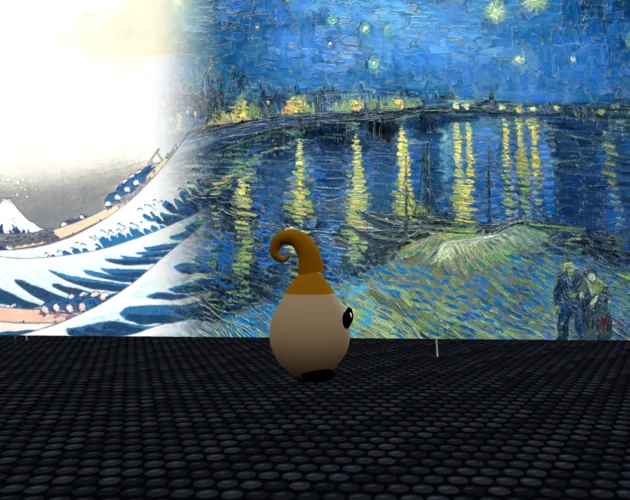
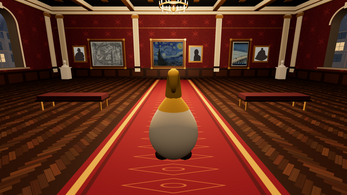
Out of Frame is a browser-based 3D adventure from developer nyxalium. Its hero is a small creature made of primer who lives in a gallery. Run at a painting and jump, and the creature unravels into the canvas; the frame opens into a 3D world built in that artist's own style. Something inside is wrong. Put it right and the painting on the wall comes alive.
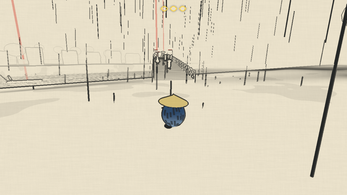
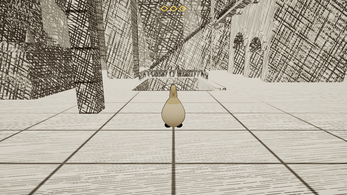
Three works can be entered. In The Starry Night, stars have fallen out of the sky into the village, and each must be carried to a swirling current that throws it home; the world itself is made of brushstrokes. The Gothic Arch, from Piranesi's Imaginary Prisons, is drawn as an etching and has three lanterns out, each behind an impossible trick: a stair that loops forever, a wall you walk up, and a drawbridge you haul down. Hiroshige's Sudden Shower over Shin-Ōhashi Bridge and Atake is a woodblock print mid-production, and three people need back what the shower blew away.
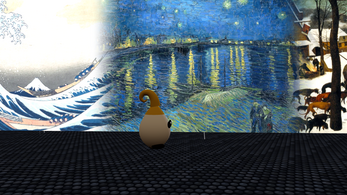
Around those frames sits a walkable gallery, with a street lined by Hokusai, Bruegel, Monet, Seurat, Friedrich and Vermeer. Benches let you study each work closely and hear about it from someone in the artist's life.
How to play
The whole game is one loop repeated three times, with a gallery between the repetitions. Walk up to a painting, run and jump into it, and the world changes register entirely: a flat surface becomes a puzzle-platformer with one obvious fault to fix. Repairs are physical. Stars get carried. Lanterns get reached across looping stairs, walkable walls and a drawbridge hauled down by hand. Whatever the rain blew away gets given back to three people.
Nothing is written down inside the worlds. Anything glowing yellow can be used, so the paintings carry their own instructions. Holding the jump key while standing on the ground winds up a super jump for gaps that a normal jump cannot clear. Esc takes you out of a painting, and the spot you left is the spot you come back to.
The gallery is where the story lives. Sit on a bench and a voice from the artist's circle talks about the work in front of you. There are no menus, prompts or labels beyond bare key names during play; words appear only in the end credits and in a thank-you card once the game is finished.
Controls
WASD moves the creature, the mouse turns the view, Shift sprints and Space jumps. The mouse only steers once the game has captured the pointer, so a click on the play area is the first move after loading. Standing on solid ground inside a painting and holding Space charges the super jump. Esc leaves a painting and returns you to the same spot. M mutes everything. A gamepad works as an alternative to keyboard and mouse.
Touch screens have their own arrangement: hold a thumb anywhere on the left half of the display for a virtual stick, and jump with a button in the bottom right corner. Chrome or Firefox on a desktop, with the sound on, is the recommended setup.
| Input | Action |
|---|---|
| W A S D | Move the creature |
| Mouse | Look around, after clicking the game to capture the pointer |
| Shift | Sprint |
| Space | Jump |
| Space held on the ground | Wind up a super jump inside a painting |
| Esc | Leave a painting and come back to the same spot |
| M | Mute |
| Gamepad | Play with a controller instead of keyboard and mouse |
| Touch, left half of screen (hold) | Virtual movement stick |
| Touch, bottom right button | Jump |
Tips for your first run
The opening is better treated as a visit than a speedrun. The gallery explains the paintings, and the bench tour is the only place that context appears; it is spoken aloud, so sound needs to be on to catch any of it. Inside a painting, resist the urge to hunt for a tutorial, because the glow is the tutorial.
- Click the play area once so the pointer is captured; mouse look does nothing until then.
- Follow yellow. Anything glowing yellow is usable, and it is the only guidance a world offers.
- Hold Space on solid ground to wind up a super jump when a gap looks too wide for a normal one.
- Sprint with Shift during long carries, such as walking fallen stars to a swirling current.
- Leave a painting with Esc whenever a section stalls; the spot you left is the spot you return to.
- Switch to a gamepad if mouse look feels awkward, since gamepads are supported.
Content and replayability
Three painting worlds, a gallery and a street add up to a compact package. Each world has a single repair job with several moving parts: fallen stars, three dead lanterns behind three architectural tricks, three people missing what the rain took. Around them the gallery hangs van Gogh's Starry Night and a self-portrait, Piranesi's Gothic Arch, Hiroshige's bridge print, a portrait of Piranesi and a memorial portrait of Hiroshige.
The bench tour reaches further, covering Starry Night Over the Rhône, Wheat Field with Cypresses, Bridge in the Rain, The Drawbridge, The Round Tower, Hiroshige's Plum Park in Kameido and a portrait of Johann Sebastian Bach. Outside, the street holds The Great Wave off Kanagawa, The Hunters in the Snow, Impression, Sunrise, A Sunday on La Grande Jatte, Wanderer above the Sea of Fog and View of Delft.
Replay value sits in the bench tour and in recognising the borrowed works rather than in branching routes: the goal inside each painting is a single repair, and the satisfaction comes from solving the trick. The final words are the credits and a thank-you card.
Presentation and performance
Rendering is the headline. The Starry Night world is built from brushstrokes, the Piranesi arch is drawn as etched linework, and the Hiroshige scene is a woodblock print in the making, with colour blocks pressing in as you return what was lost. Sound effects are synthesised rather than sampled. The score leans on public domain and CC0 recordings: Chopin's Raindrop prelude, Satie's first Gnossienne, Debussy's Clair de lune, two movements from Bach's Goldberg Variations and a shakuhachi honkyoku. Narration for the bench tour comes from three voice performances, as Theo van Gogh, Francesco Piranesi and Otatsu, Hiroshige's daughter.
One caution worth carrying into the first minute: lightning flashes in the street at the start and again in the gallery windows, so anyone sensitive to flashing imagery should plan around it.
The build is HTML5 and runs in the browser. Chrome or Firefox on a desktop, sound on, is the recommended combination; gamepads work, and touch screens get a virtual stick and a jump button. Out of Frame was made for Jamference: AI Game Jam Hack 3 on a Great Works of Art theme, with the code written by Claude Opus 5.5 and the bench tour voices generated from a script.
Who should play it
Anyone who has stood in a gallery and wanted to step through the frame is the obvious audience. The game assumes no prior knowledge: each world introduces its own problem visually, and the gallery fills in the history for anyone who sits down. Puzzle-platformer players get three compact obstacle sets with distinct hooks, including looping stairs and a walkable wall. Players who dislike tutorials and text boxes get a game with neither.
It also suits short browser sessions, art-history curiosity and anyone who would rather hear a painting discussed aloud than read a wall label. The one caveat is temperament: someone who needs written direction to make progress may find the yellow-glow convention thin at first, so a few minutes of patient looking pays off.
Screenshots
How we tested it
The build was loaded from games.debutplay.com in a headless Chromium session on ; the canvas started and no request was blocked. The guide was last checked on .
From the developer
A small creature made of primer lives in a gallery. Run at a painting and jump: the creature unravels into the canvas, and the painting opens up into a 3D world made in that artist's style. Each one has something wrong with it. Put it right and the painting on the wall comes alive. The Starry Night (Vincent van Gogh, 1889). Stars have fallen out of the sky into the village. Carry each one to a swirling current that throws it home. The whole world is built from brushstrokes. The Gothic Arch, from Giovanni Battista Piranesi's Imaginary Prisons (c. 1749–50), drawn as an etching. Three lanterns have gone out, each reached by an impossible trick: a stair that loops forever, a wall you walk up, and a drawbridge you haul down. Sudden Shower over Shin-Ōhashi Bridge and Atake (Utagawa Hiroshige, 1857), as a woodblock print being made. Give three people back what the shower blew away. Each return presses one of the print's colour blocks. Sit on…
Frequently asked questions
Is Out of Frame free to play?
Yes. It carries no price and runs inside a browser page, so there is nothing to buy before starting.
What do you need to play it?
A browser running the HTML5 build. Chrome or Firefox on a desktop with sound on is the recommended combination, a gamepad is supported, and touch screens get a virtual stick plus a jump button.
Do you have to read anything?
Almost nothing. During play there are no menus, prompts or labels beyond bare key names; the bench tour is spoken, and the only words are the end credits and a thank-you card after finishing.
How do you get inside a painting?
Run at it and jump. The primer creature unravels into the canvas and the work becomes a 3D space. Pressing Esc steps back out, and returning puts you at the same spot.
How are the puzzles explained without text?
By the paintings themselves. Anything glowing yellow can be used, and each world shows its own problem, whether that is missing stars, dead lanterns or people who lost something in the rain.
Is there any flashing imagery?
Yes. Lightning flashes in the street at the beginning and in the gallery windows, which matters for anyone sensitive to flashing light.
What games are similar to Out of Frame?
The closest matches on DebutPlay are Hush, Then Bloom, Angler’s Wake, Pippin. They share the same genre, so the controls and the pace carry over.
Something wrong or missing? Tell us. How we test games.