Simulation · New game
Salim's Stall
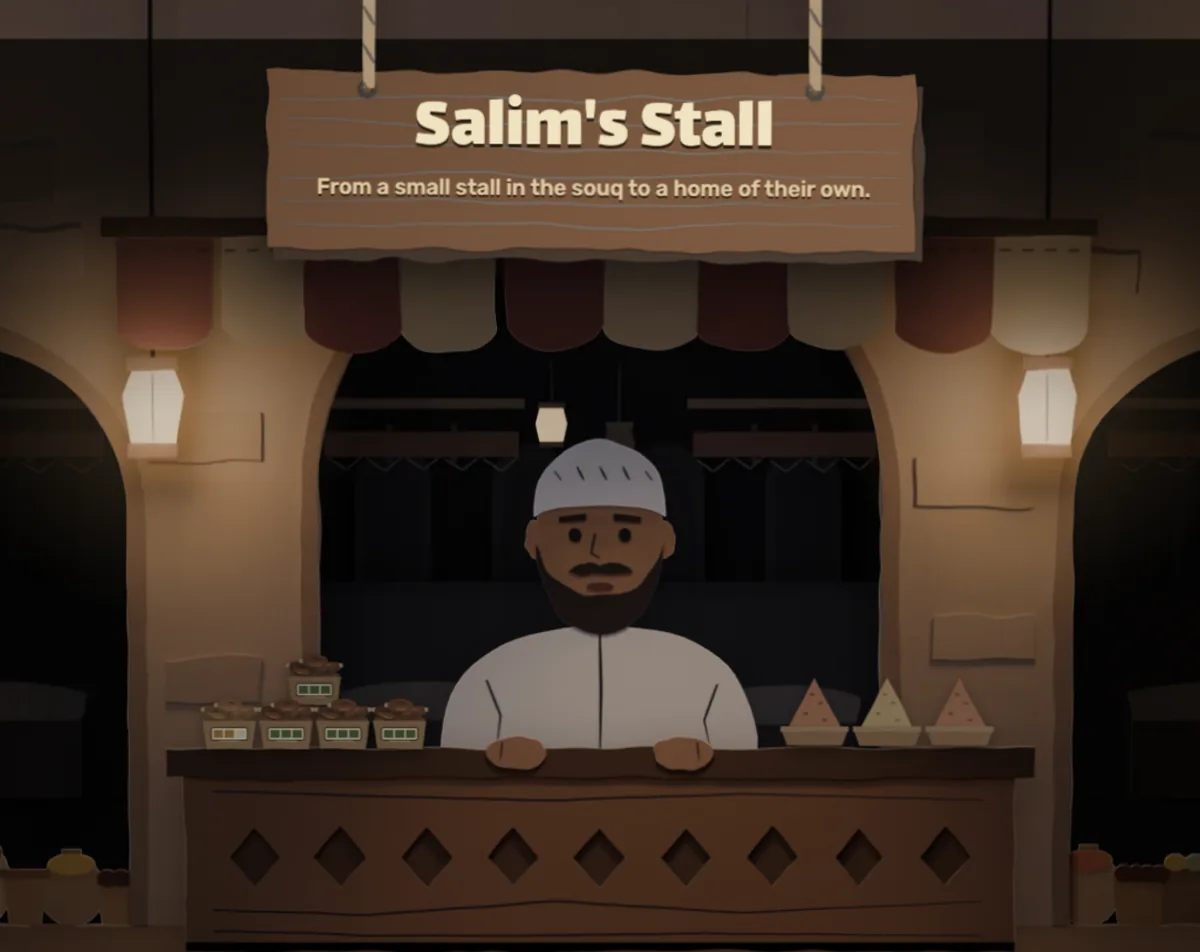
A cozy, turn-based shopkeeping sim set in a Dubai souq, where dawn stock buys, daily haggling and evening money choices slowly turn a rented home into a family's own.
#46 this weekAI-assisted: Code, Graphics, Text
The game runs in this tab. No install, no account.
The short answer
Salim's Stall is a browser-based, turn-based shopkeeping simulation set in Dubai's old souq. Players buy stock at dawn, haggle with twenty distinct customers, and decide each evening how to spend or save money. Home shares lower the rent, and the final share makes the home the family's own. It is free to play and built for short, thoughtful sessions.
What is Salim's Stall?
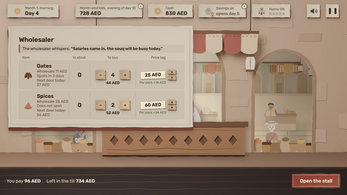
Salim's Stall is a cozy, educational shopkeeping simulation set in Dubai's old souq. Salim runs a small stall while his family rents their home, and the landlord has agreed to sell that home share by share. Each share bought lowers the rent; the last share makes the home the family's own. A run moves through a clear daily rhythm: buy stock at dawn, haggle with twenty very different customers, then decide every evening what to do with the money. The game is turn-based and single-player, with no timers and no quizzes. Its lessons come from decisions counted in dirhams, not from test questions. The prototype is free to play in a browser and focuses on pricing, budgeting and interest-free finance. A quick session uses five home shares, while the full story uses twenty. The setting gives every choice concrete stakes: stock, rent, family security and the goal of ownership. The playable build is an HTML5 browser frame.
How to play
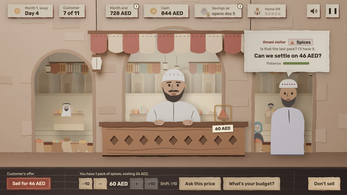
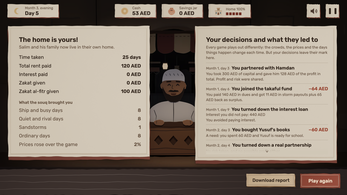
Pick Quick game for the best first visit. It runs about fifty minutes and uses five home shares to reach the ownership goal. Full game stretches to roughly four and a half hours and follows the complete story across twenty shares. During play, stock is bought at dawn, customers arrive to haggle, and each evening brings a money decision. The game saves automatically in the browser. A pause menu holds Settings, language choices and How to play. Every month closes with a report card covering the three most important decisions made that month. That report card is a review of choices, not a scored test. At the end, a full report traces every decision and its outcome, and that report can be downloaded. The haggling keyboard commands matter because price changes are part of the core loop, not a side attraction.
Controls
Mouse or touch handles the main play. The two input styles meet in the same run: pointer play for the stall and keys for negotiation. Haggling has its own keyboard layer: the left and right arrow keys change the proposed price, and holding Shift makes each change larger. Enter puts the proposed price to the customer. K accepts the customer's offer instead. B asks about the customer's budget, and S sends the customer away. The game is best in fullscreen, using the button at the bottom right of the game. On phones, the recommended orientation is landscape. The pause menu can be opened for Settings, language and How to play, and the tutorial can be turned on or off. Keyboard haggling is also called out as an accessibility feature, alongside other display and reading options.
| Input | Action |
|---|---|
| Mouse | Main input for play |
| Touch | Main input for play on touch screens |
| Left arrow / Right arrow | Change the proposed haggling price |
| Shift with Left arrow or Right arrow | Change the proposed price in bigger steps |
| Enter | Put the proposed price to the customer |
| K | Accept the customer's offer |
| B | Ask the customer for their budget |
| S | Send the customer away |
| Fullscreen button at the bottom right | Enter fullscreen |
Tips for a first run
Start with Quick game rather than Full game. Five home shares and about fifty minutes make a compact first pass through the dawn-buy, customer-haggle and evening-budget loop. Watch the pricing side closely: wholesale cost, 5% VAT, spoilage and price tags all affect margins, so a low tag is not automatically a good decision. During haggling, use B to ask a customer's budget before settling, then try Enter for the proposed price or K for the customer's offer. Keep the monthly budget focused on needs, wants and saving first; an emergency fund has a concrete use when the fridge breaks. Treat a quick loan with care, because its interest is shown in plain numbers. Remember that buying a home share lowers the rent, which makes each share a long-term move rather than a one-off purchase.
- Use Quick game for a first run of about fifty minutes and five shares.
- Ask a customer's budget with B before choosing Enter or K.
- Track 5% VAT, spoilage and wholesale cost when setting a price.
- Save before wants and build the emergency fund for the fridge failure.
- Read the quick loan's interest figures before borrowing.
Content and replayability
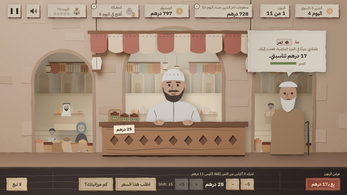
The content is built around financial decisions rather than quizzes. Pricing and margins cover wholesale cost, 5% VAT, spoilage, price tags and haggling. A monthly budget separates needs from wants and asks for saving first. An emergency fund matters when the fridge breaks, while a quick loan shows its interest in plain numbers. Interest-free finance appears through diminishing musharakah, mudaraba, takaful and qard hasan. Inflation, sandstorms and an investment that sounds too good to be true add pressure. Ramadan brings zakat, and zakat al-fitr arrives before Eid. Two lengths change the shape of a run: five home shares for a quick game around fifty minutes, or twenty shares for a full game around four and a half hours. Monthly report cards focus on the three most important decisions, and a final downloadable report records every decision and consequence. English, Arabic and Turkish are available, with Arabic presented right to left.
Presentation and performance
The look is paper cut-out art, modelled and rendered in Blender. The interface uses Rubik, Lalezar and IBM Plex Sans Arabic. English, Arabic and Turkish are supported, with Arabic laid out right to left. Accessibility options include a colour-blind palette, a simple-language mode, large text, reduced motion, slower speech bubbles, sound captions, a tutorial toggle and keyboard haggling. The game runs in an HTML5 frame in the browser and saves automatically there. Fullscreen is recommended, using the bottom-right button. On phones, landscape is the advised orientation. Sound and music use Pixabay material under the Pixabay Content License, including coins, page flips, writing, footsteps, bazaar voices and a mission-complete chime. The art was made with Blender scripts written by Claude; no image-generation models were used. Code and game text, including translation drafts, had AI assistance. Sound and music are not AI-generated.
Who should play it
Salim's Stall suits players who like cozy management with a financial spine. The loop is turn-based and single-player, with no timers or quizzes, so the appeal comes from reading a customer, setting a price and then living with the evening budget choice. Players who enjoy shopkeeping stories will find a clear goal: buy home shares, lower the rent, and make the family's rented home their own. The Dubai souq setting and the twenty different customers give each day a specific texture. The educational material is practical rather than abstract, with 5% VAT, spoilage, emergency funds, a quick loan, zakat and interest-free finance appearing as decisions. A quick game around fifty minutes is friendly to a first visit, while a full game around four and a half hours offers the complete story. Arabic, English and Turkish support broaden the reach. The prototype status is worth noting for players who prefer to try the current build before a larger release, and the game is free, so a first visit carries no price barrier.
Screenshots
How we tested it
The build was loaded from games.debutplay.com in a headless Chromium session on ; the canvas started and no request was blocked. The guide was last checked on .
From the developer
Salim runs a small stall in Dubai's old souq. His family rents their home, and the landlord has agreed to sell it to him share by share. Buy stock at dawn, haggle with twenty very different customers, and decide every evening what to do with the money. Every share you buy lowers the rent. The last one makes the home yours.No timers and no quizzes: the lessons are your decisions, counted in dirhams.What you will deal withPricing and margins: wholesale cost, 5% VAT, spoilage, price tags and hagglingA monthly budget: needs vs. wants, and saving firstAn emergency fund for the day the fridge breaksA "quick loan" whose interest the game puts in plain numbersInterest-free finance in practice: diminishing musharakah, mudaraba, takaful and qard hasanInflation, sandstorms and an investment that sounds too good to be trueZakat in Ramadan and zakat al-fitr before EidEvery month ends with a report card of your three most important decisions. The…
Frequently asked questions
Is Salim's Stall free to play?
Yes. The game is free to play, and no price is attached.
What platform does it use?
It runs as an HTML5 browser game. Touch input is supported, and phones are advised to use landscape.
How long does a run take?
Quick game takes about fifty minutes across five home shares. Full game takes about four and a half hours across twenty shares.
Does the game save progress?
Yes. It saves automatically in the browser.
Which languages are included?
English, Arabic and Turkish. Arabic is presented right to left.
What happens at the end of a run?
Every month ends with a report card on the three most important decisions. The game ends with a full report of every decision and its outcome, and the report can be downloaded.
What games are similar to Salim's Stall?
The closest matches on DebutPlay are Bloodline: Vampire Dynasty, Bald Peacock, 3D Printer Constructor. They share the same genre, so the controls and the pace carry over.
Something wrong or missing? Tell us. How we test games.