Strategy · New game
Strike Alert
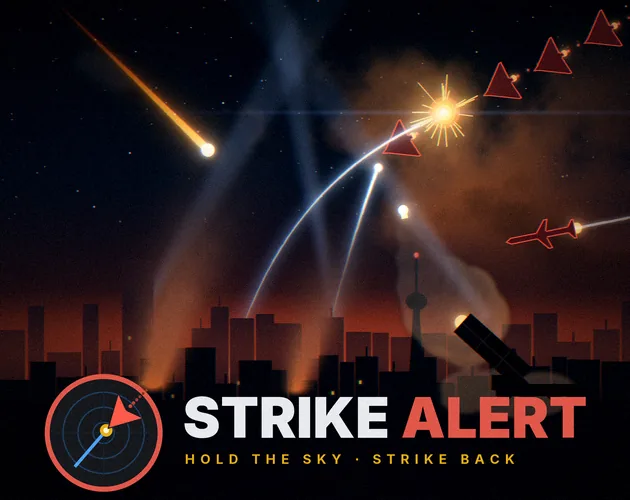
A free real-time air war played on an air-raid alert map, where factories fund the fight and the war ends when one capital falls.
#44 this weekAI-assisted: Code, Graphics, Sound
The game runs in this tab. No install, no account.
The short answer
Strike Alert is a compact real-time strategy game about air defence and deep strikes, played on a live alert map of two fictional countries. Factories pay for guns, interceptors and missiles while sirens warn of incoming raids. It runs free in a browser, with offline Windows and macOS builds, and rewards patience, scouting and route planning over clicking fast.
What is Strike Alert?
Strike Alert is a small real-time strategy game about an air war between two fictional countries, fought entirely through the lens of an air-raid alert map. One side of the front is yours: factories, anti-aircraft guns and surface-to-air missile batteries go there. The other side hides the enemy's launch sites, which have to be found before they can be hit. The whole conflict has a single win condition, and it is not attrition, because the war stops the moment one capital falls.
Play happens in the browser, and separate Windows and macOS builds run offline. The macOS version is not notarised by Apple, so a machine that refuses to open it will need the Privacy & Security panel in System Settings and the Open Anyway button. The game is still in development, with a published build dated 02 November 2026, so expect balance and map work to continue. Nothing about the price is a barrier: Strike Alert is free.
How to play
Money comes from factories, and factories are also what keeps a capital standing. While a factory's region is under air alert, its workers head for shelter and output drops to half pace. Each new factory costs more than the last, and the rear has less room for them than the front does, which pushes the economy toward danger.
Air defence splits into two jobs. Anti-aircraft guns are cheap, short-ranged and fire shells that cost nothing, which makes them comfortable against drones and less reliable against cruise missiles. SAMs reach much further and can engage drones, cruise missiles and ballistic missiles, but every interceptor costs $10, roughly the price of the drone it may bring down. Whether they bother with drones at all is your call.
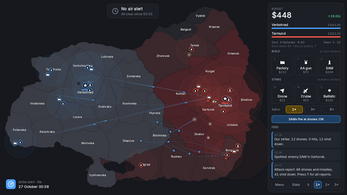
Enemy sites are hidden at the start. Drones are slow and cheap and reveal whatever they pass over, which is how targeting begins. Cruise missiles are fast and accurate; ballistic missiles are faster still and hard to stop. A launch can go straight at a target or follow a route dragged through gaps in its defences. The enemy capital repairs itself while its factories run, so the useful opening is against the factories and the air defence guarding them.
Controls
Everything is done with a mouse and a handful of keys. The mouse builds, aims and drags missile routes. Number keys 1, 2 and 3 select a factory, an anti-aircraft gun and a SAM respectively; Q, W and E select a drone, a cruise missile and a ballistic missile. A right-click puts the current tool down. T brings up the statistics, Space pauses, F11 goes fullscreen, and Esc cancels the current action or opens the menu.
Speed is adjustable in three steps, 1×, 2× and 3×, alongside pause, so a quiet stretch can be pushed forward and a heavy raid slowed to something readable. The interface is a map rather than a 3D battlefield, so almost all attention goes to regions lighting up, the front line, and the paths drawn across it.
| Input | Action |
|---|---|
| Mouse | Build structures, aim, and drag missile routes |
| 1 / 2 / 3 | Select a factory, an anti-aircraft gun, or a SAM |
| Q / W / E | Select a drone, a cruise missile, or a ballistic missile |
| Right-click | Put the current tool down |
| T | Open the statistics screen |
| Space | Pause the game |
| F11 | Go fullscreen |
| Esc | Cancel the current action or open the menu |
Tips for your first run
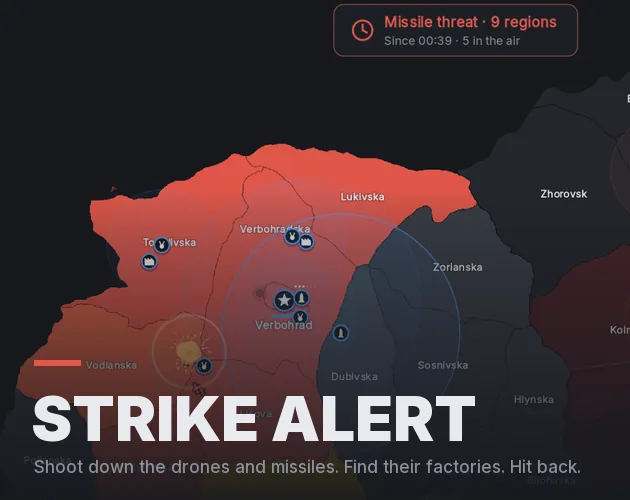
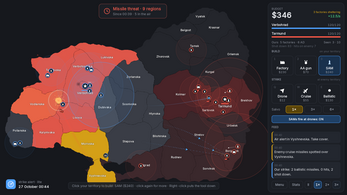
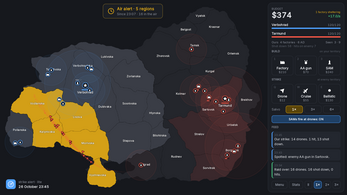
The alert map is the best warning system available and it costs nothing. Regions light up as threats cross them, missile and ballistic warnings arrive separately, and an all-clear sounds once the sky is quiet. Reading that flow matters more than reacting to the first siren.
- Place early factories with the alert rules in mind: industry in an alerted region works at half pace, and the rear has less space than the front.
- Keep a cheap anti-aircraft gun near anything valuable. Its shells are free, and drones are the raid type most likely to keep coming.
- Consider holding SAM fire against drones if $10 interceptors start costing more than the damage those drones do.
- Scout with drones before spending missiles, since a hidden site cannot be targeted and a drone reveals the ground it crosses.
- Drag cruise missile routes through gaps in the defences instead of launching straight in, so the defences have less time to answer.
- Aim the first serious strike at factories and the air defence around them, because the enemy capital keeps healing while industry runs.
- Use pause and the speed steps when intelligence warns of a massed attack; that is the moment to slow everything down.
Content and replayability
Forty maps cover two fictional countries, each with its own coastline, regions and front line, so the geography that decides a run changes from match to match. Three difficulty levels set how much thinking the opposition does: on Normal and Hard the enemy hunts factories, routes around air defence, goes after the highest-value target and masses drones and missiles into one large strike, with intelligence warning ahead of the big push.
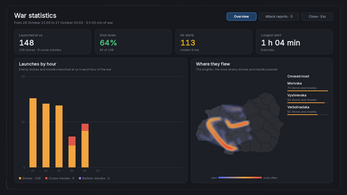
Records sit alongside the fighting. Every raid produces an attack report, and the statistics screen tracks launches by hour, the regions crossed most often and the longest alert, which turns a run into something that can be read back afterwards. Pause and the 1×, 2× and 3× settings keep the tempo adjustable, and because a capital falling ends the war, the finish is decisive rather than drawn out.
The result is a strategy game built for repeat attempts: one ruleset, many maps, three difficulty settings and an opponent that changes its plans.
Presentation and performance
Strike Alert is a 2D game built in Godot with a deliberately plain look. The alert map is the interface, and regions light up as threats pass over them, with separate warnings for missile and ballistic launches. Procedural generation is part of the map work, and the visuals stay minimal so the map remains readable when several raids are in the air at once.
The audio is the loudest thing about it. The air-raid siren is a real recording made in Ukraine in 2022, and it keeps wailing for as long as an alert lasts rather than playing a fixed sting. A Shahed engine, Gepard anti-aircraft guns, Patriot and Tomahawk launches and explosions are all cut from real recordings, and the interface uses the Inter typeface.
The browser build is a single playable frame, so starting takes a click; the Windows and macOS versions exist for offline play. The macOS app is unnotarised, which is worth knowing before the first launch attempt.
Who should play it
Strike Alert suits players who like the planning half of real-time strategy more than the clicking half. It is a singleplayer game about reading warnings, budgeting interceptors and choosing targets, driven by a mouse and a few keys rather than unit micro. Anyone who has enjoyed tower defence will recognise the logic of layering cheap guns under expensive missiles, but the factory economy and the hidden enemy sites push it closer to a small war game.
It also fits short sessions. A capital falling ends the war, the speed climbs to 3×, and pause is always there, so a run can be read at whatever tempo suits. Its focus is a single air war pushed to a capital, spread across forty maps and three difficulty settings, with an opponent that tries to outthink the defence on the harder settings.
Screenshots
How we tested it
The build was loaded from games.debutplay.com in a headless Chromium session on ; the canvas started and no request was blocked. The guide was last checked on .
From the developer
The sirens go off region by region. Drones drift in across the border, cruise missiles come in low and fast, and a ballistic launch gives you seconds. Keep your factories working under fire, and spend what they earn on finding and destroying the enemy's. Strike Alert is a small real-time air war played on an air-raid alert map. You build air defence on your side of the front and send drones and missiles across it. The war ends when one capital falls. HOW THE WAR WORKS • Factories earn the money and repair your capital. When their region is under air alert the workers take shelter and the factory runs at half pace. Each one costs more than the last, and there is more room for them near the front than in the rear. • AA guns are cheap and short-ranged, and their shells are free. Good against drones, lucky against cruise missiles. • SAMs reach far and hit drones, cruise and ballistic missiles. Every interceptor costs $10, about as much as…
Frequently asked questions
Is Strike Alert free to play?
Yes. The game is free, and it runs in a browser as well as through separate Windows and macOS downloads that work offline.
Which platforms are supported?
Three: HTML5 in the browser, Windows, and macOS. The macOS app is not notarised, so if it refuses to open, allow it through Privacy & Security in System Settings with Open Anyway.
How does a match end?
The war ends the moment one capital falls. Enemy capitals repair while their factories keep working, so industry is usually the target that matters first.
How do SAMs work?
They reach further than anti-aircraft guns and can hit drones, cruise missiles and ballistic missiles. Each interceptor costs $10, and the player decides whether they engage drones at all.
Why is factory output dropping?
Factories in a region under air alert lose their workers to shelter, and production falls to half pace until the alert clears.
How are enemy sites found?
They start hidden. Drones are slow but cheap and reveal the ground they cross, after which cruise and ballistic missiles do the damage.
What games are similar to Strike Alert?
The closest matches on DebutPlay are Moat Mayhem, Strike Alert, Three Men, Probably Norwegians. They share the same genre, so the controls and the pace carry over.
Something wrong or missing? Tell us. How we test games.