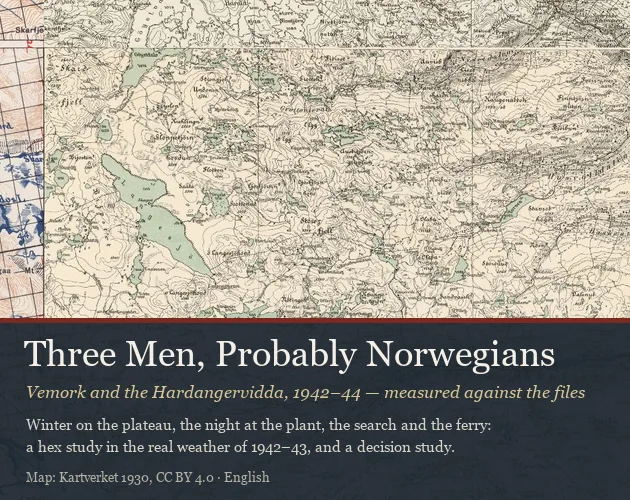
Strategy · New game
Three Men, Probably Norwegians
A day-by-day survival and decision study of Norwegian sabotage, winter weather, radio reports, and the files that judged the raid.
#7 this weekAI-assisted: Code, Text
The game runs in this tab. No install, no account.
The short answer
Three Men, Probably Norwegians is a single-player, turn-based HTML5 strategy and survival game set in Norway during 1942–44. Each turn is one day, with rationing, reindeer hunting, hut shelter, daily radio contact with London, and weather from the 1942–43 record. Three scenarios cover the plateau, the German search, and the Hydro decision study.
What is Three Men, Probably Norwegians?
Three Men, Probably Norwegians is a single-player strategy and survival game about the Norwegian sabotage campaign around Vemork and the Hardangervidda from 1942 to 1944. The premise is specific: a German report after the 28 February 1943 sabotage at the Rjukan nitrogen works described the culprits as three men, probably Norwegians, though nine had set out. The game places the player with that group, then turns to the files.
The design is organised as three scenarios. The Plateau runs from 18 October 1942 to 18 March 1943. Four Kompani Linge men come down in the west of the Hardangervidda with a month's food; the tasks are to move east, live through winter, report to London, receive the attack party in the moon period, and go down to the plant. The Search covers 7 March to 4 April 1943, with a German ring around the plateau, three ski detachments, and hut searches. Hydro, from 16 November 1943 to 20 February 1944, is a decision study around the U.S. bombing of Rjukan, Norwegian objections, and the Tinnsjø ferry. The campaign is measured against the files rather than played as a conventional war game.
How to play
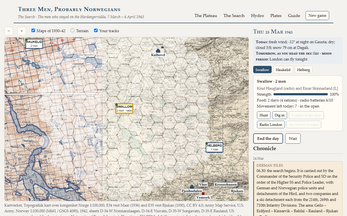
Play proceeds in daily turns. One turn represents a day, and the weather follows the real 1942–43 daily record from the Norwegian Meteorological Institute; during a storm, nobody moves on the open plateau. The daily loop asks for food management, reindeer hunting, shelter in huts, and one radio contact with London each day. Radio calls are limited, so reports can be sent as events stand or improved before transmission. London plans from those reports. Aircraft arrive only in the moon period and only when the night is fit.
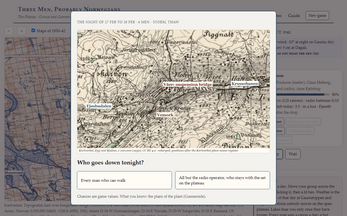
Three scenarios shape the pressure. The first two take one to two hours each; the third takes about a quarter of an hour. The German side acts only on what its own files show it knew, which keeps the opposition tied to the historical record. The attack night is resolved as six decisions on the Norwegian map of 1930. Each scenario closes with a reckoning: damage against the German estimate of four to six weeks and the day the plant ran again, what the Germans knew, what London knew, and who paid among the Freshman men, the arrested in Rjukan and on the plateau, and the dead of the bombing and the ferry.
Controls
The game uses a turn-based decision flow rather than real-time action. One turn is a day, and the practical choices are the daily survival tasks: counting rations, hunting reindeer, sheltering in huts, and making one radio call to London. The radio limit means each contact is a deliberate choice, and London's planning depends on what is sent. The attack night reduces the wider campaign to six decisions on the Norwegian map of 1930.
Because the scenarios are single-player and the German side acts only on its own file knowledge, the pace is deliberative. Weather is not background detail: a storm can stop movement on the open plateau, so a turn can become a wait or a shelter decision. The Search scenario adds pressure from a German ring around the plateau, three ski detachments, and hut searches. Hydro shifts to a decision study, with the U.S. bombing of Rjukan, Norwegian objections, and the Tinnsjø ferry as its frame.
The game page does not list its controls. Check the in-game tutorial or pause menu for the current scheme.
Tips for your first run
Start with The Plateau, because it introduces the daily rhythm before the search pressure and the later decision study. Treat radio calls as scarce. A report sent early may be less useful than one sent after a key event, but waiting has its own cost. Watch the moon period if aircraft are part of the plan; a fit night matters as much as the request. Shelter and food are not flavour: rations and reindeer hunting keep the winter turns viable, and huts give the party a place to wait out bad weather.
- Count rations before moving east; the party starts with one month's food.
- Use huts when a storm stops movement on the open plateau.
- Keep a radio call for a change London needs to know about.
- In The Search, expect a German ring, three ski detachments, and hut searches.
- For Hydro, focus on the decision study rather than a long campaign.
Content and replayability
Three scenarios provide the structure: The Plateau, The Search, and Hydro. The first two are estimated at one to two hours each, and the third at about a quarter of an hour. That makes the game a set of focused studies rather than one long campaign. Saves are kept in the browser, and the interface is in English. The game is HTML5 and single-player. The scenario reckoning gives each run a documentary frame: damage is compared with the German estimate of four to six weeks and the day the plant ran again, alongside German and London knowledge and the cost to named groups. The dead are counted, never scored, and the killing of the Freshman prisoners, the arrests, and the burning of huts are fixed in the chronicle at their dates rather than being player moves. The game does not simulate the German uranium project, and counters carry plain-text names only. The Files document collection is offered in PDF and EPUB at ten dollars, with facsimiles, transcriptions, and English translations.
Presentation and performance
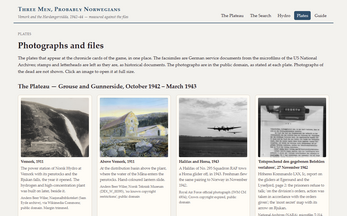
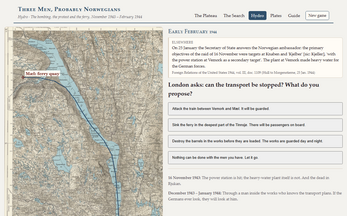
Presentation is built around archival material. The board uses Norwegian map sheets and US Army Map Service sheets from 1942. Fifteen plates provide facsimiles of German reports and public-domain photographs. Counters carry plain-text names, and chances and strengths are marked as game values rather than presented as historical certainties. Chronicle cards identify their documentary basis, and the German files were read at the frame on National Archives microfilms. The four screenshots show a map-and-document presentation rather than an action spectacle.
Performance is tied to the HTML5 format and saves held in the browser. The game is played in a browser frame. The technical frame is modest: maps, plates, plain counters, and text. That suits a design where the daily weather record, the moon period, and the documentary reckoning carry the tension. The result should be judged as a turn-based study, not a real-time action product.
Who should play it
Players who want a compact historical strategy game with explicit documentary limits should find the premise strong. The daily turn, ration count, reindeer hunting, hut shelter, and limited radio calls give the survival layer concrete decisions. The German side acting only on its own file knowledge will appeal to those who prefer constrained opposition to an all-seeing opponent. The Search adds the pressure of a ring around the plateau, three ski detachments, and hut searches. Hydro is for players who want a short decision study about the U.S. bombing of Rjukan, Norwegian objections, and the Tinnsjø ferry.
Those who want a long campaign, real-time action, or a simulated German uranium project should look elsewhere; the last is explicitly outside the design. The counters use plain-text names, the dead are counted rather than scored, and the chronicle fixes civilian and prisoner suffering at its dates. The result is best for readers of military history, map-and-counter players, and anyone curious about the gap between a German report of three men and the nine who set out.
Screenshots
How we tested it
The build was loaded from games.debutplay.com in a headless Chromium session on ; the canvas started and no request was blocked. The guide was last checked on .
From the developer
Three Men, Probably NorwegiansVemork and the Hardangervidda, 1942–44 — measured against the filesOn the morning of 28 February 1943, the German commander in Norway reported an act of sabotage at the 'nitrogen works' at Rjukan: damage to be repaired in four to six weeks, the culprits 'three men, probably Norwegians'. There had been nine. This game puts you with them – and then opens the files.- The Plateau — 18 October 1942 – 18 March 1943. Four men of Kompani Linge come down in the west of the Hardangervidda with a month's food. Walk east, live through the winter, report to London, receive the attack party in the moon period, and go down to the plant.- The Search — 7 March – 4 April 1943. The men who stayed on the plateau, under the German search laid out in the corps order of 21 March 1943: a ring around the plateau, three ski detachments, and every hut searched.- Hydro — 16 November 1943 – 20 February 1944. A decision study: the…
Frequently asked questions
How long are the scenarios?
The first two scenarios are estimated at one to two hours each. The third is about a quarter of an hour. Three scenarios are included.
What platforms does it run on?
It is an HTML5 game with saves in the browser. The listed platform is HTML5.
How much does it cost?
The game is priced at eight dollars. The Files document collection is offered in PDF and EPUB at ten dollars.
Is it multiplayer?
It is single-player. The scenarios are turn-based and built around daily decisions, radio reports, and documentary reckoning.
What is the weather system?
Each turn is a day, and the weather follows the 1942–43 daily record from the Norwegian Meteorological Institute. A storm can stop movement on the open plateau.
Does it simulate the German uranium project?
No. The game does not simulate the German uranium project. Its focus is the Norwegian sabotage story, the search, and the Hydro decision study.
What games are similar to Three Men, Probably Norwegians?
The closest matches on DebutPlay are Moat Mayhem, Strike Alert, Fatebound: War of the Four Suits. They share the same genre, so the controls and the pace carry over.
Something wrong or missing? Tell us. How we test games.