Card game · New game
Runebinder: Chronicles of the Lands Between
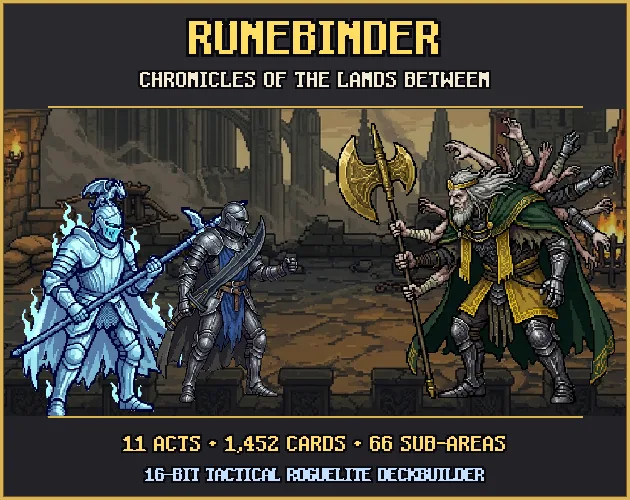
A free 16-bit tactical card RPG and roguelite deckbuilder that turns the Lands Between into an 11-Act campaign of real-time initiative combat, equipment paper-dolling, and card binding.
#2 this weekAI-assisted: Code, Graphics
The game runs in this tab. No install, no account.
The short answer
Runebinder: Chronicles of the Lands Between is a free 16-bit tactical card RPG and roguelite deckbuilder for HTML5 and Windows. It spans 11 Acts and 66 Sub-Areas, with 1,452 cards, real-time initiative battles, stance breaks, and equipment that visibly changes a Tarnished Hero. Play it now for a dense fan-made tribute with boss encounters, NPC questlines, and side systems.
What is Runebinder: Chronicles of the Lands Between?
Runebinder: Chronicles of the Lands Between is a 16-bit tactical card RPG and roguelite deckbuilder set in a dark-fantasy reimagining of the Lands Between. The campaign is built as 11 Acts across 66 Sub-Areas, and its card pool reaches 1,452 unique 16-bit cards. Rather than a pure turn-based duel, combat runs on real-time initiative, so card decisions sit alongside active defense and timing.
Equipment is not just a stat block: right-hand weapons, left-hand shields or catalysts, and armor sets visibly attach to the Tarnished Hero in real time, with 55 distinct Hero body archetypes supporting the paper-doll system. The game is free and non-commercial, made as a fan tribute to Elden Ring. It is available for HTML5 and Windows.
The structure leans on a full campaign plus repeatable side systems: the Grace Triad card game, multi-act NPC questlines, Bloody Finger invasions, and Jarburg sanctuary defense. Boss encounters are framed as wide close-up fights, including 10 Colossal Dragons, Astel, Naturalborn of the Void, and the Elden Beast. Five Sovereign endings give the campaign different final directions.
For a player about to click Play, the appeal is the combination of deck construction, visible equipment changes, and active combat maneuvers rather than a static card-only flow. The pixel art, 16-bit UI, and reactive soundtrack are part of the same tribute package.
How to play
Start with the Hero loadout, because every right-hand weapon, left-hand shield or catalyst, and armor set is part of the visible paper-doll rig. With 55 Hero body archetypes, the equipment layer is meant to be read on the character, not buried in menus. Card binding drives the build; the pool includes weapon arts, sorceries, incantations, talismans, Spirit Ashes, Crystal Tears, cookbooks, 14 Boss Remembrances, and 11 Great or Mending Runes.
Combat uses real-time initiative, so the turn order is not a fixed pause between decisions. Active defense matters: Dodge Rolls carry invincibility frames, Shield Parries are another active option, Poise Breaks open Critical Ripostes, and Dual-Wield Power-Stancing changes how weapons pair. The eight status afflictions include Hemorrhage, Frostbite, Scarlet Rot, and Death Blight; each one gives a different angle on a fight.
Between battles, the Roundtable Hold services support progression: Master Hewg handles Smithing from +1 to +10, Roderika tunes Spirit Ashes, Finger Reader Enia transposes Boss Remembrances, Miriel teaches dual-catalyst spell mastery, and Fia also appears in the hub. The campaign moves through 11 Acts and 66 Sub-Areas, so deck and equipment choices can shift as new regions and bosses arrive.
Controls
The game is built around mouse-first play. Point-and-click control covers card binding, target selection, map navigation, foraging, and the services in the Roundtable Hold. That means a player can handle most menu and map work without leaving the mouse.
Combat adds keyboard shortcuts: Space pauses or resumes combat, while Q, W, E, and R trigger the active maneuvers for Dodge, Parry, Ash of War, and Physick Flask. The 16-bit UI is designed for 1152x648 at 16:9 and scales to 1080p, 1440p, and 4K with integer-crisp pixel rendering. Status badges are colorblind-safe, which matters because combat tracks eight afflictions. Options include group password modifiers, a useful detail for players who want a shared modifier setup.
Accessibility is not limited to scaling: the interface is meant to stay readable while card text, map movement, and combat prompts share the screen. The combat shortcuts sit beside the initiative system, so pausing and resuming is part of managing a fight rather than a separate menu. Because the controls combine mouse-driven card work with keyboard maneuvers, first-time players should learn the pause key early and keep the active defense keys within reach. The control scheme supports the hybrid loop of deck decisions and real-time reactions.
| Input | Action |
|---|---|
| Mouse | Point-and-click handling for binding cards, choosing targets, moving around the map, foraging, and using Roundtable Hold services. |
| Space | Pause or resume combat. |
| Q / W / E / R | Trigger the active combat maneuvers for Dodge, Parry, Ash of War, and Physick Flask. |
Tips for your first run
Treat the first Act as a read on the initiative rhythm. Real-time initiative means a strong card line can still fall apart if a Dodge Roll, Shield Parry, or Poise Break is late. Learn when to pause with Space, then use Q, W, E, and R for the active maneuvers rather than treating combat as a pure card menu.
The equipment paper-doll is also a planning tool: check how a right-hand weapon, left-hand shield or catalyst, and armor set change the visible Hero before committing to a build. The eight afflictions are not interchangeable, so a deck that spreads across too many of them may lack a clear finish. Use colorblind-safe status badges to track what is active, and keep the Roundtable Hold services in mind between runs. The Grace Triad is a useful change of pace and a low-pressure way to practice corner-rank captures and Plus/Same chain combos.
- Test a Dodge Roll and Shield Parry early; invincibility frames and Poise Breaks are central to the real-time initiative layer.
- Watch for a stance break before spending a heavy card; Critical Ripostes reward the setup.
- Use the paper-doll view to confirm that weapon, shield or catalyst, and armor changes are actually equipped.
- Try the Grace Triad at the Roundtable Hold parlor to learn directional captures and chain combos.
- Check the colorblind-safe badges when multiple status afflictions are active.
Content and replayability
The content footprint is unusually wide for a card RPG with an HTML5 build. The campaign runs through 11 Acts and 66 Sub-Areas, moving from Limgrave and Liurnia through Caelid, Nokron, Leyndell, the Mountaintops, Farum Azula, and the Ashen Capital. Boss encounters include 10 Colossal Dragons, among them Agheel, Adula, Ekzykes, and Placidusax, plus Astel, Naturalborn of the Void, and the Elden Beast.
Replay value comes from build variety and branching systems: 1,452 cards, 55 Hero body archetypes, 14 Boss Remembrances, and 11 Great or Mending Runes support different loadouts. The Roundtable Hold has three wings and hosts services tied to Master Hewg, Roderika, Finger Reader Enia, Miriel, and Fia. Seven multi-act NPC questlines follow Ranni, Millicent, Alexander, Blaidd, Sellen, Nepheli Loux, and Patches.
Side systems add the Grace Triad card game, named Bloody Finger and Recusant invasions, and Jarburg sanctuary defense with Jar-Bairn, Iron Fist Alexander, and Diallos. Five Sovereign endings, including an Elden Lord path, the Age of the Duskborn, the Age of Order, the Blessing of Despair, and Ranni's Age of the Stars, give clear reasons to return with a different plan.
Presentation and performance
Presentation is built around a handcrafted 16-bit look. Boss fights use wide close-up framing, with custom elemental auras and multi-phase signature counters for encounters such as the Colossal Dragons, Astel, and the Elden Beast. The ending presentation includes a three-stage Sovereign Ending cutscene and 11-Act paired pixel vignettes, so the campaign's finales are treated as visual events rather than text screens.
Audio is also regional and reactive: the soundtrack uses a six-sub-area by seven-stem structure, producing 462 regional stems. The interface is designed for 1152x648 at 16:9 and scales to 1080p, 1440p, and 4K with integer-crisp pixel rendering. Colorblind-safe status badges support the eight-affliction combat layer, and group password modifiers appear in Options.
The project uses Godot 4 GDScript systems, with custom 16-bit sprites, paper-doll rigs, and procedural acoustic audio stems. For a player clicking Play, the practical takeaway is that the visual and audio layer is tuned to the same tribute style as the card and equipment systems.
Who should play it
This is for players who want a card RPG with active defense rather than a purely turn-based duel. The real-time initiative layer, Dodge Rolls with invincibility frames, Shield Parries, Poise Breaks, Critical Ripostes, and Dual-Wield Power-Stancing give the combat a timing component. Deckbuilder fans get 1,452 cards, 14 Boss Remembrances, 11 Great or Mending Runes, and equipment paper-dolling across 55 Hero body archetypes.
Souls-like players will recognize the boss names and the affliction set, while pixel-art fans get a 16-bit presentation with wide close-up boss framing. Players who enjoy side systems can spend time on the Grace Triad, seven NPC questlines, invasions, and Jarburg defense. The free, non-commercial fan-tribute status makes it easy to try in HTML5 or on Windows. Anyone who wants the Lands Between reworked into an 11-Act campaign with 66 Sub-Areas and five endings has a clear reason to click Play.
Screenshots
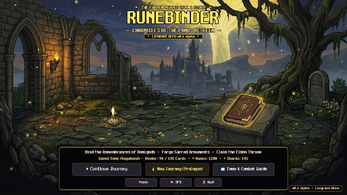
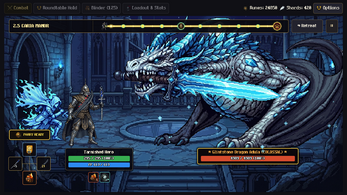
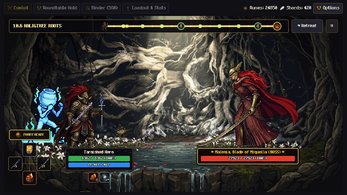
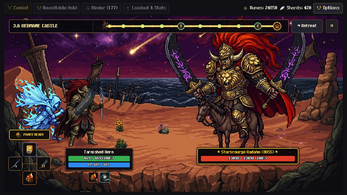
How we tested it
The build was loaded from games.debutplay.com in a headless Chromium session on ; the canvas started and no request was blocked. The guide was last checked on .
From the developer
⚔️ CHRONICLES OF THE LANDS BETWEEN A Complete 11-Act 16-Bit Tactical Card RPG & Roguelite Deckbuilder Step into a handcrafted 16-bit dark-fantasy reimagining of the Lands Between. Runebinder: Chronicles of the Lands Between blends real-time initiative combat, deep equipment paper-dolling, and tactical card binding across 11 complete Campaign Acts, 66 Sub-Areas, and 1,452 unique 16-bit cards. 🔥 KEY FEATURES 🗺️ Complete 11-Act Campaign Across 66 Sub-Areas Journey from Limgrave, Liurnia of the Lakes, and Caelid through Nokron & Nokstella, Altus Plateau, Mt. Gelmir, Leyndell, Royal Capital, Deeproot Depths & Mohgwyn Palace, Mountaintops & Farum Azula, Elphael, Brace of the Haligtree, and the Ashen Capital. 🃏 1,452 Unique 16-Bit Cards & 3-Layer Live Paper-Doll Hero Every right-hand weapon, left-hand shield or catalyst, and armor set (across 55 distinct Hero body archetypes) visibly equips directly onto your Tarnished Hero in real time.…
Frequently asked questions
Is Runebinder: Chronicles of the Lands Between free?
Yes. It is a free, non-commercial fan-made tribute to Elden Ring.
What platforms can run it?
It runs on HTML5 and Windows. The HTML5 build is playable in a browser.
Is it an official Elden Ring game?
No. It is a non-commercial fan-made tribute. The project is not affiliated with, endorsed by, or sponsored by FromSoftware or Bandai Namco.
What makes combat different from a standard card game?
Combat uses real-time initiative alongside card binding. Dodge Rolls have invincibility frames, Shield Parries and Poise Breaks feed Critical Ripostes, Dual-Wield Power-Stancing changes weapon pairing, and eight status afflictions are active in fights.
How much campaign content is included?
The campaign spans 11 Acts and 66 Sub-Areas. It includes 1,452 unique 16-bit cards, 10 Colossal Dragons, Astel, the Elden Beast, seven multi-act NPC questlines, and five Sovereign endings.
What side activities are available?
Players can challenge NPC patrons to the Grace Triad card game, follow seven NPC questlines, fight named Bloody Finger and Recusant invaders, and defend the Living Jars in Jarburg with Jar-Bairn, Iron Fist Alexander, and Diallos.
What games are similar to Runebinder: Chronicles of the Lands Between?
The closest matches on DebutPlay are Moat Mayhem, Vina Cards Fight, Fatebound: War of the Four Suits. They share the same genre, so the controls and the pace carry over.
Something wrong or missing? Tell us. How we test games.