Strategy · New game
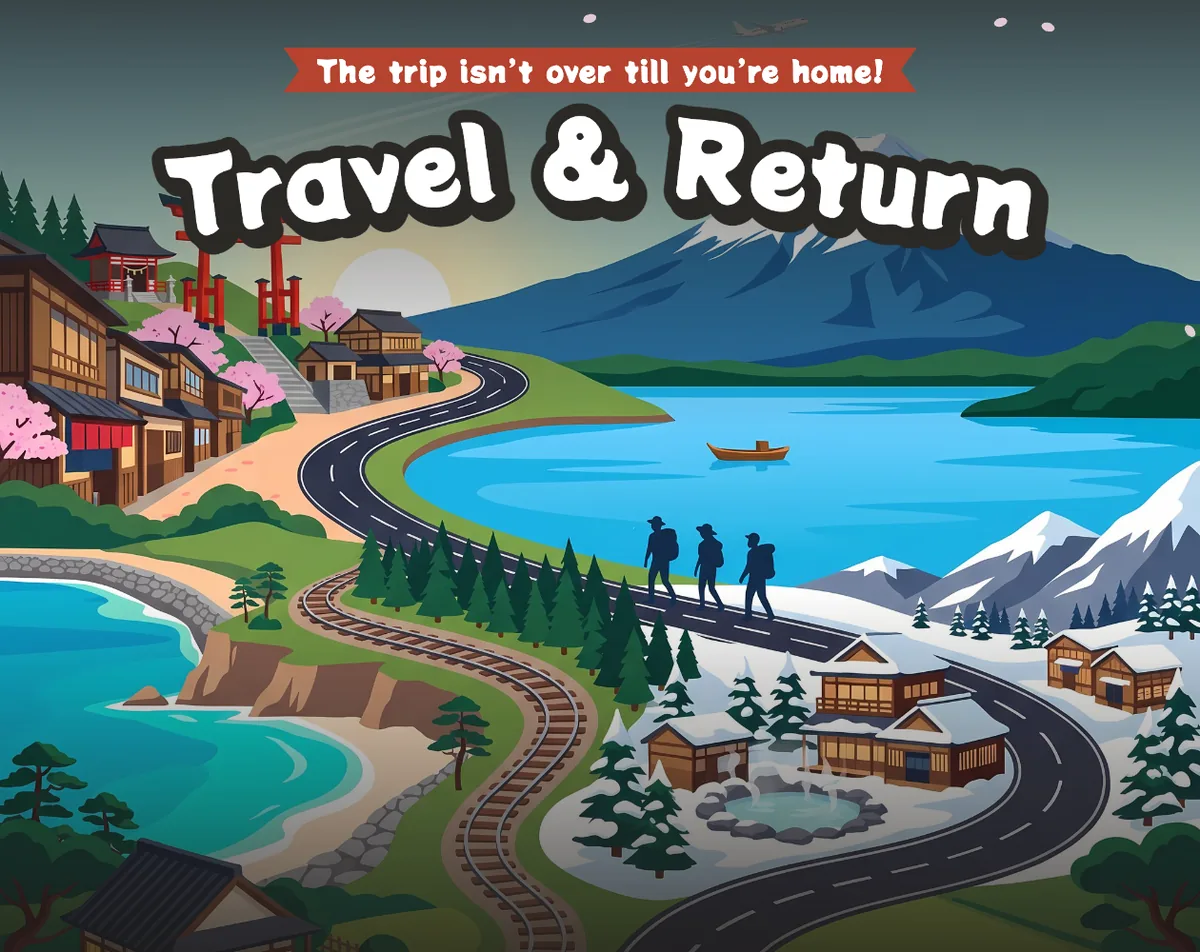
Travel & Return: The trip isn't over till you're home!
A free browser board game that turns a dice-driven tour of Japan into a race to be home by Day 14, with solo scoring runs, CPU rivals and local pass-and-play.
#6 this weekAI-assisted: Graphics, ai.soundsmusic
The game runs in this tab. No install, no account.
The short answer
Travel & Return is a free browser board game about touring Japan by dice and getting back to your hometown before Day 14 ends. It packs a solo high-score mode with 44 courses, two-to-four-player trips against CPU rivals or friends on one device, and a set of star-rated challenges, all playable in English or Japanese without installing anything.
What is Travel & Return?
Travel & Return is a digital board game built on a constraint that most travel games ignore: the holiday is not finished until the traveller is back in their hometown. Play moves around a map of Japan, from Hokkaido in the north down to Okinawa in the south, with dice rolls pushing each trip along its routes. Every destination reached is turned into a memory card, so a finished run reads like a souvenir album as much as a scoreline.
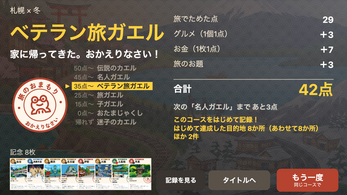
The deadline supplies the tension. A trip runs against a day counter, and anyone who is not back home when Day 14 closes hands back 10 points. That single rule reframes every roll, because distance from home matters as much as the next famous place on the route.
It comes from developer Eclipse1984 and sits in the strategy genre, but the tone is closer to a cosy tabletop evening than a crunch-heavy optimisation puzzle. Three play structures sit on the same core: a solo scoring run, a two-to-four-player contest against rivals, and a set of scripted challenge trips. Everything runs in a browser at no cost.
How to play
Every turn begins with the dice. A roll carries the traveller along the routes between destinations, and each destination reached is converted into a memory card that stays with the trip. The calendar climbs alongside the map, and a run only finishes cleanly if the player is standing in their hometown at the end of Day 14; otherwise 10 points come off the total. So the map is only half the game — the other half is judging when to turn around.
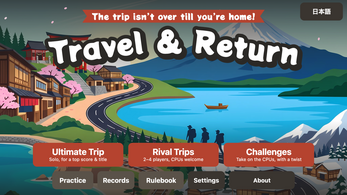
That core loop is dressed three ways. Ultimate Trip is the solo structure, where one player chases a high score and works toward a title, with Legendary Frog at the top of the ladder. Rival Trips seats two to four players at the same board, either against CPU opponents with distinct personalities or in a pass-the-device session with friends in the room. Challenges are scripted journeys, each built around its own twist, and they pay out stars rather than a plain score.
A step-by-step Practice mode, led by a frog guide, sits underneath all of it for anyone who wants the rules walked through before the calendar starts to bite.
Controls
The game runs inside a browser window, so there is nothing to download or install before the first roll. It is built to work on a desktop machine, on an iPad and on a smartphone, with landscape orientation recommended on the smaller screens.
Local play for two to four people is handled by passing a single device around, which means the whole table shares one screen instead of needing separate machines or accounts. Solo runs in Ultimate Trip and the frog-led Practice mode use the same single-screen setup.
Language is a menu setting rather than a fixed build. English and Japanese can be swapped at any point from the main menu, which makes it easy for a bilingual household to change language between turns or between sessions.
Actual turn flow is driven by the dice and by the routes between destinations, so the roll is what decides how far a trip advances before the calendar moves on.
The game page does not list its controls. Check the in-game tutorial or pause menu for the current scheme.
Tips for your first run
The only scoring penalty spelled out is the 10-point hit for missing the Day 14 cutoff, so treat the journey home as a fixed cost rather than an afterthought. On a first attempt, the safest habit is to look at how far the route has travelled from home before pushing on to one more famous place.
Starting in Practice mode is worth the few minutes it costs. The frog guide walks through the sequence step by step, which means the first real run can be spent thinking about the map instead of the rules.
- Reserve part of the calendar for the return leg — the end of Day 14 is a hard stop and missing it costs 10 points.
- Bank memory cards steadily instead of gambling everything on one long final loop, since each destination reached becomes a card.
- Learn a course in solo Ultimate Trip before adding rivals, so the only pressure comes from the clock.
- Try the different CPU personalities — a gentle, careful, balanced and daring opponent each change how crowded the routes feel.
- Once solo scores feel repeatable, move to the challenge trips, where each journey changes the terms of the run.
Content and replayability
The course count is the headline number. Eleven hometowns multiplied by four seasons gives 44 separate courses, so the starting point and the time of year both change what a run looks like. That is a lot of variation for a game built on a single dice loop, and it is the main reason a solo score chase stays interesting after the map stops feeling new.
There are 40 destinations in total, and each one carries its own illustration and a short travel note, which turns the board into a light travelogue as the trip fills in. The challenge mode adds 8 special trips, each with its own twist, with 48 stars available across the set for players who want a completion target rather than a high score.
Titles give the solo mode a longer arc, running up to Legendary Frog, while the rival mode covers both CPU opposition and same-room play with friends on one shared device. Add the ability to switch between English and Japanese and the package covers a lot of ground for something that loads in a browser tab.
Presentation and performance
The look is deliberately handmade, which fits a game that began life as a physical board game before being turned into an app. The 40 destinations each get an illustration and a short travel note, so the screen fills with places rather than abstract spaces as a run progresses, and the memory cards give the trip a visible record.
Some of the illustrations and the background music were produced with generative AI tools, specifically ChatGPT and Gemini, and the sources and licences are listed inside the game in an About section for anyone who wants to check them.
Performance-wise, this is a browser title: it loads in a tab and runs on desktop, iPad and smartphone, with landscape orientation recommended on phones. The English and Japanese switch sits on the main menu, so the interface can be re-read in either language whenever it helps.
Who should play it
Anyone who likes the shape of a tabletop game — dice, a board, a route, a score — will recognise the rhythm immediately. The Day 14 deadline gives that familiar loop a sharp little edge, because greed is punished in a way that is easy to understand and easy to blame on the dice.
It suits solo players who enjoy chasing a personal best across many variations, since the 44 courses and the title ladder give a score chase somewhere to go. It also suits a group sharing one tablet or laptop, especially a group that includes someone who would rather not learn a rulebook cold — the frog guide in Practice mode covers that.
Japan travellers and language learners get something extra from the 40 illustrated destinations and the anytime English-Japanese toggle. Players who want zero setup and zero cost before deciding can open it in a browser and roll.
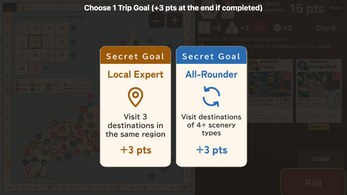
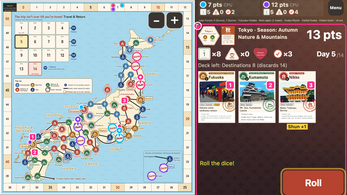
Screenshots
How we tested it
The build was loaded from games.debutplay.com in a headless Chromium session on ; the canvas started and no request was blocked. The guide was last checked on .
From the developer
**Travel & Return** is a digital board game about traveling around Japan — and getting home in time. Roll the dice, follow the routes, and visit famous places from Hokkaido to Okinawa. Each destination you reach becomes a memory card. But the trip isn't over till you're home: if you're not back in your hometown by the end of Day 14, you lose 10 points! **Three ways to play** - **Ultimate Trip** — Play solo, chase a high score, and earn a title — all the way up to Legendary Frog. 11 hometowns × 4 seasons = 44 courses to explore. - **Rival Trips** — 2 to 4 players. Face CPU rivals with different personalities (Easy, Cautious, Balanced, Bold), or pass one device around with friends. - **Challenges** — 8 special trips, each with its own twist. Earn up to 48 stars. **Also included** - A step-by-step **Practice** mode with a friendly frog guide - 40 destinations, each with an illustration and a short travel note - Play in English or…
Frequently asked questions
Is Travel & Return free to play?
Yes. It is free to play in a browser, and there is no purchase to start rolling. An iOS app is in the works, and a small donation is welcomed but not required.
What devices can run it?
It is an HTML5 browser game that plays on desktop, iPad and smartphone. Landscape orientation is recommended on the smaller screens.
How many people can play at once?
Ultimate Trip and Practice are solo. Rival Trips takes two to four players, either against CPU opponents or by passing one device around a group of friends.
What happens if you are not home by Day 14?
The run ends with 10 points deducted. Getting back to the hometown before Day 14 closes is part of the goal, not an optional extra.
Can the language be changed?
Yes. English and Japanese are both included, and the switch lives on the main menu, so the language can be changed at any point in a session.
How much content is there?
Eleven hometowns across four seasons make 44 courses, with 40 illustrated destinations, 8 challenge trips worth 48 stars combined, and a title ladder topping out at Legendary Frog.
What games are similar to Travel & Return: The trip isn't over till you're home!?
The closest matches on DebutPlay are Cast the Bones: Dice Battler, Pokémon Rumblefield, Thrink. They share the same genre, so the controls and the pace carry over.
Something wrong or missing? Tell us. How we test games.