Educational · New game
Common Ground: English Town
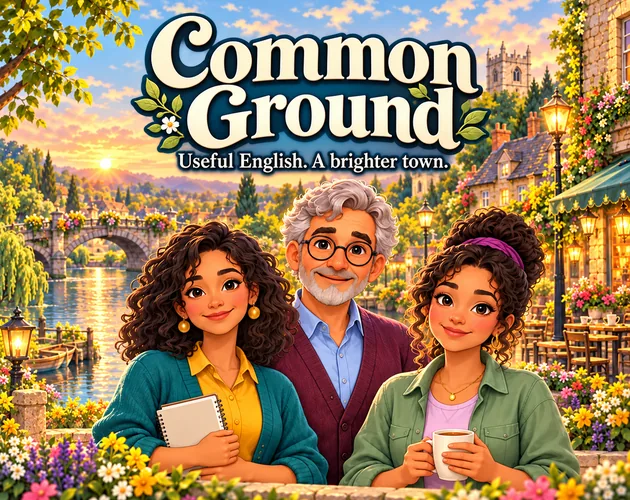
A cozy neighbourhood builder where everyday English choices decide what gets built, who can reach it, and how Maya, Eli and Noor solve their problems.
#2 this weekAI-assisted: Code, Graphics, Sound, Text
The game runs in this tab. No install, no account.
The short answer
Common Ground: English Town is a free browser game that mixes home furnishing, garden growing and community layout with English practice aimed at teens and adults at B1–B2. Six chapters hold 36 neighbour stories, and the language choices made in conversation change the neighbourhood itself. Playing starts in the browser with mouse, keyboard or touch.
What is Common Ground: English Town?
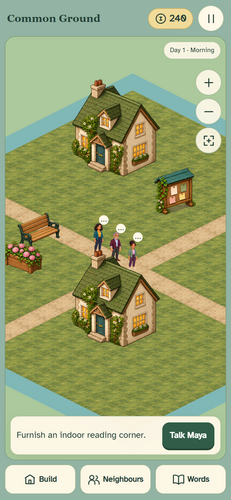
Common Ground: English Town is a small original life simulation about building a place to belong. The framing goal is simple: furnish a home, grow a shared garden, and help three neighbours, Maya, Eli and Noor, work through everyday problems. The neighbourhood reflects those conversations, so the layout becomes a record of the choices made in English.
The scope is deliberately modest rather than a full household or career simulation. Prefab homes come with furnishable rooms and editable floors, and there are 64 buildable objects covering homes, furniture, paths, gardens and community spaces. Neighbours travel to reachable objects and use the spaces created for them, which makes placement more than decoration.
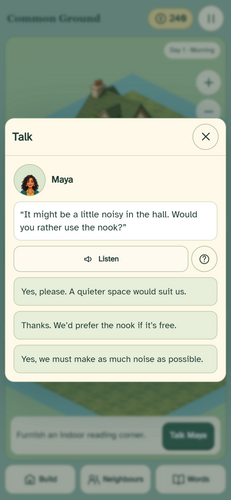
The language layer is aimed at teens and adult learners at B1–B2. English stays the target language even when another interface language is selected, and the built environment responds to what is said: making room for quiet, providing shade, arranging a meeting or deciding whether to leave out the sugar. It is a cosy, singleplayer, relaxing build rather than a graded course.
How to play
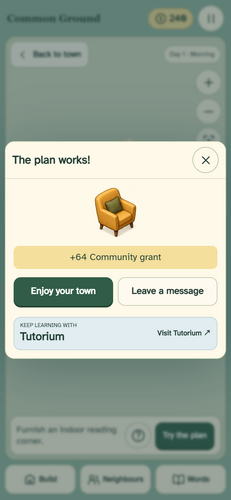
The loop begins by entering the town and talking to a neighbour. A conversation offers a reply to choose, and the chosen answer changes the actual neighbourhood rather than just advancing dialogue. Then the plan can be tried out to see whether the arrangement works, which is where reachability matters: neighbours travel to objects and use the spaces that were created.
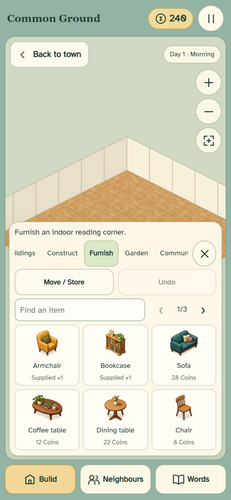
Between stories, building is free-form. Objects can be placed, moved, rotated, stored and undone, so a layout can be rearranged without committing to it. Supplied task items and full refunds keep experimentation comfortable, and undo covers the moment when a placement turns out wrong.
Progress is structured as 36 neighbour stories across six chapters. Assistance comes in guided, balanced and independent levels, plus optional automatic fading, and the level can be changed at any time. Help is also layered into the language work through short messages, optional transcripts and translations, and later recall of expressions used earlier.
There is no proficiency test at the end and original writing is ungraded. Translation drafts have coverage and rendering checks, but native-speaker review and learner studies have not yet been completed, so the game is best treated as practice rather than a measure of level.
Controls
Input is covered by touch, mouse and keyboard, with separate layouts for phone, tablet and desktop. Building actions map onto place, move, rotate, store and undo, and those same actions carry the neighbourhood design work as well as the furnishing of rooms.
The main menu also handles language selection, offering English, Simplified Chinese, Spanish, Arabic, French and Brazilian Portuguese. English remains the target language whatever is chosen there, so interface language and the language being practised are separate decisions.
Accessibility settings sit alongside the controls: larger text, reduced motion, slower speech and separate audio controls. Speech is delivered as 108 recorded ElevenLabs v4 lines with optional transcripts and translations, which can be slowed down when the pace is difficult. Assistance settings for guided, balanced and independent help, including optional automatic fading, can also be adjusted at any time rather than locked in at the start.
| Input | Action |
|---|---|
| Mouse | Navigate menus and place, move, rotate or store objects |
| Keyboard | Play and build using keyboard input |
| Touch | Play and build on phone and tablet layouts |
Tips for your first run
Start with a conversation rather than a floor plan. Talking to a neighbour and choosing a reply sets the problem that the neighbourhood then has to solve, so the reply is where the session actually begins. Trying the plan afterwards reveals whether neighbours can reach what was built for them.
Because neighbours travel to reachable objects, paths and access deserve attention before decoration. The 64 buildable objects include homes, furniture, paths, gardens and community spaces, and a layout that reads well can still fail if the spaces cannot be used. Undo and full refunds on task items make it cheap to test a different arrangement.
Experiment with the assistance setting early. Guided, balanced and independent help behave differently, and optional automatic fading changes how support tapers, but the choice can be revised whenever it suits. Larger text, reduced motion, slower speech and separate audio controls are worth adjusting before the first long session.
Keep an occasional backup. Progress, settings and optional writing stay local in the browser, and a backup can be exported from Settings, which is the sensible habit to adopt before clearing browser data or moving to another machine.
- Talk to a neighbour first and choose a reply to set the problem
- Check that paths make objects reachable for travelling neighbours
- Try the plan before investing in a larger arrangement
- Adjust assistance, text size, motion and speech speed early
- Export a backup from Settings to keep local progress safe
Content and replayability
The story content runs to 36 neighbour stories spread over six chapters, built around Maya, Eli and Noor and their everyday problems. Each story turns a language decision into a building consequence, so replaying with a different reply produces a different neighbourhood rather than the same scene with new words.
The buildable set of 64 objects covers homes, furniture, paths, gardens and community spaces. Prefab homes have furnishable rooms and editable floors, which gives interior work a place alongside outdoor layout. Free building between stories means the sandbox does not stop when a chapter does.
Language support extends across six interface options, with English kept as the target language, and speech content includes 108 recorded lines with optional transcripts and translations plus later expression recall. There is no account, no purchases, no compulsory timers and no daily streak penalties, so returning after a break carries no cost. Progress, settings and optional writing stay local, and a backup can be exported from Settings.
Scope limits are worth knowing up front: this is a small original life simulation without a full household or career system, and original writing is not graded. The learning design uses spacing and support thresholds as heuristics rather than as a validated syllabus, and native-speaker review and learner studies are still outstanding.
Presentation and performance
The game runs as an HTML5 build in the browser with phone, tablet and desktop layouts, plus touch, mouse and keyboard input. Because it is a browser title with no account requirement, starting is a matter of loading the frame rather than installing anything, and there are no purchases or compulsory timers interrupting play.
Artwork is original illustration produced with OpenAI ImageGen, and voices use ElevenLabs v4 across 108 recorded lines. Music and effects are original procedural audio, with separate audio controls available alongside slower speech, larger text and reduced motion for players who need a calmer presentation.
Typefaces are Atkinson Hyperlegible and bundled Noto language fonts under the SIL Open Font License, a pairing suited to a readable interface across the six supported languages. Content and code were created with AI assistance, and the credits name Steven Ross of Tutorium. The host and the optional external Tutorium website each have their own privacy information, which matters because in-game progress stays local to the browser.
Cozy, relaxing and singleplayer are the stated tone, and the presentation supports that: short messages, optional transcripts and translations, and no penalty for stepping away. Performance beyond the stated browser and layout support is not documented in the available material.
Who should play it
This suits teens and adults working at B1–B2 who want English practice folded into something gentle and constructive rather than a drill. The appeal is the coupling of conversation with consequence: a reply about quiet, shade, a meeting or sugar turns into a decision about the neighbourhood, and neighbours then use what was built.
It also suits players who like furnishing and layout work without the pressure of a full life sim. Prefab homes with furnishable rooms, editable floors and 64 objects across homes, furniture, paths, gardens and community spaces offer enough material for rearranging, while free building between stories keeps sessions open-ended.
It is a poor fit for anyone wanting a proficiency test, graded writing feedback or a household and career simulation, since none of those are included. Learners who need verified native-speaker review should note that review and learner studies are not yet complete. Players who prefer no account, no purchases, no timers and no streak penalties will find the model agreeable, and the local-only progress with an exportable backup keeps the commitment low.
Screenshots
How we tested it
The build was loaded from games.debutplay.com in a headless Chromium session on ; the canvas started and no request was blocked. The guide was last checked on .
From the developer
Build a place to belong. Furnish a home, grow a shared garden and help Maya, Eli and Noor solve everyday problems. Common Ground is a free neighbourhood building and English practice game for teens and adults at B1–B2. 64 buildable objects: homes, furniture, paths, gardens and community spaces. Place, move, rotate, store and undo.36 neighbour stories across six chapters. English changes what you build: make room for quiet, provide shade, arrange a meeting or leave out the sugar.Neighbours travel to reachable objects and use the spaces you create.Choose English, 简体中文, Español, العربية, Français or Português (Brasil) on the main menu. English stays the target language.Guided, balanced and independent help, plus optional automatic fading. Change assistance at any time.108 recorded ElevenLabs v4 lines, optional transcripts/translations, short messages and later expression recall.Touch, mouse and keyboard; phone, tablet and desktop…
Frequently asked questions
Is Common Ground: English Town free to play?
Yes. It is a free neighbourhood building and English practice game, played in the browser with no purchases.
What level of English is it for?
It is designed for teens and adults at B1–B2, and it is described as practice rather than a proficiency test.
Which languages can be selected?
English, Simplified Chinese, Spanish, Arabic, French and Brazilian Portuguese are offered on the main menu, and English stays the target language.
Does it work on phones and tablets?
Yes. Touch, mouse and keyboard are supported with phone, tablet and desktop layouts.
Is progress saved to an account?
There is no player account. Progress, settings and optional writing stay local in the browser, and a backup can be exported from Settings.
How much content is there?
There are 36 neighbour stories across six chapters, 64 buildable objects and 108 recorded voice lines, with free building between stories.
What games are similar to Common Ground: English Town?
The closest matches on DebutPlay are Mit englischer Zunge – English on the Tongue, SNOWBANK, Tadaima. They share the same genre, so the controls and the pace carry over.
Something wrong or missing? Tell us. How we test games.