Simulation · New game
Mit englischer Zunge – English on the Tongue
A bilingual browser simulation in which the player leads a German community’s board through nine generations, from Germantown in 1683 to Meyer v. Nebraska in 1923, with no score.
#6 this weekAI-assisted: Code, Text
The game runs in this tab. No install, no account.
The short answer
Mit englischer Zunge – English on the Tongue is a free browser simulation about a German community in America. The board is steered through nine educational stations, deciding what the community retains: its tongue, schools, congregations, newspapers, standing, and internal bonds. Choices come from period sources, and after every station the game reveals what the real community did. It runs in German or English and takes roughly 30 to 45 minutes.
What is Mit englischer Zunge – English on the Tongue?
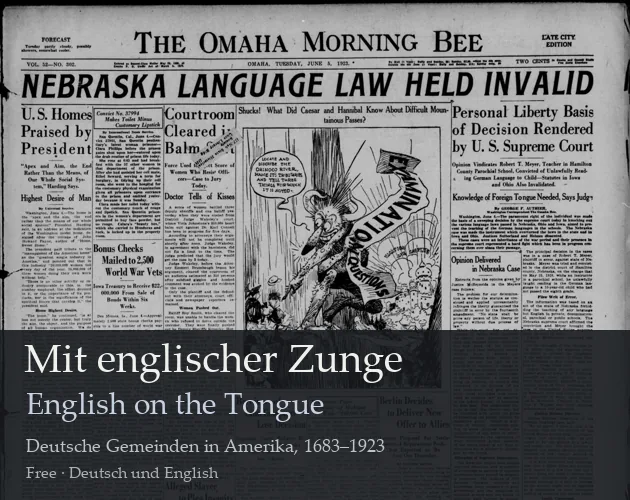
Mit englischer Zunge – English on the Tongue is a browser-based educational simulation by Pantaleon Fassbender. The player leads a German community’s board in America across nine generations. The story opens with Krefeld families founding Germantown near Philadelphia in October 1683, a town with its own court but operating under English law. Its endpoint is the 4 June 1923 US Supreme Court ruling that a Nebraska teacher could teach German to children.
Across nine stations, the player works through fixed historical conditions: laws, court rulings, wars, and immigration waves do not change. Decisions shape what the community retains—its language, schools, churches, press, reputation, and cohesion. The stations range from offices and conscience in Germantown and 1750s elections and English free schools to the 1794 petition and the Muhlenberg legend, the 1816 dispute over English worship in Philadelphia, Hermann in Missouri, the 1854 San Antonio platform, Wisconsin’s Bennett Law, the 1917–18 war, and the Zion School’s extended lunch break in Nebraska. At the close of each station, the game shows what the actual community did. There is no score. The game is free, can be switched between German and English, and plays in a browser. The expected run is 30–45 minutes.
How to play
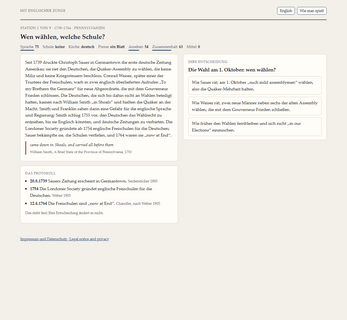
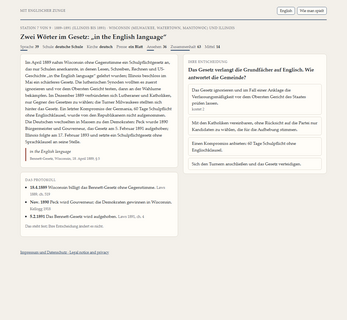
Play unfolds station by station. At each of the nine stops, the board makes a decision. The options are not invented dialogue: each one is taken word for word from primary sources, carries a reference, and was checked against page images. The historical frame stays fixed—laws, court decisions, wars, and immigration waves do not bend. What moves is the community’s inheritance: its tongue, schools, congregations, newspapers, standing, and internal bonds.
After a choice, the game discloses what the real community did. That comparison, rather than points, is the main feedback loop. The aim is to weigh a board’s judgment against the historical record. German and English can be switched during play, and the game runs as an HTML5 browser experience. A free source apparatus is available online. The decisions concern whether the community keeps its language, schools, churches, press, reputation, and cohesion; those consequences carry the run.
Controls
The interface uses the browser frame and a German-English language switch. The game is an HTML5 experience played in a browser, and the language can be toggled between the two versions. Decisions happen at nine stations; each station presents options tied to primary-source wording and references, and the game responds by showing the actual community’s action. Each station’s text is tied to a source passage and citation, so the interface presents reading and selection rather than reflex-driven action. The source apparatus is available online, while the companion reader is a separate PDF and EPUB product. The game’s feedback is historical comparison: after a station, the player sees what the real community did. The rest of the interaction is organized around choosing among source-backed options.
The game page does not list its controls. Check the in-game tutorial or pause menu for the current scheme.
Tips for your first run
Set aside 30–45 minutes for the full nine-station arc; this is a compact historical simulation rather than a long campaign. Use the language switch to read decisions in German or English; it changes the frame. Treat each station as a board decision, not a puzzle with a perfect score. Since there is no score, the useful comparison comes after the choice, when the game shows what the real community did. Read that reveal before moving on; it is the core feedback.
- Expect nine decision points and a fixed historical frame: laws, rulings, wars, and immigration waves do not bend.
- Weigh the six named community assets—language, schools, churches, press, reputation, and cohesion—when considering an option.
- Use the online source apparatus if a cited option raises a question about the primary record.
- Leave time for the endpoint: the 4 June 1923 Meyer v. Nebraska ruling.
- Remember that the companion reader is optional and separate from the browser game; it is not needed to play.
Content and replayability
Content is built around nine historical stations and a 30–45 minute run. The game covers Germantown in 1683, 1750s elections and English free schools, the 1794 petition and the Muhlenberg legend, the 1816 Philadelphia dispute over English worship, Hermann in Missouri, the 1854 San Antonio platform, Wisconsin’s Bennett Law, the 1917–18 war, and the Zion School’s longer lunch break in Nebraska. These are not alternate-history prompts: laws, judgments, wars, and immigration waves stay fixed. The variable is what the community keeps, grouped into language, schools, churches, press, reputation, and cohesion.
Replay value comes from trying different source-backed options and seeing how each affects those six areas, then comparing the result with the actual community’s response. The game does not use a score, so there is no ranking to beat. The German-English switch lets the whole experience be read in either language. The optional companion reader expands the material with 156 excerpts from public-domain prints, each checked against a page image and presented in its original language with a translation. One purchase includes two editions: a German-framed version of 103 pages and an English-framed version of 79 pages, in PDF and EPUB, with legends, official number series, and 19 image plates. It is edited by Pantaleon Fassbender and priced at 5 USD.
Presentation and performance
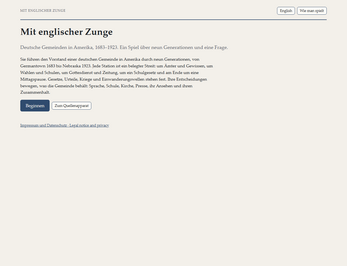
The game is delivered as an HTML5 frame in a browser. A language toggle switches between German and English. The design is documentary in structure: choices are presented with source wording and references, and each of nine stations ends with the actual community’s response. Feedback is historical comparison rather than a points tally. The source apparatus is available online. The companion reader sits outside the browser game as a PDF and EPUB publication, with two language-framed editions and 19 image plates. Four screenshots accompany the release, and the playable frame is available. The title uses a bilingual presentation, matching its subject: a German community negotiating English-language institutions. The historical stations move from Germantown in 1683 to the 1923 Meyer v. Nebraska ruling, so the presentation is organized around chronology and source comparison. The 30–45 minute runtime supports a single sitting, and the focus stays on the post-station reveal.
Who should play it
Players drawn to documentary history, immigration stories, and bilingual material are the natural audience. The game is a simulation and educational title, not an action game: the work is reading source-backed choices, making board decisions, and comparing them with the real community’s actions. German and English readers can switch languages. The nine-station arc and 30–45 minute runtime suit a single focused session. The absence of a score will appeal to players who want historical role-play rather than optimization, and may disappoint those who need a win state. The setting spans Germantown in 1683, Hermann in Missouri, San Antonio in 1854, Wisconsin’s Bennett Law, the 1917–18 war, and the Zion School in Nebraska, so it fits readers interested in German-American institutions, language politics, and immigration. The optional reader is for those who want 156 primary excerpts in two editions, with translations and 19 image plates. It is not required for the browser game.
Screenshots
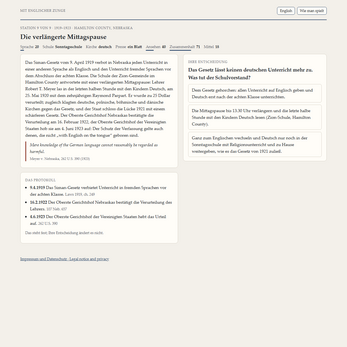
How we tested it
The build was loaded from games.debutplay.com in a headless Chromium session on ; the canvas started and no request was blocked. The guide was last checked on .
From the developer
Bleibt man deutsch? Im Oktober 1683 legten Krefelder Familien bei Philadelphia Germantown an, eine Stadt mit eigenem Gericht, aber „nach denen Englischen Gesetzen“. Am 4. Juni 1923 entschied der Oberste Gerichtshof der Vereinigten Staaten, dass ein Lehrer in Nebraska Kindern Deutsch beibringen durfte. Sie führen den Vorstand der Gemeinde durch neun Generationen: Ämter und Gewissen in Germantown, Wahlen und englische Freischulen in den 1750ern, die Petition von 1794 (und was an der Muhlenberg-Legende nicht stimmt), der Streit um den englischen Gottesdienst in Philadelphia 1816, die deutsche Stadt Hermann in Missouri, die Plattform von San Antonio 1854, das Bennett-Gesetz in Wisconsin, der Krieg 1917/18 und am Ende die verlängerte Mittagspause der Zion-Schule in Nebraska. Gesetze, Urteile, Kriege und Einwanderungswellen stehen fest. Ihre Entscheidungen bewegen, was die Gemeinde behält: Sprache, Schule, Kirche, Presse, Ansehen,…
Frequently asked questions
Is Mit englischer Zunge free to play?
Yes. The browser game is free. The optional companion reader is separate and priced at 5 USD; it is not required for play.
How long is a run?
The game has nine stations and an expected play time of 30–45 minutes.
What platforms does it run on?
It runs as an HTML5 game in a browser.
Is there a score?
No. There is no score. After each station, the game shows what the real community did, so the comparison is the feedback.
What languages are available?
The game can be switched between German and English. The companion reader comes in a German-framed edition and an English-framed edition, with source excerpts in their original language plus translation.
What is in the companion reader?
It contains 156 excerpts from public-domain prints, each checked against a page image, in the original German or English with a translation. One purchase includes a 103-page German-framed edition and a 79-page English-framed edition in PDF and EPUB, with legends, official number series, and 19 image plates. It is edited by Pantaleon Fassbender and sold for 5 USD.
What games are similar to Mit englischer Zunge – English on the Tongue?
The closest matches on DebutPlay are Pax Libera, Earthward, Somehow, Janken Football. They share the same genre, so the controls and the pace carry over.
Something wrong or missing? Tell us. How we test games.