Strategy · New game
Critterfront
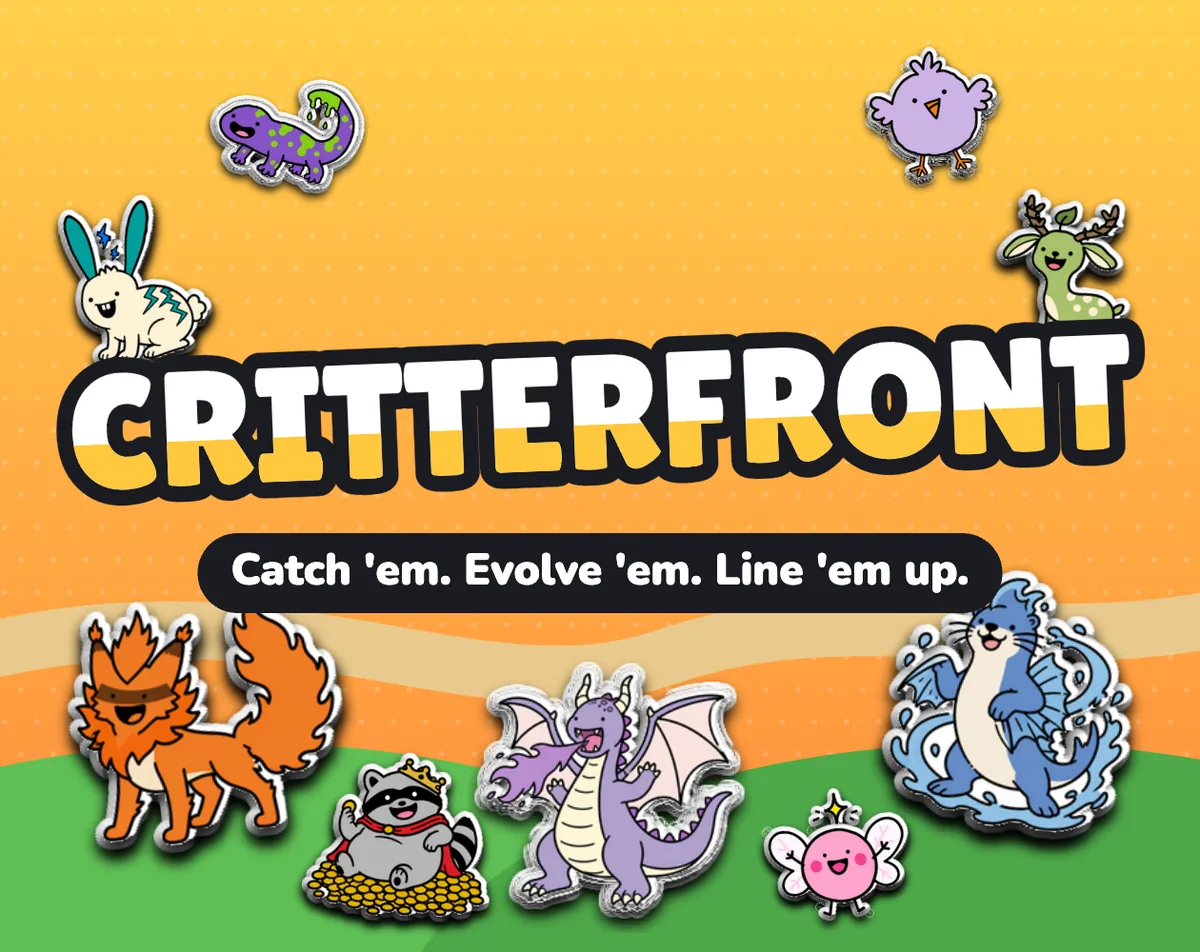
Critterfront mixes creature collecting with tower defense, asking players to defend roads, raid rivals, and evolve a party across eight regions.
#12 this weekAI-assisted: Code, Graphics, Sound, ai.textcritterfront was made with the help of generative ai. - code: the game was programmed with the ai assistant claude (by anthropic), ai.working from my design direction, ai.testing and feedback. - art: the critter sticker artwork was generated with canva's ai image tool from text prompts i wrote, ai.then curated and processed for the game. the cover image was assembled from that artwork. - writing: store page and devlog text were drafted with ai assistance and edited by me. the game design, ai.creature concepts, ai.progression, ai.balance decisions and testing are my own direction.
The game runs in this tab. No install, no account.
The short answer
Critterfront is a free HTML5 strategy game that blends creature collecting with tower defense. Choose a fire fox, water otter, or grass fawn, deploy party members on glowing tiles, level them mid-battle, and watch evolutions unfold on the field. Raid modes invert the formula, sending critters around rival loops with skills such as Shield, Freeze, and Blast.
What is Critterfront?
Critterfront is a 2D strategy game that combines creature collecting with tower defense. Its sketchbook-and-sticker look frames a campaign about defending roads with a party of critters. Players choose among three starters: a fox tied to fire, an otter tied to water, and a fawn tied to grass. From there, the journey crosses eight regions, with wild critters marching along roads while the player's team stands in as towers. The tone is cute, casual, and single-player, but the type chart gives battles a tactical spine.
The collection layer is built around 24 critter lines and 64 hand-drawn stickers. Every creature can evolve, and some evolve twice. Two legendaries wait on the late roads. Battles run on 18 types with real matchups: a fire move has the edge over leaf, water puts out fire, and earth resists spark. Across 57 stages, road defense accounts for 24 maps; rival raids add 16; arenas and hideouts contribute eight and four respectively; the Summit Four and the Paragon close the campaign. That mix gives the launch version both a defensive backbone and an attacking raid structure.
How to play
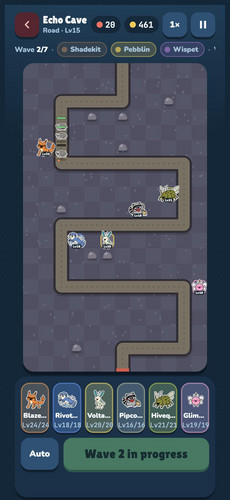
Road battles follow classic tower defense rules. A party member is selected, then a glowing tile is tapped to deploy that critter as a tower. Tapping the deployed critter on the field raises its level during the fight. Wild critters march down the roads, so placement and type matchups matter. After a road is cleared, a wild critter may wander in for capture; rare creatures have low catch rates, while flawless clears improve the odds.
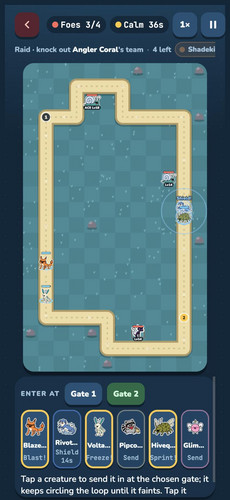
Raids flip the perspective. Instead of defending, the player attacks a rival's loop, picks a gate, and taps a critter to send it in. Tapping that critter again triggers its skill, with Shield, Freeze, and Blast named as examples. The goal is to knock out the opposing team. Arena Wardens, the Gloom Syndicate, and the Paragon appear in these raid scenarios, and the Syndicate hideouts yield Surge Shards. Arena Wardens provide gear. Those rewards feed Surge forms and team growth. Each critter's level cap rises with EXP, so repeated battles have a clear progression hook.
Controls
Critterfront uses a tap-driven interface. In road defense, the sequence is straightforward: tap a party member, then tap a glowing tile to send that critter out. Once deployed, tap the critter on the field to level it up. In raids, the pattern changes slightly. Pick a gate first, then tap a critter to send it into the loop; tap that critter again to use its skill. The same actions cover the main interactions described for both defensive and raiding modes. Because the build runs in HTML5, those taps work inside a browser window; there is no separate control scheme to learn. The game presents a portrait layout and a desktop layout, so the tap targets stay central to play. Master the two-tap rhythm and the rest of the battle flow becomes readable.
| Input | Action |
|---|---|
| Tap | Select a party member, then tap a glowing tile to deploy it |
| Tap | Tap a deployed critter on the field to level it up |
| Tap | In raids, pick a gate, then tap a critter to send it in |
| Tap | Tap a raiding critter again to use its skill |
Tips for your first run
Start by thinking about type matchups rather than raw favorites. A fire move beats leaf, water beats fire, and earth resists spark. Those three examples hint at the value of bringing a balanced party into each road. Because 18 types exist, a single starter cannot answer everything; the fire fox, water otter, or grass fawn is a beginning, not a full solution.
Use mid-battle leveling aggressively. Tapping a deployed critter to raise its level can turn a strained defense around. In raids, remember that a critter's second tap uses its skill, so Shield, Freeze, and Blast should be timed rather than spent blindly. Clear roads flawlessly when possible to improve capture odds, especially for rare critters. Spend Arena Warden gear and Syndicate Surge Shards with Surge forms in mind. Finally, progress saves automatically in the browser, but clearing browser data erases it, so avoid wiping site data until export and import arrive.
- Pick the starter that covers a gap; fire, water, and grass each answer different matchups.
- Tap deployed critters to level them mid-battle when a road starts to slip.
- Aim for flawless clears before chasing rare catches, since clean wins improve capture odds.
- In raids, pick a gate, deploy a critter, then tap again for Shield, Freeze, or Blast.
- Save Arena Warden gear and Syndicate Surge Shards for Surge forms and long-term team growth.
Content and replayability
Critterfront launches with a substantial collection and stage spread. The creature roster covers 24 lines and 64 hand-drawn stickers. Evolution is universal, and some lines evolve twice; two legendaries wait on the late roads. With 18 types and explicit matchups, team-building has more depth than a simple cute-monster theme might suggest. Catching supports the collection: after a road is cleared, a wild critter can wander in, rare ones resist capture, and flawless clears raise the chance.
The stage structure gives the campaign several rhythms. Road defense supplies the classic tower-defense core; rival raids, Arena Wardens, the Gloom Syndicate, and the Paragon invert that relationship by making the player the attacker. Arenas, hideouts, the Summit Four, and the Paragon add named milestones. Progression runs through levels, gear from Arena Wardens, and Surge Shards from Syndicate hideouts, with Surge forms as a payoff. The single-player focus keeps the loop self-contained. Replay value comes from chasing rare catches, building multiple critter lines, and testing teams against the 18-type chart rather than from a separate competitive mode.
Presentation and performance
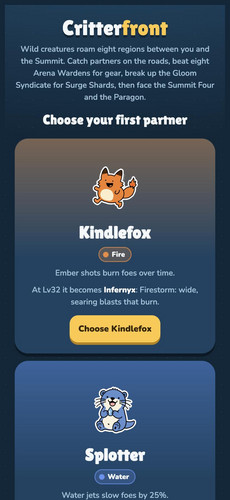
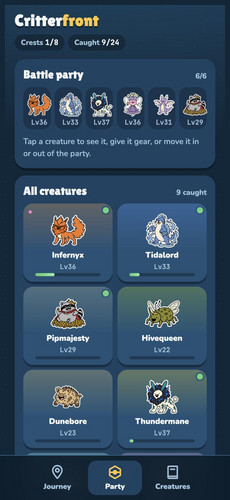
The visual identity is a sketchbook filled with stickers. Critters are drawn as hand-drawn stickers, and evolutions happen right on the field, so the collection theme carries into battle rather than sitting in a menu. The game is 2D and leans cute, with a casual tone that fits the creature-collecting side. Four screenshots accompany the launch, showing starter selection, the regional journey, road defense with an evolved team, and a raid against rivals.
Technically, Critterfront is an HTML5 browser game. Progress saves automatically in the browser, which keeps the loop frictionless, but clearing browser data erases that progress. A save export button is planned. Sound effects and music are also planned for a later update rather than included in this early release. The current build puts its attention on the sticker art, readable battlefields, and the two-mode structure of defense and raids.
Who should play it
Critterfront should appeal to players who like tower defense but want a collection hook. The three starters, 24 critter lines, mid-battle evolution, and 18-type matchup chart give team builders plenty to tinker with. Fans of cute, sketchbook-style art will find a consistent look across the 64 stickers and the on-field evolutions. Players who prefer defensive play can focus on the 24 roads; those who want offense can move into rival raids, arenas, hideouts, and the late Summit Four and Paragon fights.
It is also an early-release browser game, so the audience should be comfortable with an evolving build. The core loop is already broad: 57 stages, capture attempts after clears, gear from Arena Wardens, and Surge forms tied to Syndicate Shards. The single-player structure makes it a low-pressure pick-up game rather than a competitive commitment. Anyone who wants a finished audio package should note that sound effects and music are planned for later. The free browser entry point makes trying the fire fox, water otter, or grass fawn a low-stakes decision.
Screenshots
How we tested it
The build was loaded from games.debutplay.com in a headless Chromium session on ; the canvas started and no request was blocked. The guide was last checked on .
From the developer
Critterfront is a creature-collecting tower defense game drawn like a sketchbook full of stickers.Pick one of three partners — a fire fox, a water otter or a grass fawn — and head out across eight regions. Wild critters march down the roads; send your party out as towers, level them up mid-battle, and watch them evolve right on the field.What's inside24 critter lines, 64 hand-drawn stickers. Every creature evolves (some twice), and two legendaries hide on the late roads.18 types with real matchups. Fire burns Leaf, Water douses Fire, Earth shrugs off Spark — pick the right team for each fight.Catch what you beat. Clear a road and a wild critter wanders in to catch. Rare ones have low catch rates; flawless clears boost your odds.Defend and raid. Roads are classic tower defense. Rivals, Arena Wardens, the Gloom Syndicate and the Paragon flip it around: you send your critters around their loop, use skills like Shield, Freeze and Blast,…
Frequently asked questions
Is Critterfront free?
Yes. Critterfront is free to play in a browser. No price is attached to the HTML5 release.
What platforms does Critterfront run on?
Critterfront runs in HTML5 in a browser. The game is designed around tap controls and includes portrait and desktop layouts.
How many stages are in Critterfront?
The campaign totals 57 stages. Road defense makes up 24; rival raids add 16; arenas and hideouts account for eight and four; the Summit Four and the Paragon close out the set.
How does catching work?
After a road is cleared, a wild critter may wander in for capture. Rare critters have low catch rates, and flawless clears improve the odds.
How do raids differ from roads?
Roads are classic tower defense. Raids make the player the attacker: pick a gate, send critters around a rival's loop, tap again for skills such as Shield, Freeze, and Blast, and knock out the whole team.
Does progress save?
Progress saves automatically in the browser. Clearing browser data erases it. A save export button is planned.
What games are similar to Critterfront?
The closest matches on DebutPlay are Cast the Bones: Dice Battler, Travel & Return: The trip isn't over till you're home!, Pokémon Rumblefield. They share the same genre, so the controls and the pace carry over.
Something wrong or missing? Tell us. How we test games.