Strategy · New game
Till Peace Returns
A free browser strategy and simulation game about running a Florida phosphate company across 54 half-years, from the first Dunnellon rock to the autumn of 1914.
#20 this weekAI-assisted: Code, Text
The game runs in this tab. No install, no account.
The short answer
Till Peace Returns is a free, turn-based HTML5 strategy and simulation game about a Florida phosphate company in the Dunnellon district, 1888–1914. Across 54 half-year turns, manage land, pits, washing and drying, wages, rail and river routes, and Hamburg prices. Play it now for a compact historical management game with dated decisions and a hidden underground.
What is Till Peace Returns?
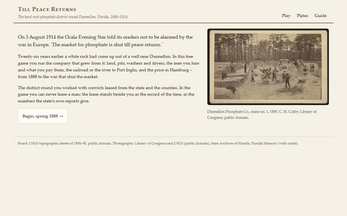
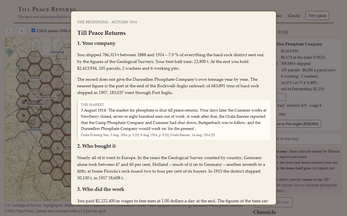
Released on 3 November 2026, Till Peace Returns is a free, turn-based strategy and simulation game set in the hard-rock phosphate district around Dunnellon, Florida, between 1888 and 1914. The player runs the company that grew from a white rock found in a well near Dunnellon twenty-six years before the Ocala Evening Star, on 3 August 1914, told readers not to panic over the European war because the phosphate market would stay shut until peace returned.
The company side is concrete: land, pits, washers and dryers, hired men and their pay, and transport. Rock can move by railroad to Fernandina or by a company line and river lighters to Port Inglis on the Withlacoochee. The Hamburg price is central because half the district's rock went to Germany.
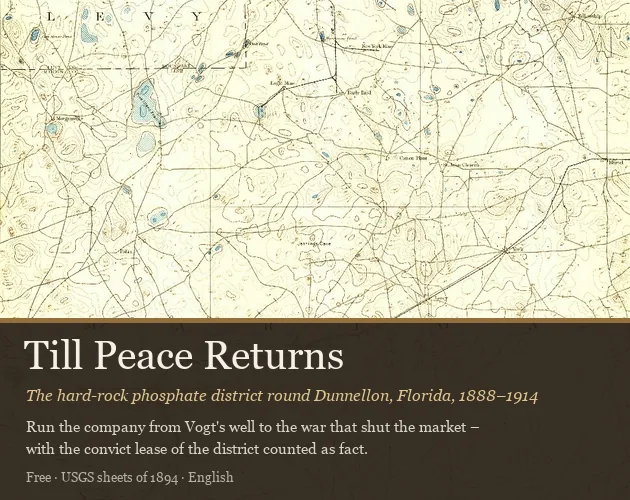
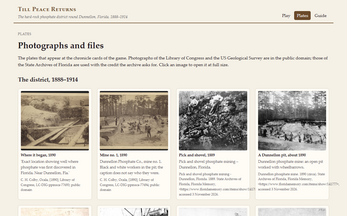
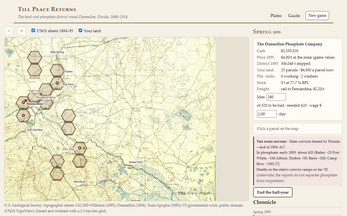
A single game covers 54 half-years, runs an hour or two, is in English, and saves in the browser. The board uses US Geological Survey sheets from 1894–95 with the mines of the time marked. The ground beneath a holding is hidden, and borings can mislead. Prices and district shipment totals follow recorded period figures. Nine plates come from the Library of Congress (1890), USGS, and the State Archives of Florida.
How to play
Each turn is half a year, spring or autumn, the two shipping seasons. Play is single-player and turn-based. The dated choices include founding the firm in 1889, attending the Ocala convention two years later, reducing pay in 1895, entering the pool in 1899, and acquiring a neighboring works in 1903. European shipping halted in autumn 1914.
The operating loop joins land and pits to processing and transport. Washers and dryers handle the rock; hired men and wage levels shape the company; the railroad to Fernandina or a company line and river lighters to Port Inglis move it. The Hamburg price links the company to a market where half the district's rock went to Germany.
The ground is not fully known. A holding's underground resource is hidden, and borings can mislead, so a cheap parcel is not a guaranteed pit. Prices and district shipment totals use period figures, while costs and chances that fall between dated figures are game values.
Controls
The turn is the main control: each advance moves through one spring or autumn shipping season. Company formation in 1889 is one dated moment when a decision is asked for; the autumn 1914 halt to European shipping is another fixed point on the timeline.
Play runs in a playable HTML5 frame. Saves are kept in the browser, so a session can be resumed without a separate launcher. The game is English-language and single-player.
Within a turn, the objects under management are land, pits, washers and dryers, hired men and their pay, the railroad to Fernandina or a company line with river lighters to Port Inglis, and the Hamburg price. The board is built on the 1894–95 US Geological Survey sheets, with period mines marked; the ground under a holding remains hidden and borings can mislead.
The game page does not list its controls. Check the in-game tutorial or pause menu for the current scheme.
Tips for your first run
Treat the first run as a lesson in two clocks. One clock is the half-year turn; the other is the dated sequence of company choices and the autumn 1914 shutdown of European shipping. The hidden ground makes early certainty dangerous, so read borings as hints, not promises. Keep the Hamburg price and the district's shipment totals in view, because half the district's rock went to Germany.
- Map the transport choice early: railroad to Fernandina or a company line and river lighters to Port Inglis.
- Do not treat a low-cost holding as proved ground; the underground is hidden and borings can mislead.
- Watch wage decisions against the dated prison counts; the company is never allowed to lease a man.
- Use the half-year rhythm: spring and autumn are the shipping seasons, so plan moves around those windows.
- Expect a compact run: 54 half-years, roughly an hour or two, with browser saves for stopping and returning.
Content and replayability
The content is one historical management game rather than a broad sandbox. A run covers 54 half-years and takes an hour or two. The dated spine includes the 1889 company formation, the 1891 Ocala convention, the 1895 wage cut, the 1899 pool, the 1903 purchase of a neighbor's works, and the autumn 1914 halt to European shipping.
The prison ledger is part of the content. The district used convict labor; the state rented out prisoners, largely Black, through contractors who passed them on to phosphate operators, and counties also hired out their own. The player's company is barred from leasing a man. At set dates, state prison counts sit beside the books: prisoners, the number assigned to phosphate work on report dates, camp deaths, and visible gaps where a report is absent. No prisoner names are shown.
At the end, the company is set against the district, the market against the war, and wages against the lease. Dunnellon in 1917 appears on a Sanborn map that marks its works as closed indefinitely. Replay value comes from testing different dated choices against that fixed record rather than from invented branches. A separate 73-page reader in PDF and EPUB is sold for 5 USD; it adds a timeline, people, and Ocala papers from 1891 to August 1914.
Presentation and performance
The visual frame is historical. The board is drawn from US Geological Survey sheets of 1894–95, with the mines of the time marked. Nine plates come from the Library of Congress (1890), USGS, and the State Archives of Florida. The end screen uses a Sanborn map of Dunnellon in 1917 that marks the works as closed indefinitely.
The game runs as a playable HTML5 frame and saves in the browser. It is English-language and built for one player. A session is short: one game of 54 half-years, an hour or two. Prices and district shipment totals use period figures; costs and chances between dated figures are game values.
Dated chronicle cards sit alongside the management view, and the prison counts appear beside the company books at their dates. No prisoner names are shown. The presentation is documentary in tone: maps, plates, dated cards, and ledgers carry the history rather than cinematic scenes.
Who should play it
This suits players who want a compact, turn-based management game with a documentary edge. The appeal is the join between company operations and a dated historical record: land, pits, washers and dryers, wages, rail and river transport, and the Hamburg price.
It also suits players interested in the Dunnellon phosphate district, Florida history, and the 1888–1914 period. The game does not let the player lease a man, and it places prison counts and camp deaths beside the books at set dates, with gaps marked and names omitted.
Players who want a quick browser strategy session get 54 half-years, an hour or two, English text, and browser saves. Those seeking action controls or a large branching campaign should look elsewhere; the design points to one focused historical game.
Screenshots
How we tested it
The build was loaded from games.debutplay.com in a headless Chromium session on ; the canvas started and no request was blocked. The guide was last checked on .
From the developer
Till Peace Returns The hard-rock phosphate district round Dunnellon, Florida, 1888–1914 — measured against the record On 3 August 1914, the Ocala Evening Star told its readers not to be alarmed by the war in Europe. "The market for phosphate is shut till peace returns." Twenty-six years earlier, a white rock had come up out of a well near Dunnellon. In this free game you run the company that grew from it: land, pits, washers and dryers, the men you hire and what you pay them, the railroad to Fernandina or your own line and lighters down the Withlacoochee to Port Inglis, and the price in Hamburg – half of the district's rock went to Germany. How it plays. Each turn is half a year, spring and autumn, the two shipping seasons. The board is the US Geological Survey's sheets of 1894–95, with the mines of the time on them; the ground under your land is hidden, and borings mislead. Prices and the district's shipments are the figures of the…
Frequently asked questions
Is Till Peace Returns free?
Yes. It is free. A separate 73-page reader in PDF and EPUB is listed at 5 USD.
How long does one game last?
One game covers 54 half-years. The stated play time is an hour or two.
What period and place does it cover?
The hard-rock phosphate district around Dunnellon, Florida, from 1888 to 1914.
Can the player lease prisoners?
No. The company is never allowed to lease a man, even though the district used convict labor and the state rented out prisoners to contractors.
How does it run in a browser?
It uses HTML5 and a playable browser frame. Saves are kept in the browser, and the game is in English.
What happens at the end?
The game compares the company with the district, the market with the war, and wages with the lease, then shows Dunnellon in 1917 on a Sanborn map marking the works as closed indefinitely.
What games are similar to Till Peace Returns?
The closest matches on DebutPlay are Critterfront, Cast the Bones: Dice Battler, Travel & Return: The trip isn't over till you're home!. They share the same genre, so the controls and the pace carry over.
Something wrong or missing? Tell us. How we test games.