Interactive fiction · New game
Damnatio: Every Thread Has a Price
Three figures from a Greco-Roman world of gods and empire are bound by the same thread, and a browser-based narrative of choices lets the player tie, cut and tangle their fates.
#37 this weekAI-assisted: Code, Graphics
The game runs in this tab. No install, no account.
The short answer
The game is a singleplayer interactive fiction set in a Greco-Roman world where gods, empire and memory share one thread. Lívia the Vestal, Asterion the Minotaur and Théron, a forgotten hero, each get a vase and a story. Chapter 1 runs in an HTML5 browser frame, costs nothing, and asks only a click to start.
What is Damnatio: Every Thread Has a Price?
Damnatio: Every Thread Has a Price is a singleplayer interactive fiction set in a Greco-Roman world where gods, empire and memory are spun from one cord. The story follows three people who should never have met, and hands the player the power to knot their fates together, sever them, or leave them snarled.
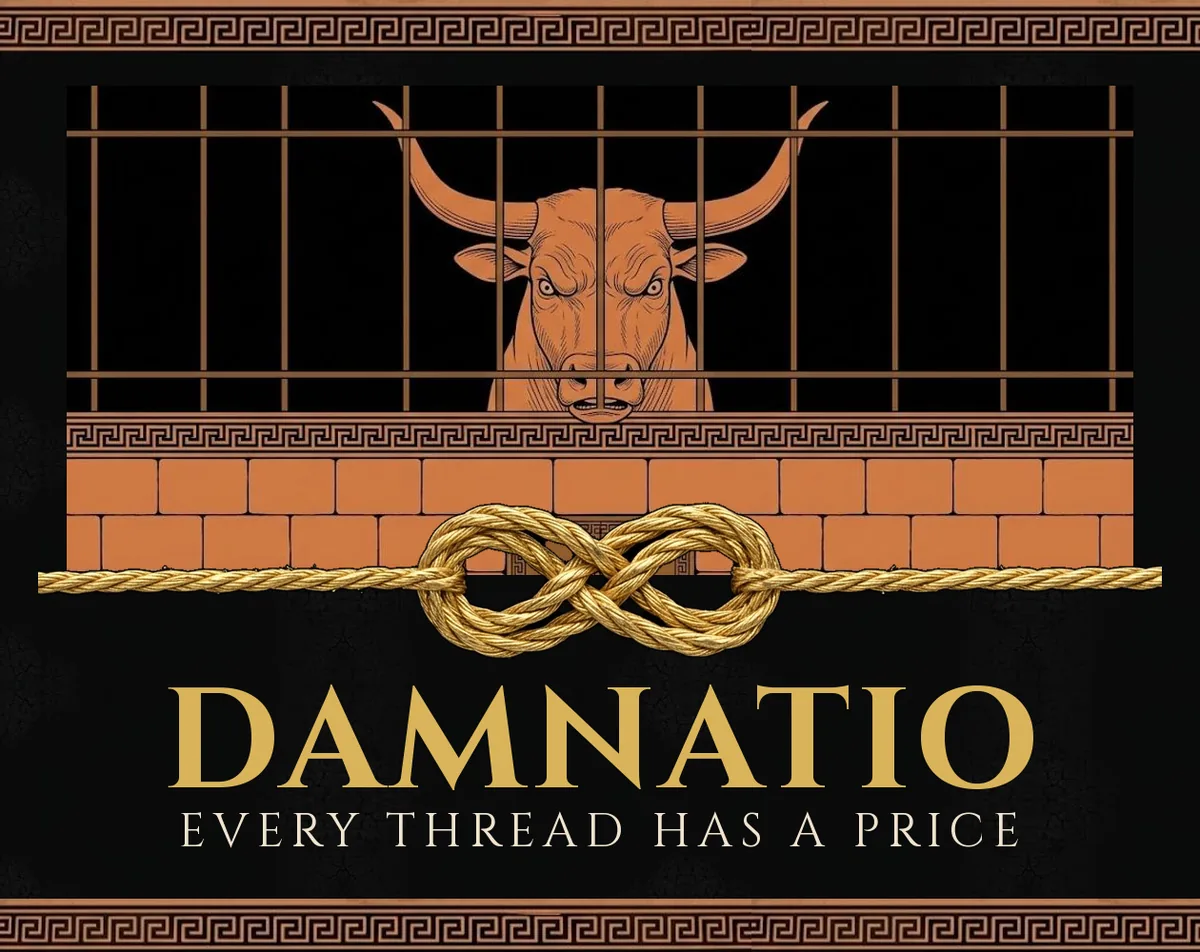
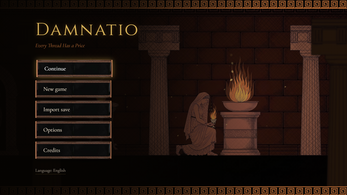
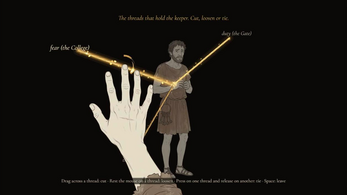
Each of the three gets a vase and a viewpoint. Lívia is a Vestal rendered in red-figure, guarding a flame that is not what it appears to be. Asterion is the Minotaur in black-figure, held behind a bronze gate and piecing together what he was before the legend swallowed him. Théron appears on a white-ground lekythos, a hero the world has forgotten, thinning out a little further with every thread he touches.
The project comes from developer jgmtz and remains in development, with Chapter 1 playable now inside a browser frame. It carries tags for 2D, atmospheric, dark, story rich and narrative, with Greek mythology, meaningful choices and multiple endings at its centre. Rather than a morality meter, the world answers through signs, and every gift has a price.
How to play
Play begins with a click, which is also what lets the sound start. The whole game runs in the browser with nothing to install, and it is built for a desktop browser driven by mouse and keyboard. Fullscreen with audio on is the recommended way to take it in.
Moment to moment, the flow is reading and deciding. Prose advances with Space or Enter, and numbered options are picked with the 1 to 9 keys; a mouse works too, so a player can click through instead of typing. Three verbs sit alongside the choices: F offers a gift, E examines what is in front of the scene, and Tab opens the threads.
Those verbs carry weight because every gift has a price. There is no morality meter tallying virtue against vice; instead the world replies through signs, so the player reads the environment rather than a bar. Scenes arrive in first person and Chapter 1 is where a first run starts today. The story is unfinished, and feedback from players is invited to shape what comes next.
Controls
Input is split between a mouse and the keyboard, and neither side is complicated. A cursor handles navigation and selection, while WASD or the arrow keys move through the interface. Space or Enter pushes the prose forward, and when a decision appears the digits 1 through 9 select the numbered option.
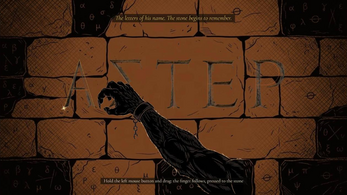
Four more keys handle the verbs that define the story. F is the gift action, the one that costs something. E examines the scene, whether that means tracing letters cut into stone or looking closer at an object. Tab brings up the threads, the connective tissue of the whole narrative, and Esc reaches the menu.
The scheme assumes a desktop browser with a keyboard, and it suits a game about reading: one hand on the number row, the other on the mouse. Sound only begins after the first click, so a player who loads the page in silence decides when to bring audio in.
| Input | Action |
|---|---|
| Mouse | Navigate and select options |
| WASD or arrow keys | Move through the interface |
| Space or Enter | Continue the prose |
| 1-9 | Choose a numbered option |
| F | Offer a gift |
| E | Examine the scene |
| Tab | Open the threads |
| Esc | Open the menu |
Tips for your first run
Go slowly through Chapter 1. The game rewards attention rather than speed, and its verbs exist for players willing to take a second look at a scene before moving on.
- Examine before acting: E is there for carved letters, curious objects and anything in a first-person scene that deserves a closer pass.
- Open the threads with Tab whenever a choice feels heavy, since the connections between the three lives are the substance of the story.
- Treat every gift as a cost. Each one carries a price, so weigh what is worth spending before pressing F.
- Number keys make decisions quick, but nothing forces haste; read the options from 1 to 9 before committing.
- Play fullscreen with sound on, and remember audio waits for the first click; keep expectations at Chapter 1, the portion playable today.
Content and replayability
Three protagonists, three vases, three angles on the same woven world. Lívia's flame, Asterion's bronze gate and Théron's fading presence are separate threads that the player tangles together, and decisions made inside one strand carry across the others. Meaningful choices and multiple endings are both part of the design, which is why a second run makes sense: a different set of answers should pull the knot another way.
The absence of a morality meter changes what replaying feels like. Instead of chasing a light or dark outcome, a player learns to read signs — a flame that behaves oddly, a hero who loses a little more of himself, a gate that stays shut. Nothing announces whether a decision was good. The world simply answers.
Content today is Chapter 1. The game carries an in-development status and player feedback is invited to shape what comes next, so the current build is a foundation rather than a finished arc.
Presentation and performance
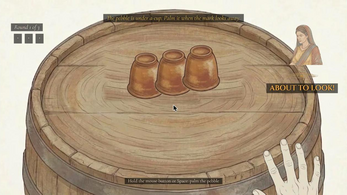
The look is the hook: art in the manner of Greek vase painting, sorted into red-figure, black-figure and a white-ground lekythos for the three leads. Scenes are staged in first person, which puts the player inside the painted world rather than watching it from outside — pouring sacred oil, tracing letters in stone, palming a pebble at the fair. The palette leans atmospheric and dark across a 2D presentation.
Rendering is HTML5 in the browser, with no install step and no download. The build targets a desktop browser with mouse and keyboard, and fullscreen plus sound is the recommended setup. Audio waits for the first click before starting, a small courtesy for anyone opening a tab in a quiet room.
Music comes from a credited set of Creative Commons tracks by independent composers, spanning harp loops, ambience and themed pieces. Art and story are credited to João Guilherme, with the graphics noted as made with AI assistance. As a browser build still in development, it is best approached as a work in progress.
Who should play it
Players who come to mythology for the monsters and the gods will find the perspective flipped: Asterion gets a voice and a memory behind his gate, and Théron is a hero the world has let go of. Anyone tired of parables with a virtue meter will appreciate a narrative that answers in signs instead of scoring. Readers of interactive fiction who like heavy choices and atmospheric prose are the core audience.
It also suits players who want to try something in a browser tab without a download, and who are comfortable with an unfinished story. The control scheme assumes a keyboard and mouse on a desktop browser, so a phone or touch-only session is not the target here.
Anyone who needs a complete arc before starting should probably wait. Anyone who enjoys being early — testing a choice system while it is still being tuned, and reading a Greco-Roman story from the underside — has a reason to click Play today.
Screenshots
How we tested it
The build was loaded from games.debutplay.com in a headless Chromium session on ; the canvas started and no request was blocked. The guide was last checked on .
From the developer
Every thread has a price. Damnatio is a narrative game of choices, painted like a Greek vase. In a Greco-Roman world where gods, empire and memory are woven from the same thread, you will tie, cut and tangle the lives of three people who should never have met. Three vases, three lives Lívia, the Vestal (red-figure): keeper of a flame that is not what it seems.Asterion, the Minotaur (black-figure): behind a bronze gate, remembering what he was before the legend.Théron (white-ground lekythos): a hero the world has forgotten, fading a little more every time he touches the threads. Features Choices that matter and multiple endingsArt in the style of Greek vase painting, with first-person scenes: pour the sacred oil, trace letters in stone, palm a pebble at the fairNo morality meter: the world answers through signs, and every gift has a priceOriginal story, mythology told from the other sidePlays in your browser, no install. Best in…
Frequently asked questions
Is Damnatio: Every Thread Has a Price free to play?
Yes. It costs nothing to play, and it runs in a browser frame with nothing to install.
What platforms does it run on?
It is an HTML5 build for desktop browsers, played with a mouse and keyboard. No mobile or touch version is part of the current release.
How much of the game can be played right now?
Chapter 1 is playable in the browser frame. The game as a whole is still in development.
Do the choices actually change anything?
The design promises meaningful choices and multiple endings across three leads whose fates can be tied, cut or tangled. There is no morality meter; the world responds through signs and every gift carries a price.
What are the controls?
Mouse or WASD and arrow keys for navigation, Space or Enter to continue, 1 to 9 to choose, F for a gift, E to examine, Tab for the threads and Esc for the menu.
Does it have sound?
Yes, and audio starts only after the first click. Fullscreen with sound on is the recommended way to play, with music drawn from credited Creative Commons tracks.
What games are similar to Damnatio: Every Thread Has a Price?
The closest matches on DebutPlay are Dating Killmulator. They share the same genre, so the controls and the pace carry over.
Something wrong or missing? Tell us. How we test games.