Puzzle · New game
Eatime
A $1.99 timeline puzzle about fitting several Chinese dishes into one small kitchen, where the order of every step decides whether service runs smooth.
#22 this weekAI-assisted: Code, Graphics, Sound, Text
The game runs in this tab. No install, no account.
The short answer
Eatime is a single-player scheduling puzzle from chenjsoul in which Chinese recipes are broken into preparation and cooking steps that must be arranged on a shared timeline. Limited cooks, workspaces and cookware force trade-offs, and serving order decides your star rating. It costs $1.99, runs in a browser or on Windows, and offers roughly 6–10 hours of puzzles.
What is Eatime?
Eatime is a scheduling puzzle from developer chenjsoul, released on 02 November 2026 for HTML5 browsers and Windows. It sits where the puzzle and strategy shelves meet: the subject is one small kitchen and a menu of Chinese dishes, and the problem is getting several of them finished and sent out without the whole service collapsing.
Nothing about it is a reflex test. Every recipe is a sequence of preparation and cooking steps, and those steps have to be placed on a timeline. Because the kitchen only offers so many cooks, workspaces and pieces of cookware, two dishes cannot simply be cooked one after another; their steps must be interlaced so that simmering, steaming and resting time is spent on the next job rather than wasted.
The game is single-player, drawn in a warm hand-drawn 2D style, and sold for $1.99. On Steam it holds a 90 percent positive review rating, which suggests the timeline juggling lands with the puzzle audience it is built for.
How to play
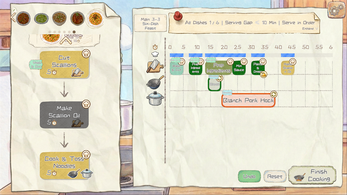
A puzzle starts with an order to fill. Each dish in that order arrives as its own sequence of preparation and cooking steps, and the job is to drag those steps onto the shared timeline and fit them together. The kitchen's resources are what make it difficult: only a set number of cooks, workspaces and cookware are available, so overlapping dishes compete for the same hands and the same equipment.
The interesting decisions come from weaving rather than stacking. While one dish simmers, steams or rests, a cook has a spare moment that has to be filled with something useful, and the game is built around spotting what that something is. There are shortcuts to hunt for as well: compatible tasks can be combined, alternative cooking methods are worth exploring, and new constraints keep arriving as progress continues, so a plan that worked earlier will not necessarily survive later.
Serving order and timing decide the outcome. Puzzles are constructed around the moment dishes are meant to reach the table, and once a plan holds together it can be refined for a three-star result. The single-player structure means the only competition is your own previous attempt.
Controls
Planning runs on a mouse drag. Individual preparation steps and cooking steps are picked up and dropped onto the timeline, then nudged around until the sequence of the whole meal holds together. That drag-and-place interaction is the core of the game, and it maps cleanly onto the subject: everything you decide in a puzzle ends up expressed as the order of steps on one shared line.
Because the game is built for HTML5 as well as Windows, the browser version loads straight into the page when you click Play, with nothing to install first. The Windows demo exists for anyone who wants to test the feel of the loop before spending anything.
Nothing more elaborate is required. There are no combo inputs, no timed button presses and no action sequences to survive; the difficulty lives entirely in the arrangement of work on the timeline and in the recipe steps that arrangement has to respect.
| Input | Action |
|---|---|
| Mouse | Drag preparation and cooking steps onto the timeline and rearrange them |
Tips for your first run
The first few puzzles will teach the basics quickly, but the habits that carry you deeper are about filling gaps rather than finishing dishes fast. Treat every idle cook as a resource that is being wasted, and treat every dish as a source of small windows that another dish can use. A short list to keep in mind while dragging steps around:
- Lay down the dish with the most steps first, then let simpler recipes fill the space around it.
- Start the next dish's preparation while something else simmers, steams or rests.
- Combine compatible tasks instead of running them separately when the timeline gets tight.
- Read the serving order before you plan, because the puzzles are built around it.
- Try an alternative cooking method when a standard sequence refuses to fit.
- Once a plan clears, revisit it and tighten the timing for three stars.
Content and replayability
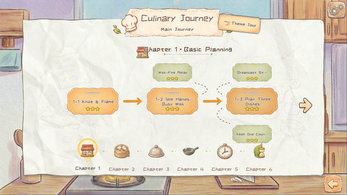
The full game is pitched at roughly 6–10 hours of kitchen puzzles, and that estimate shifts with how quickly you solve and how stubbornly you chase three stars on each one. The menu expands as you go, moving from everyday meals toward carefully coordinated banquets, and new cooking mechanics are introduced along the way rather than front-loaded.
Replay value comes from the star ratings and from the plans themselves. A puzzle that has been solved can still be solved badly, and the gap between a working timeline and an elegant one is where the extra hours go. Different approaches to the same order, including swapped cooking methods and merged tasks, give each scenario more than one shape.
A free Windows demo covers the core loop, giving a feel for planning, juggling kitchen resources and bringing several dishes together before any purchase. The full game is $1.99.
Presentation and performance
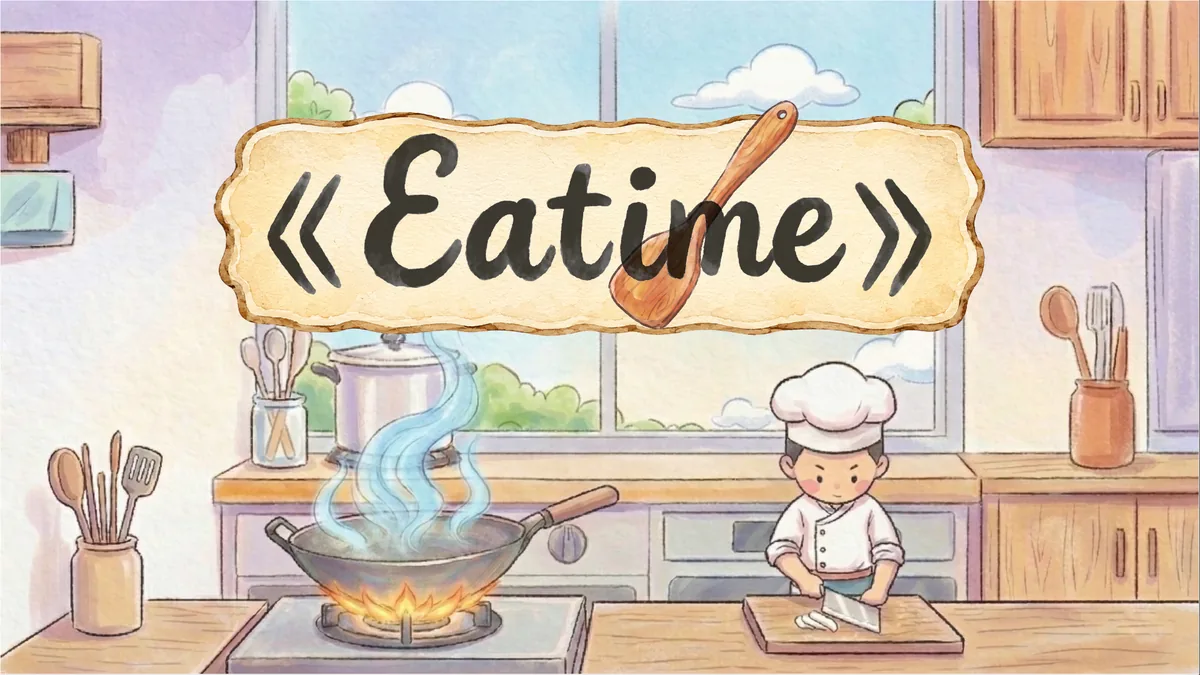
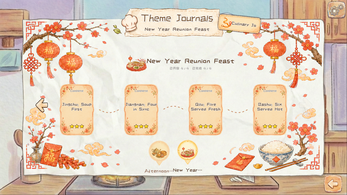
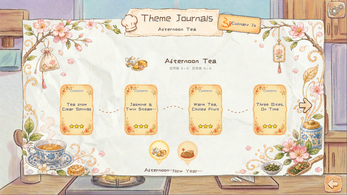
The look is warm and hand-drawn, with a 2D approach that suits the subject: a compact kitchen, a menu of Chinese dishes and a timeline that stays readable while several recipes overlap on it. Four screenshots accompany the release, and they show the same priorities the mechanics do — the food, the workspace and the schedule rather than spectacle.
Delivery is split between two options. The HTML5 build runs in the browser through a playable frame, so a session can start from the page itself, while Windows players have a downloadable version. The modest scope means the visual work is concentrated on recipe steps and kitchen equipment, which is exactly where the puzzle asks you to look.
The tone stays relaxed rather than frantic. A 90 percent positive rating on Steam suggests the presentation and the scheduling challenge hold up together for the audience that found it.
Who should play it
Eatime is for players who enjoy planning more than reacting. If the pleasure of a puzzle is in laying out a sequence, spotting where two tasks can share a moment, and then shaving a few seconds off a plan that already works, this is built directly around that instinct. Fans of cooking settings will recognise the appeal of a menu of Chinese dishes, but the actual challenge is resource scheduling, not culinary trivia.
It suits single-player sessions too. There is no opponent, no timer pressure from another person and no multiplayer commitment; the puzzles wait while you think, and the three-star targets give completionists a reason to return to a level that already works.
At $1.99 with a browser build, it is a low-risk click for anyone curious about scheduling games, and the free Windows demo lets the cautious try the core loop first. Players who need fast action or a story campaign should look elsewhere.
Screenshots
How we tested it
The build was loaded from games.debutplay.com in a headless Chromium session on ; the canvas started and no request was blocked. The guide was last checked on .
From the developer
Plan the prep. Share the stove. Bring it all to the table. Eatime is a scheduling puzzle game about the satisfying challenge of cooking several Chinese dishes in one small kitchen. 90% positive reviews on Steam How to Play Drag preparation and cooking steps onto a timeline, then work out how to fit everything together with limited cooks, workspaces, and cookware. Each recipe has its own sequence—but the secret to a smooth service lies in how you weave them together. The soup is simmering. Your cook has a moment to spare. What should happen next? A Little Kitchen. Plenty to Think About. Plan a whole meal. Coordinate dishes, follow recipe steps, and find room for everything on your timeline. Make waiting time work for you. Prepare the next dish while another simmers, steams, or rests. Find clever shortcuts. Combine compatible tasks, explore alternative cooking methods, and adapt to new constraints as you progress. Serve with good…
Frequently asked questions
How much does Eatime cost?
The full game is priced at $1.99. A free Windows demo covers the core planning loop for anyone who wants to try it before buying.
Where can you play Eatime?
It is built for HTML5 browsers and for Windows. The browser version runs in a playable frame on the page, so no download is needed to start.
Is Eatime multiplayer?
No. It is a single-player game, with puzzles that wait while you plan and no second player involved.
How long is the full game?
Roughly 6–10 hours of puzzles. The figure moves depending on your solving pace and how much time goes into refining plans for three stars.
How do you earn three stars?
Puzzles are built around serving order and timing. Once a meal comes together, the plan can be refined to earn the three-star result.
What is the core mechanic?
Preparation and cooking steps are dragged onto a shared timeline and fitted together within limited cooks, workspaces and cookware, so dishes have to be interwoven.
What games are similar to Eatime?
The closest matches on DebutPlay are Galileo Base: Forces & Motion in 3D, Bubble Tea Sort: Drink Puzzle, After Hours: The Ashgrove Museum. They share the same genre, so the controls and the pace carry over.
Something wrong or missing? Tell us. How we test games.