Action · New game
Hours of Spire
A free action roguelite where every second doubles as your health bar and your wallet, and the only way up a frozen tower is to spend them carefully.
#46 this weekAI-assisted: Code, Graphics, Sound, Text
The game runs in this tab. No install, no account.
The short answer
Hours of Spire is a free action roguelite for the browser and Windows in which seconds serve as health and currency at once. Pick the Wanderer or the Clockmaker, take a Lantern, Staff or Crossbow, and clear trial floors where shooting and dodging on the beat builds combos and buys back time.
What is Hours of Spire?
Hours of Spire is an action roguelite from NeonMoss Studio, currently in development with a 31 October 2026 date attached, and it costs nothing to play. It runs in a browser through an HTML5 build and also arrives as a Windows download.
The premise is a tower where the clock stopped. A great cog cracked, the sands quit flowing, and everything that once ticked went still. The Wanderer wakes on a stone floor, picks up a staff and starts climbing, while the Clock Guardians hold the top.
What makes the climb unusual is that time is both your health and your money. A hit does not simply dent a bar; it strips seconds off what is left of your life. A victory hands some of them back. Buying anything, from an upgrade to a rune, is paid for out of that same pool, so every purchase is a small surrender of survival. Play well and the clock stays generous. Play carelessly and it runs dry.
How to play
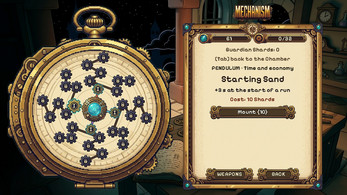
Every climb opens with a hero choice. The Wanderer begins with 30 seconds on the clock and two rune slots, which makes him the steadier option. The Clockmaker starts with only 20 seconds but carries three rune slots, and she has to be unlocked with Guardian Shards.
Weapons come in three flavours: a Lantern, a Staff and a Crossbow. They differ in how hard they hit, how quickly they fire and what abilities they bring, so the pick shapes the pace of a run rather than just its damage output.
Floors are framed as trials, and they are not all the same shape. Some throw waves of enemies at you, one is a race away from the clock itself, and others are a siege, a crystal-gathering job or a platform climb that ends at a portal. Combat ties into the soundtrack: firing in time with the music stacks an endless combo, and dodging on the beat is how seconds are won back. Tickers, Cuckoos, Chimes, Mirrors and Second Thieves will not politely wait for you to settle in.
Controls
Hours of Spire is a keyboard-and-mouse game. WASD moves the hero, the mouse aims, and the left button fires whatever weapon is equipped. Space jumps and Shift dodges; the dodge is worth practising in tempo, since a well-timed one returns time rather than merely avoiding a hit.
Runes sit on Q, E and R. F handles conversation, Tab opens the mechanism, and Escape pauses the action. Because the whole economy runs on seconds, the beat-timed shot and the beat-timed dodge are the two inputs that decide how long a run lasts. Movement, aim and fire are the baseline, and runes are the emergency tools you spend when a floor turns hostile.
The browser build needs no installation before a first climb, while the Windows version arrives as an installer that places a desktop shortcut. Practise the movement and dodge keys early, since a mistimed Shift costs more here than a mistimed shot.
| Input | Action |
|---|---|
| W A S D | Move |
| Mouse | Aim |
| Left mouse button | Shoot |
| Space | Jump |
| Shift | Dodge |
| Q E R | Trigger the three rune slots |
| F | Talk |
| Tab | Open the Mechanism |
| Esc | Pause |
Tips for your first run
The opening minutes reward caution more than aggression, because every purchase and every mistake draws from the same reserve of seconds. A few habits make the first climb considerably less punishing.
- Take the Wanderer first. The extra 10 seconds at the start and the simpler two-slot loadout leave more room to learn the beat timing.
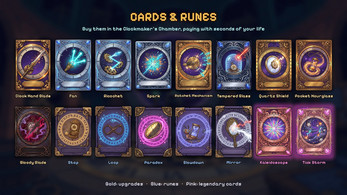
- Treat the Card Altar as a health decision, not a shopping trip. Upgrades and runes are bought with your own time, so the more you buy, the less of it you keep.
- Read the Second Thief's offer carefully. Borrowed time and cursed cards always come with a share taken back later.
- Fuse rather than hoard. Two matching cards combine into a legendary one, which is a better use of a slot than two duplicates.
- Shoot on the beat to keep a combo alive and dodge on the beat to reclaim seconds. The rhythm layer is the fastest way to refill a thinning clock.
- On the tenth floor, jump the Clockwork Golem's shockwave and then hit the exposed core before it closes again.
Content and replayability
The structure is built for repeated climbs rather than a single pass. Eight floor types cover everything from arenas and sieges to vaults and events, and the trials within them range across enemy waves, a race against the clock, a siege, crystal gathering and a platform route to the portal.
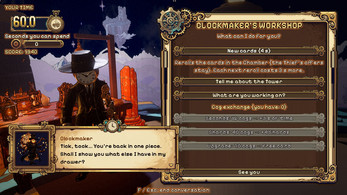
Between floors you rest in the Clockmaker's Chamber. The Card Altar sells upgrades and runes, the Second Thief trades in borrowed time and cursed cards, and matching pairs of cards fuse into legendaries. Three portals lead onward, each offering a different floor, map, reward and modifier, so the route upward is a decision rather than a corridor.
Progress also accumulates outside a single run. The Clockmaker is unlocked with Guardian Shards, giving a second hero with a thinner clock and a wider rune loadout once she is available. The Mechanism holds 32 cogs, three weapons cover the combat styles, and the tenth floor is guarded by the Clockwork Golem. That combination of branching routes, card fusion and a delayed boss gives each climb a different shape and a clear target to aim at.
Presentation and performance
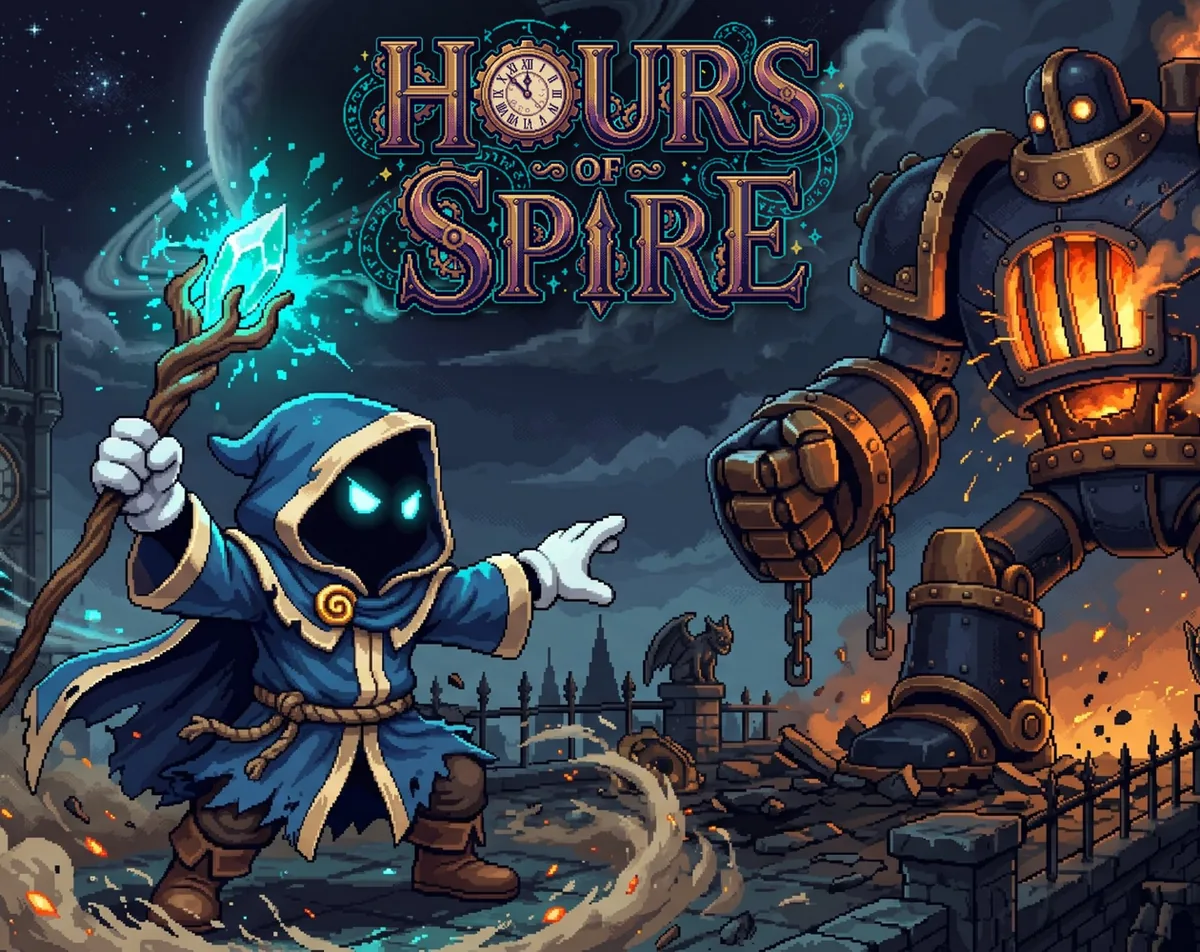
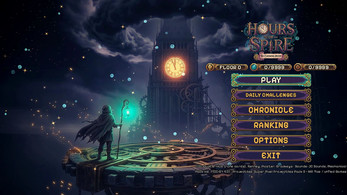
The look is pixel art, built in Godot, with a hand-animated intro and cutscenes bookending the climb. Text and voice work are offered in English and Polish, so the story of the cracked cog and the stalled sands is readable in either language.
The two platforms are not identical. The browser version starts instantly but runs lighter graphics, dropping volumetric fog and using fewer lights. The Windows build is the fuller presentation, delivered as an installer with a desktop shortcut.
Windows may flag that installer with a SmartScreen warning. The route through it is to click More info and then Run anyway. Anyone who wants the quickest possible first look should stay in the browser; anyone who wants the atmosphere the art is aiming for should take the download.
Neon Moss Studio is also collecting feedback by email, which suggests the presentation and balance are still moving as development continues toward the 31 October 2026 date.
Who should play it
This is a game for players who like a roguelite with a blade against their throat. The seconds-as-currency rule means there is no comfortable hoarding phase: every upgrade is a gamble that the time you spend now pays back before the clock empties.
Rhythm-game players have a second way in. Shooting and dodging to the beat is not decoration, it is the engine behind combos and refunded seconds, so anyone who enjoys locking into a soundtrack will find the timing layer more than cosmetic.
It also suits people who want a quick browser session without installing anything, with the Windows build held back for when the mood calls for fog and lights. Fans of branching routes will find the three-portal choice between floors, each with its own floor, map, reward and modifier, the most interesting decision in the game.
Players who prefer a fixed, hand-built campaign with a set difficulty curve may find the run-based structure and the draining clock less relaxing. Anyone curious can try it at no cost, since the game is free.
Screenshots
How we tested it
The build was loaded from games.debutplay.com in a headless Chromium session on ; the canvas started and no request was blocked. The guide was last checked on .
From the developer
Every second is your life. And your coin. Climb a tower where time has stopped. Every hit takes seconds away, every victory gives them back. The more you buy, the less time you have. A Tower Where Time Stood Still Once everything here was ticking. Then the great cog cracked and the sands of time stopped flowing. The Wanderer wakes up on a stone floor, grabs a staff and heads up. The Clock Guardians wait at the top, and on every floor something wants to steal his last seconds. Pick Your Hero and Weapon Wanderer 30 s at the start and 2 rune slots. A safe pick for any climb. Clockmaker only 20 s at the start, but 3 rune slots. Unlock her with Guardian Shards. Lantern, Staff, Crossbow three weapons with different damage, pace and abilities. Fight Time in the Arenas Every floor is a different trial: waves of enemies, escaping the clock, a siege, crystal gathering or a platform climb to the portal. Shoot to the beat of the music to build an…
Frequently asked questions
Is Hours of Spire free?
Yes. The game costs nothing to play, on either the browser build or the Windows download.
What platforms can run it?
An HTML5 version that plays in the browser and a Windows build. No other platforms are listed for the game.
How does the browser build differ from the Windows download?
The browser version starts instantly but uses lighter graphics, with no volumetric fog and fewer lights. The Windows installer delivers the full presentation and adds a desktop shortcut.
How do you unlock the Clockmaker?
She is unlocked with Guardian Shards. Once available, she starts each climb with 20 seconds on the clock and three rune slots instead of the Wanderer's 30 seconds and two.
What waits on the tenth floor?
The Clockwork Golem. Jump over its shockwave, then shoot the exposed core before it closes again.
Which languages are supported?
English and Polish, covering the hand-animated intro and the cutscenes.
What games are similar to Hours of Spire?
The closest matches on DebutPlay are MEATGRINDER, Last Light, ONE SECOND LEFT. They share the same genre, so the controls and the pace carry over.
Something wrong or missing? Tell us. How we test games.