Adventure · New game
Living Dioramas
A free browser prototype turns four African cities into miniature worlds where players shift weather and time, explore landmarks and follow stories, including a playable missing-recording mystery.
#43 this weekAI-assisted: Code, Sound, Text
The game runs in this tab. No install, no account.
The short answer
Living Dioramas is a free browser prototype that turns four African cities into miniature dioramas. Rotate each world, zoom in, change weather and time, and click buildings to open stories. Three cities offer narrative trails, while Addis Ababa adds a playable mystery about a missing recording. It suits players who want calm exploration with a detective hook.
What is Living Dioramas?
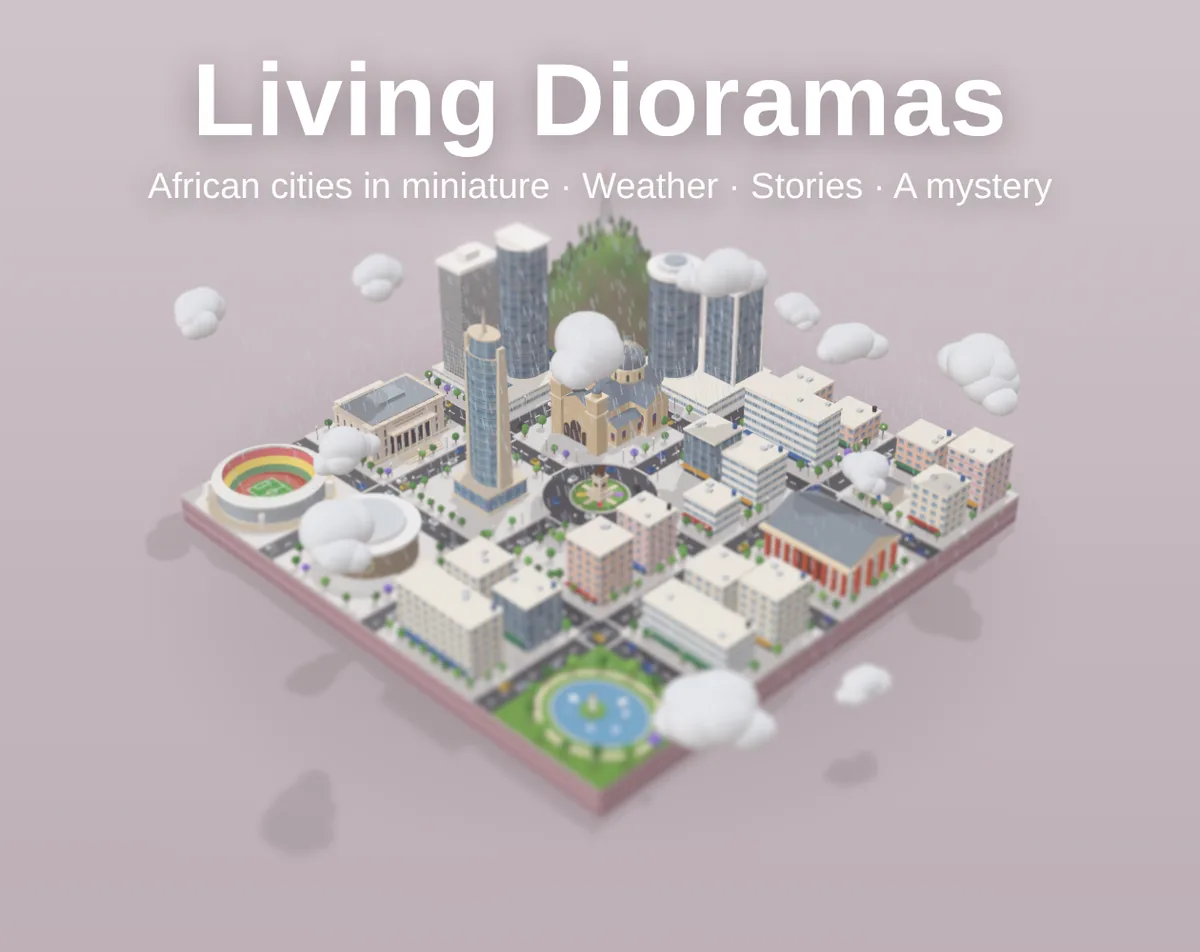
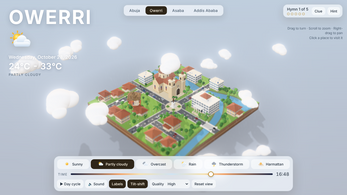
Living Dioramas is a free browser-based adventure prototype from dejeffo. It presents African cities as small 3D scenes that can be handled like tabletop models: rotated, zoomed and inspected. The four settings are Abuja, Owerri, Asaba and Addis Ababa. Rather than treating each city as a static backdrop, the game lets players alter conditions around it: sunlight, cloud, rain, thunderstorms and dry-season haze are available, and a time control can move the scene toward evening so the city lights appear. Buildings are entry points. Selecting one opens the story attached to that place.
Abuja, Owerri and Asaba carry narrative trails, while Addis Ababa contains a playable mystery. The project is explicitly a prototype. Its characters and personal stories are fictional, and some buildings are artistic interpretations rather than exact copies. Real landmark information has been checked against public references, which matters for players interested in the places behind the dioramas. The result is less a conventional action adventure than a compact exploration toy with storytelling and detective work layered onto recognizable city details.
How to play
Play begins with a city diorama. Dragging rotates the model, while zooming moves closer to rooftops, streets and landmarks. Clicking or tapping a building is the main action: each selected structure can reveal the story held inside it. The weather selector changes the atmosphere among sun, cloud, rain, thunderstorms and dry-season haze; the time slider or Day cycle option changes the light and brings out night illumination. Abuja's trail is The Surveyor's Notebook, a grandfather's account of building a capital from nothing. Owerri's trail is The Choir Book, which contains five hymns left by a mother. Asaba's trail is The Ferryman's Ticket, built around four crossings of the River Niger.
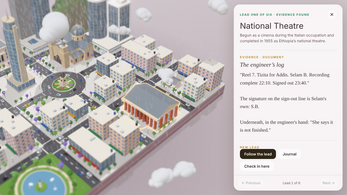
Addis Ababa is different because it contains The Lost Tizita, a playable mystery. In March 1963, a singer recorded one song at the National Theatre, and the tape vanished that same night. Six leads spread across the city; evidence is gathered in a journal. The case asks players to work out who concealed the tape, its location and the motive. Solving it causes the song to play.
Controls
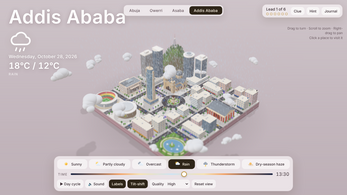
Living Dioramas uses direct manipulation rather than a complex command set. Drag to rotate the city model. Scroll with a mouse wheel or pinch on a touch screen to zoom. Right-drag to pan across the scene. Click or tap a building to visit it and open its associated story. These inputs work for both desktop and mobile browser play, so the same basic actions apply whether using a mouse or touch. The bottom panel also contains a Quality setting. If the device runs hot, setting Quality to Low is the remedy.
Weather and time are changed through the on-screen controls: the weather choices cover cloud, sun, rain, thunderstorms and dry-season haze, and the time slider or Day cycle button moves the city through changing light. Sound can be turned on for live-generated rain, wind, birds, traffic and thunder. The control scheme is intentionally lightweight, keeping attention on rotating, inspecting and selecting buildings.
The game page does not list its controls. Check the in-game tutorial or pause menu for the current scheme.
Tips for your first run
Pick one city and treat its trail as a reason to open buildings rather than trying to see everything in a single pass. Abuja's Surveyor's Notebook follows a grandfather's account of building a capital; Owerri's Choir Book preserves five hymns left by a mother; Asaba's Ferryman's Ticket is organized around four crossings of the River Niger.
In Addis Ababa, The Lost Tizita is a case to solve: gather the six leads, check the journal, then decide who hid the tape, its location and the motive. Use the time slider or Day cycle to compare daylight with the lit-up night city. Try the weather choices to see how rain, thunderstorms, cloud, sun and dry-season haze alter the mood. If the device runs hot, switch Quality to Low.
- Rotate first, then zoom, to keep track of the miniature layout.
- Open one building at a time so each story detail is easier to place.
- Use the journal before making the final deduction in The Lost Tizita.
- Test the night view with the time slider or Day cycle.
- Lower Quality if the device runs hot.
Content and replayability
Four cities provide the content frame. Abuja's diorama includes Aso Rock, the National Assembly and the National Mosque. Owerri features Maria Assumpta Cathedral, an Mbari house and a pair of rivers. Asaba is built around the old jetty, the mall and the River Niger with its bridge. Addis Ababa spreads across Entoto, Tewodros Square, Friendship Park and the AU Conference Center, with Holy Trinity Cathedral and the National Theatre also among its locations.
The trails give each city a distinct narrative anchor: a grandfather's account of constructing a capital in Abuja, five hymns left by a mother in Owerri, and four river crossings in Asaba. Addis Ababa carries The Lost Tizita, which begins with a singer recording one song at the National Theatre in March 1963 and the tape disappearing that night. Six leads, a journal and a final deduction about the person who hid the tape, its location and the motive make it the clearest investigative thread. Replay value comes from revisiting dioramas under different weather and lighting, opening buildings that were skipped, and comparing the city at day and night. The prototype status means the four settings should be approached as compact experiences rather than a finished campaign.
Presentation and performance
The presentation is built around the miniature idea: cities are small enough to rotate in the hand, yet detailed enough to contain named landmarks and building-level stories. Weather is not cosmetic background only; cloud, rain, sun, thunderstorms and dry-season haze change the atmosphere, while the time slider and Day cycle let the city light up at night. Sound is generated live, covering rain, wind, birds, traffic and thunder, so the audio layer shifts with conditions rather than sitting as a fixed track.
The project uses Three.js and runs in an HTML5 browser frame. It works on desktop and mobile browsers, which makes the touch-friendly zoom and tap controls relevant. Performance guidance is direct: if the device runs hot, set Quality to Low in the bottom panel. The visual treatment is interpretive rather than a replica survey; some buildings are illustrative versions. That choice fits a prototype focused on mood, recognition and story rather than architectural exactness.
Who should play it
Living Dioramas is aimed at players who enjoy exploration, atmosphere and small-scale mystery more than pressure. The four cities invite slow inspection: rotating a model, changing the weather, moving the time slider and opening buildings to find a grandfather's notebook, a mother's hymns, a ferryman's crossings or a missing recording. Detective-minded players have the clearest hook in Addis Ababa, where six leads and a journal lead to a deduction about a vanished tape.
Players interested in African urban settings will find Abuja, Owerri, Asaba and Addis Ababa treated as recognizable places with landmarks, not generic backdrops. The calm pace of rotating, shifting weather and discovering stories suits the relaxing mood. Those who like miniature worlds, gentle discovery and a case to solve are the natural audience.
Screenshots

How we tested it
The build was loaded from games.debutplay.com in a headless Chromium session on ; the canvas started and no request was blocked. The guide was last checked on .
From the developer
Living Dioramas turns African cities into tiny living worlds you can hold in your hand. Turn them, zoom in, change the weather and the time of day, and click on buildings to discover the stories inside them. Four cities Abuja: the National Mosque, Aso Rock and the National Assembly. Follow The Surveyor’s Notebook, a grandfather’s story of building a capital from nothing.Owerri: Maria Assumpta Cathedral, two rivers and an Mbari house. Follow The Choir Book, five hymns left by a mother.Asaba: the River Niger and its bridge, the mall and the old jetty. Follow The Ferryman’s Ticket, four crossings of the river.Addis Ababa: Entoto, Holy Trinity Cathedral, the National Theatre, Tewodros Square, Friendship Park, the AU Conference Center and more. Solve The Lost Tizita, a playable mystery. The Lost TizitaIn March 1963 a singer recorded one song at the National Theatre in Addis Ababa, and the tape disappeared that same night. Follow six leads…
Frequently asked questions
Is Living Dioramas free?
Yes. It is free and runs as an HTML5 browser game.
What platforms does it support?
It is an HTML5 browser game. It works on desktop and mobile browsers.
How many cities are included?
Four: Abuja, Owerri, Asaba and Addis Ababa.
What is The Lost Tizita?
It is the playable mystery in Addis Ababa. A singer recorded one song at the National Theatre in March 1963, and the tape disappeared that night. Players follow six leads, collect evidence in a journal, and determine who hid the tape, its location and the motive. Solving the case makes the song play.
Can weather and time be changed?
Yes. Players can switch among cloud, sun, rain, thunderstorms and dry-season haze. A time slider and Day cycle option change the light, including night illumination.
Is it a finished game?
It is a prototype. Characters and stories are fictional; some buildings are illustrative interpretations rather than exact replicas. Landmark facts have been checked against public references.
What games are similar to Living Dioramas?
The closest matches on DebutPlay are Alchademics:Abyssal Realm, MOURNSEAM, Little Orbit: A Picnic on the Breeze. They share the same genre, so the controls and the pace carry over.
Something wrong or missing? Tell us. How we test games.