Simulation · New game
Slime Glade
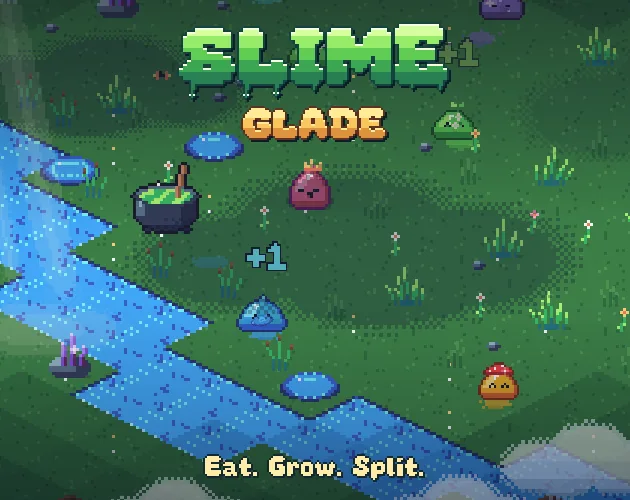
A crowned pink slime eats, splits and redraws its cloud-borne glade in a free browser incremental where colonies, cauldrons and seasons handle the slow work.
#52 this weekAI-assisted: Code, Graphics, Sound, Text
The game runs in this tab. No install, no account.
The short answer
Slime Glade is a free HTML5 incremental simulation from xKoMaRx about a crowned pink slime living on a glade in the clouds. Click food, split into more slimes, and let the colony forage while days, seasons and weather shift how fast things regrow. The demo stops at eight slimes after roughly an hour; the full version is still in development.
What is Slime Glade?
Slime Glade is a small, cozy incremental simulation set on a glade that floats in the clouds. The player starts as a little pink jelly wearing a crown, and the whole loop begins with hunger: food sits on the grass, in puddles and inside lumps of magic ore, and a click sends the crowned slime hopping over to swallow whatever was chosen.
Eat enough and the slime splits. A second slime appears, the mist pulls back, and a fresh ring of the glade opens with new food on it. That is the heart of the design: every split redraws the map instead of simply ticking a number upward.
The small slimes forage without supervision, and each one takes the shape of whatever it eats most, becoming a Mossling, a Droplet, a Rockback or a Capling. The crowned slime is the exception. It hunts insects, copies their form, reaches glimmering food the others cannot touch, and can shout to hurry the entire colony along. Slime Glade runs in a browser and is currently in development, with a free demo that is playable now.
How to play
Early play is almost entirely clicking. Grass, puddles and ore lumps are the first targets, and each bite pushes the colony closer to its next split. Once a second slime exists, the glade starts expanding on its own, because the small ones keep eating whether or not anything is clicked.
The cauldron is where experiments happen. Two slimes go in and get stirred, and the outcome is not guaranteed: sometimes a hybrid crawls out and sometimes the pair simply looks at each other. Anything that works is recorded in the recipe book for later use.
Gaia Seeds sprout on the newest ring and pay for upgrades that stay forever. The King's orders handle automation, and that automation is earned through play rather than purchased: auto-shout and auto-buy are available in the demo, with auto-split planned for a later stage of development.
Timing matters more than it first appears. Days, nights, seasons and weather all change how quickly food grows back, so the pace of the colony rises and falls. While the tab is closed, the colony keeps eating for up to eight hours at half speed.
Controls
Everything happens with a mouse. Clicking a piece of food sends the crowned slime to fetch and eat it, and clicking buttons or icons covers every other action in the game. Dragging with the right or middle mouse button moves the view across the glade, and the scroll wheel zooms in and out. No keyboard input is required at any point.
Two options soften the experience for players who need them: one reduces the number of visual effects, and another swaps in a more readable font. Buying upgrades can be set to single, ten or maximum quantities, so repeat purchases do not need to be clicked one at a time.
| Input | Action |
|---|---|
| Left click on food | Send the crowned slime to hop over and eat it |
| Left click on buttons and icons | Handle every other action in the game |
| Right or middle mouse drag | Move the view around the glade |
| Mouse wheel | Zoom in and out |
Tips for your first run
The demo is short, so a few deliberate choices early on make the hour go further. The main one is variety: what the small slimes eat decides what they become, so spreading clicks across different food types produces a broader colony than hammering a single patch.
- Steer the small slimes by choosing which food they reach most often; the diet decides whether they turn into Mosslings, Droplets, Rockbacks or Caplings.
- Keep the crowned slime on insects so it can take their shape and reach glimmering food the rest of the colony cannot touch.
- Use the shout when a burst of colony activity is worth more than waiting out the natural pace.
- Put Gaia Seeds into upgrades on the newest ring, since those purchases stay permanently.
- Try pairs in the cauldron, but expect duds; not every stir produces a hybrid, and successful results only matter once they land in the recipe book.
- Watch the numbers breakdown when production feels stuck, because it shows where the output is actually coming from.
- Plan around the cycle rather than against it, since day, night, season and weather change how fast food returns.
- Switch bulk buying to ten or maximum once individual purchases stop mattering.
Content and replayability
The free demo caps the colony at eight slimes, which comes to about an hour of play. That is a deliberately small slice, and it is built to show the shape of the loop rather than its full length: splitting, foraging, the cauldron, Gaia Seed upgrades and the King's orders are all present within that limit.
Longer-term goals sit around the edges of the demo. There are 110 achievements to chase and an album that records the slime forms discovered along the way, plus the recipe book that fills in as the cauldron produces results. The full version, still in development, adds more rings, the Heart of the Glade, new islands reached across a bridge, and growth that does not stop.
The game is available in English and Polish, and progress is saved in the browser, so a session can be closed and picked up later without an account.
Presentation and performance
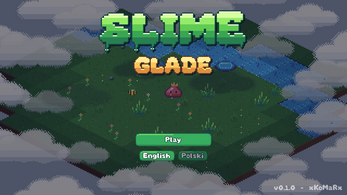
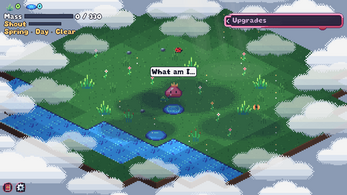
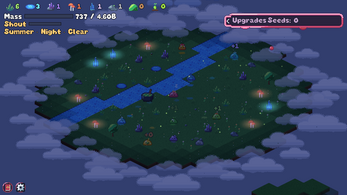
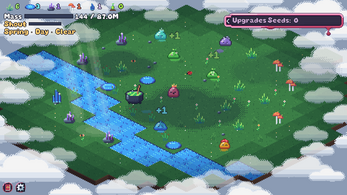
Visually, Slime Glade leans on isometric pixel art: a floating glade viewed at an angle, with small slimes hopping between food that sits on rings of grass. The palette and the pacing both aim at cozy rather than frantic, and the mood is matched by a calm soundtrack that shifts with the day, the night, winter and the cauldron.
Sound effects are built from CC0 recordings, with fonts from PixelLab and music generated with Suno; the hand-made pixel sprites were refined with scripts to fit the game's visual style. The project is made in Godot Engine and delivered as an HTML5 build, so it runs inside a browser without an install step.
There are no ads, no purchases and no sign-in, which keeps the load light and the first click close to the game. Progress lives in browser storage, and the two accessibility options for effects and font legibility are there for players who need a calmer screen.
Who should play it
This one suits players who like watching a small system turn itself: incremental and idle fans who enjoy coming back to a colony that kept working, and clicker players who want the clicks to leave a visible mark on the map rather than only on a counter.
It also fits anyone looking for a short, gentle browser session with no sign-up and no spending. The demo's eight-slime ceiling and roughly one hour of play make it an easy thing to try in a single sitting, and the seasonal regrowth plus the cauldron give tinkerers something to poke at between splits.
Players who want a finished, sprawling production chain today should note that the full version is still in development, with more rings, the Heart of the Glade and new islands planned beyond the demo's stopping point.
Screenshots
How we tested it
The build was loaded from games.debutplay.com in a headless Chromium session on ; the canvas started and no request was blocked. The guide was last checked on .
From the developer
Slime Glade is a small, cozy incremental about one hungry slime on a glade floating in the clouds. You wake up as a little pink jelly with a crown. Click the grass, a puddle or a lump of magic ore and your slime hops over and swallows it. Eat enough and you split: one more slime, the mist pulls back and the glade grows a new ring with new food on it. The small slimes forage on their own. Whatever they eat most, they turn into: a Mossling, a Droplet, a Rockback, a Capling... The crowned one is a hunter: it jumps on insects and takes their shape, it gets the glimmering food the others can't touch, and when it shouts the whole colony hurries up. Eat, grow, split — every split changes the glade, not just a number.The cauldron — drop two slimes in and stir. Sometimes a hybrid crawls out, sometimes they just look at each other. Recipes go into the book.Gaia Seeds sprout on the newest ring and buy upgrades that stay forever.Days, nights,…
Frequently asked questions
Is Slime Glade free to play?
Yes. The game carries no price and is built without ads, in-game purchases or a sign-in step, with progress stored in the browser instead of an account.
How long is the demo?
The free demo stops at eight slimes, which comes to roughly an hour of play. The full version is still in development and continues past that point with more rings and new islands.
Can it be played on a phone or tablet?
The game is an HTML5 browser build. No mobile or touch version is described, and every control is mouse-based, from clicking food to dragging the view with the right or middle button.
Does the colony keep working while the tab is closed?
Offline progress is part of the design: the colony continues eating while the player is away, for up to eight hours, at half the usual speed.
What languages are supported?
English and Polish are both available. Separately, an option swaps in a more readable font, and another reduces the number of visual effects on screen.
What does the full version add?
More rings beyond the demo's eight-slime limit, the Heart of the Glade, new islands reached across a bridge, and growth that never stops. All of it remains in development.
What games are similar to Slime Glade?
The closest matches on DebutPlay are Decision Maker, DomeLand Demo, What is PGSX. They share the same genre, so the controls and the pace carry over.
Something wrong or missing? Tell us. How we test games.