Simulation · New game
The Last Saint
A saint walks an infected walled city where twenty survivors decide for themselves whether to follow, ignore, or denounce the light that just arrived among them.
#1 this weekAI-assisted: Code, Text
The game runs in this tab. No install, no account.
The short answer
The Last Saint is a low-poly 3D survival simulation from Leonardo Guidolin in which a holy figure heals bites, blesses the brave, and revives the dead while twenty survivors make their own choices. A browser demo covers three days; the paid build runs thirty. Connect Claude, GPT, Gemini, or a local model to give each character a voice.
What is The Last Saint?
Three days have passed since the city fell, and twenty people are still breathing inside its walls. The player arrives as something other than a soldier: a saint who can close bite wounds, offer blessings to the brave, and pull the dead back from death.
The catch is authority. Nothing in the role grants direct command. Each survivor carries fear, hunger, grudges, and a personal opinion about the light that appeared among them, and that opinion decides whether the person follows, shrugs the saint off, or brands the visitor a demon.
Structurally this is a survival simulation stretched over a thirty-day siege inside a walled 3D city with four gates and a large map beyond them. The full version costs US$2 and contains all thirty days, every miracle, and all endings. A free browser demo covers the opening three days with Ascension up to level III.
Leonardo Guidolin ships it as an HTML5 build that also runs on Windows, macOS, Linux, and Android, with an offline HTML file offered for PC and Android.
How to play
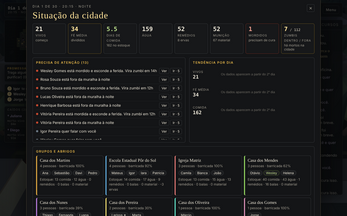
Every day of the siege asks for the same balancing act. Survivors carry health, hunger, and thirst bars above their heads, and the saint's toolkit is built around keeping those bars from emptying while fear and doubt eat away at loyalty. Healing a bite and blessing a brave follower are direct interventions; bringing back the dead is the loudest one available.
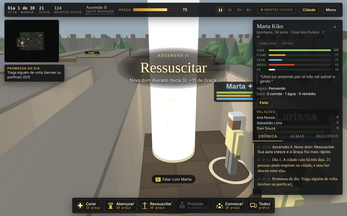
Progress runs through six Ascension levels that unlock eight miracles in total, and three hidden shrines hold secret miracles that sit outside that track. A radio tower offers a different kind of solution, since it can call in a rescue helicopter rather than holding the city indefinitely.
The map outside the walls keeps the pressure varied: zombie nests, a friendly camp, a raider gang, trader caravans, and shifting weather all compete for the same thirty days. Defeat is real and comes in several forms. Everyone can die, the faith surrounding the saint can fade, or a heretic can have the saint exiled. Three difficulty settings and seven endings, three of them losses, define how a run closes, with twenty-one achievements and a high score tracking performance across attempts.
Controls
No key map or input layout is published, so the practical answer is that the saint steers outcomes rather than bodies. Survivors act on their own read of the situation, and the visible levers are the health, hunger, and thirst bars above each of them plus the Ascension track that expands the miracle list.
That means the interface matters less than the schedule. Days pass, hunger rises, weather turns, and caravans and raider gangs move around a city with four gates. The player chooses when to heal, when to bless, when to raise the dead, and when to spend attention on the radio tower instead of the walls.
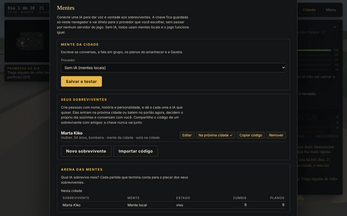
Custom survivors add a second layer of setup. A name, a story, and a personality can be written for a new arrival, and an AI can be assigned to that specific character before dropping them into the city, where they plan their own day and talk back.
The game page does not list its controls. Check the in-game tutorial or pause menu for the current scheme.
Tips for your first run
The opening stretch rewards observation more than heroics. Before spending anything, the three-day demo shows how quickly a survivor's mood can shift and how much of a day gets eaten by basic needs.
Treat the miracle list as a budget rather than a menu. Six Ascension levels gate the eight standard miracles, and the three hidden shrines sit outside that progression, so exploration pays off in abilities that a straightforward climb will never reach.
Faith is the resource that is easiest to lose and hardest to rebuild, and the heretic ending waits on the other side of that collapse. A run that ends with the saint exiled is a loss just as surely as one where the entire population dies.
- Use the free browser demo to learn the first three days and Ascension up to III before paying for the full thirty-day siege.
- Watch the health, hunger, and thirst bars together; a survivor who is fed but afraid is still a survivor who may refuse to follow.
- Hold the radio tower in mind as an alternative to an endless defense, because a rescue helicopter can end the siege differently than a miracle can.
- Search out the three hidden shrines for secret miracles that the main Ascension track does not hand over.
- Running without a connected AI still works: built-in local minds keep every survivor talking and deciding on their own.
Content and replayability
Thirty days inside a four-gate city with a large exterior map is a lot of ground for a US$2 game, and the content is spread across the map rather than stacked in one place. Zombie nests, a friendly camp, a raider gang, trader caravans, and weather each pull a run in a different direction, and six Ascension levels with eight miracles give the saint a widening set of answers.
The ending structure carries most of the replay value. Seven endings, three of which are defeats, plus three difficulty settings and twenty-one achievements mean the same thirty days can close very differently depending on which survivor was saved, which shrine was found, and whether the heretic was allowed to gather support.
Two features push it further. The Mind Arena keeps a scoreboard of which connected AI survives longest, turning the cast into a small competition, and custom survivors can be built with a written name, story, and personality, then shared with friends through a code that never carries the API key. Each shared character can be assigned a different AI and dropped into someone else's city.
Presentation and performance
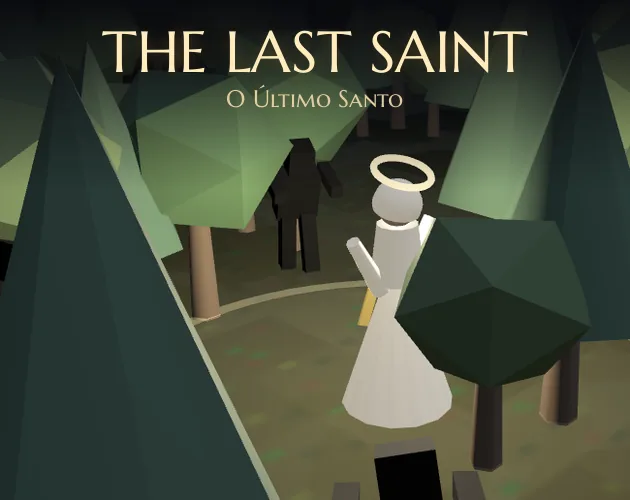
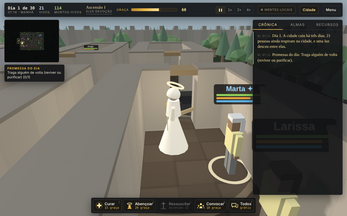
The look is deliberately low-poly and post-apocalyptic, with a walled 3D city rendered as a readable space of four gates and a wide exterior rather than a detailed simulation of streets. Weather moves across that map and changes how the siege reads from day to day, while horror sits underneath the god-game framing.
Because the whole thing runs as an HTML5 build, it plays in a browser and on desktop and mobile, with an offline HTML file that works on PC and Android without a connection. That single-file structure suits a game built around short daily decisions rather than twitch reactions.
The game is in Brazilian Portuguese, and connected survivors speak Portuguese as well. AI connections run through Anthropic, OpenAI, Google Gemini, OpenRouter, or any OpenAI-compatible endpoint, including Ollama for a model hosted on the player's own machine. Keys stay in the browser and travel straight to the chosen provider, and a character-sharing code never includes them.
Who should play it
This is a god-game for players who want influence instead of a cursor full of units. Anyone who has bounced off management games because the population felt like spreadsheets should find the setup interesting, since twenty survivors with their own fears, hunger, grudges, and faith are the actual puzzle.
The AI layer appeals to a specific kind of tinkerer. Connecting Claude, GPT, Gemini, OpenRouter, or a local Ollama model gives each survivor an individual voice for planning and arguing, and the Mind Arena turns that into a comparative experiment. Someone with no interest in API keys can ignore all of it and let the built-in local minds run the cast.
Survival players drawn to siege fiction, low-poly horror, and endings that can be lost outright are the core audience. The browser demo makes the decision cheap, and the offline file suits laptop play on Windows, macOS, or Linux, or on Android hardware.
Screenshots
How we tested it
The build was loaded from games.debutplay.com in a headless Chromium session on ; the canvas started and no request was blocked. The guide was last checked on .
From the developer
The city fell three days ago. Twenty people are still breathing — and a light just came down among them. You are not a soldier. You are a saint. You walk among the survivors, heal bites, bless the brave and bring the dead back to life. But you control no one: every survivor has fears, hunger, grudges and their own faith in you. They decide whether to follow you, ignore you or call you a demon. 🎮 Free demo in the browser (the first 3 days, Ascension up to III). Full game: US$2 — 30 days, every miracle, all endings, one offline HTML file for PC and Android. Bring your own AI Connect the AI you already use and every survivor talks, plans and argues in their own voice: Anthropic (Claude), OpenAI (GPT), Google Gemini, OpenRouter, or any OpenAI-compatible endpointOllama for a free AI running on your own computerYour key stays only in your browser and goes straight to the provider you chooseNo AI? The game still works with built-in local…
Frequently asked questions
How much does The Last Saint cost?
The full game is US$2 and includes thirty days, every miracle, and all endings. A browser demo is available at no cost and covers the first three days with Ascension up to level III.
Do you need an AI key to play?
No. Survivors fall back on built-in local minds when nothing is connected. Linking Anthropic, OpenAI, Google Gemini, OpenRouter, or an OpenAI-compatible endpoint such as Ollama gives each character a separate voice, and the key stays in the browser.
Which platforms are supported?
The game runs as an HTML5 build in a browser and on Windows, macOS, Linux, and Android, and a single offline HTML file is provided for PC and Android.
How long does a run last?
The full version spans a thirty-day siege inside a walled 3D city with four gates. The free demo stops after the first three days.
Can the saint actually lose?
Yes. Defeat arrives if everyone dies, if the faith fades, or if a heretic gets the saint exiled. Three of the seven endings are defeats, spread across three difficulty settings.
What language is the game in?
The game is in Brazilian Portuguese, and connected survivors speak Portuguese too.
What games are similar to The Last Saint?
The closest matches on DebutPlay are Machine Manager, Draft Him, UFO SALVAGE. They share the same genre, so the controls and the pace carry over.
Something wrong or missing? Tell us. How we test games.