Simulation · New game
UFO SALVAGE
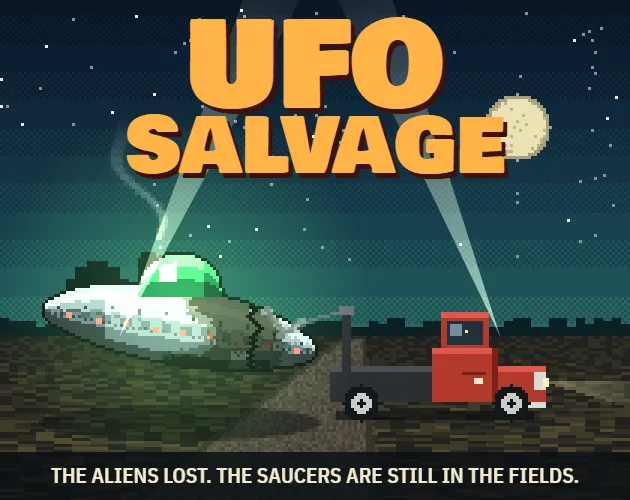
A free browser salvage game about hauling fallen saucers out of farm country, stripping them for parts and staying ahead of an Army sweep.
#4 this weekAI-assisted: Code, Graphics, Text
The game runs in this tab. No install, no account.
The short answer
UFO Salvage is a free HTML5 incremental where a farm-town salvage yard becomes the centre of a post-invasion clean-up. Choose a saucer, choose a route, send a truck, then strip the wreck and sell the parts. The Army's red line is the clock, and every saucer brought home opens the next of seven counties.
What is UFO Salvage?
The invasion lasted a weekend, and the fields are still full of hardware. UFO Salvage hands over a salvage yard in a farm town where saucers came down and nobody has cleared them away. The job is easy to state and harder to finish: haul the wrecks off the land, take them apart, and turn the pieces into money before the Army's sweep reaches them.
It is an incremental management game that runs in a browser, built around seven counties and a new saucer generation on every attempt. Wrecks do not arrive with the same set of parts twice. Core Systems Asset Factory releases it free, with progress kept in the browser instead of behind an account.
The tone is comic rather than grim: small-town nosiness, a military clean-up that treats a farmer's tow truck as a problem, and a yard that slowly turns into an operation. Under the jokes sits a routing and timing puzzle with numbers that keep climbing, from better trucks and bigger crews to faster stripping and richer buyers.
How to play
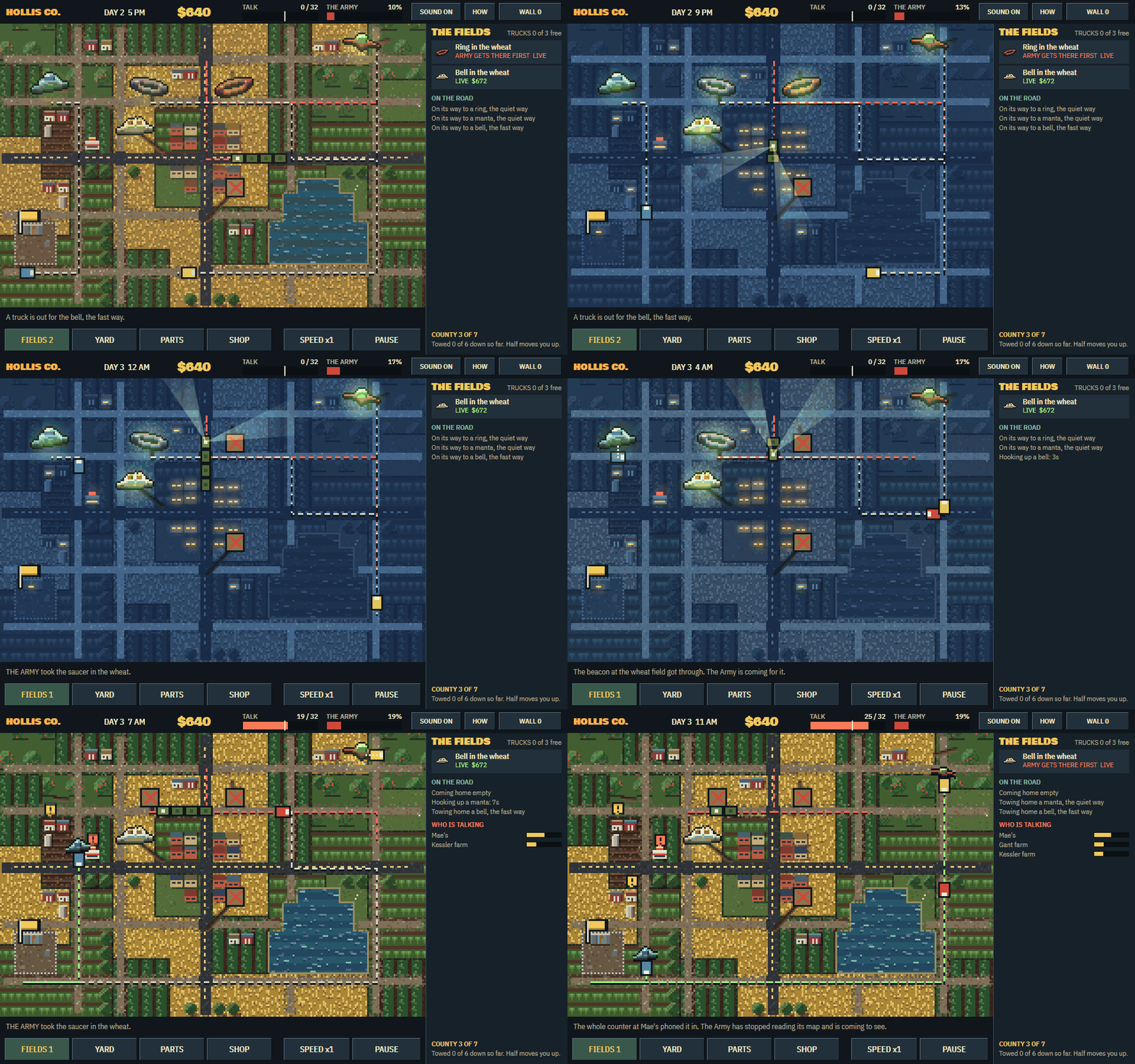
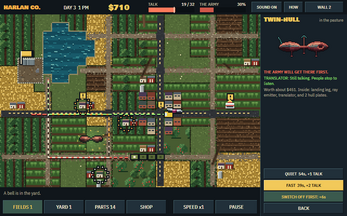
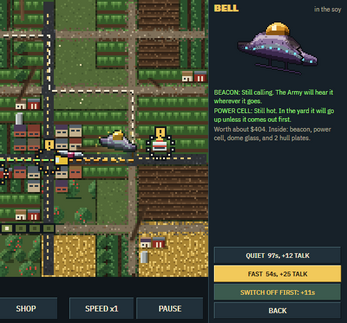
A job begins with two choices: which wreck to take and which road to use. Two routes usually exist. FAST runs the blacktop past the town and the diner; QUIET takes the gravel the long way round. The confirmation button estimates how long the trip takes and roughly how much talk it costs, and the map rings the places where the truck will be seen.
The Army is the clock. A red line works across the county and claims every saucer it reaches; when that route ends, whatever remains is collected and the county closes. Getting half of what fell back to the yard opens the next county, so a clean sweep is welcome but not required.
Talk is the other pressure. A truck that is spotted starts talk, and enough of it produces a phone call: the Army hurries, turns around to look, and after a third call in a county it comes to the yard, takes what is outside and leaves a fine. Night is the ally here, because hardly anyone is awake.
Some wrecks still have something running. Switching it off costs time; leaving it on carries its own price, whether a beacon that draws the Army to the truck, a gravity plate that floats the tow for everyone to see, or a power cell sitting on a fuse. Back at the yard, crews strip the saucers, and the Scrapyard, the University, the Museum and the Collector each pay differently, with a well-stocked buyer paying less for a while.
Controls
Everything runs on a single tap or click. Tabs, cards and menus all respond to the same input, so there is no gesture vocabulary to learn. Keyboard players get 1 through 4 for tabs, space to pause, S to change speed, M to toggle sound and Esc to close a card.
On a phone the interface rearranges itself, and upright and sideways each have a separate layout. A tap registers when the finger lifts rather than when it lands. From 360x560 in portrait or 640x320 in landscape, every word measures at least 10 CSS pixels and every control at least 24, which keeps small targets usable.
Those figures were measured on simulated phones rather than a physical handset, so the feel on any particular device may differ. The game runs inside the browser, and the keyboard shortcuts remain the quickest way to move between tabs on a desktop.
| Input | Action |
|---|---|
| Mouse or touch | Tap or click for everything, from switching tabs to closing a card |
| 1, 2, 3, 4 | Select tabs |
| Space | Pause |
| S | Change speed |
| M | Toggle sound |
| Esc | Close an open card |
Tips for your first run
The opening counties reward patience more than speed. Distance, visibility and the Army's position decide most jobs, and a few habits keep the pressure low.
Because the yard keeps working while the player is away, crews can strip a backlog without supervision, which makes short sessions productive. The wall of finished saucers doubles as a progress log.
- Take the gravel at night. A quiet road through a sleeping town keeps talk close to zero, and talk is what turns a routine tow into a search.
- Shut down live tech before the wheels turn. Losing time at the wreck is cheaper than a beacon calling the Army down on the truck.
- Count the calls. Two reports make the Army look; the third brings it to the yard, the one place where a fine really hurts.
- Rotate the buyers. The Scrapyard, the University, the Museum and the Collector price parts differently, and a buyer with plenty pays less for a while.
- Buy capacity first. Trucks, crews and a winch compound, and a false wall behind the barn, the Sheriff's Cousin, Mabel on the radio and a Foreman all take work off the player's hands.
- Settle for half. Hitting the halfway mark opens the next county, and the wall keeps a record of every saucer already stripped.
Content and replayability
Seven counties make up the run, and the last one holds the Mother Ship. Between them, the game keeps generating new wrecks from a seed, so a second attempt in a county does not replay a solved puzzle; the parts, the live tech and the risk all change.
Failure is softened deliberately. Lose a county and another appears at the same level, with money, trucks and the saucer wall carried over, so a bad night costs time rather than the whole run. That makes the incremental curve forgiving for a browser game played in short bursts.
The long game is automation. Mabel on the radio and a Foreman arrive later to handle parts of the routine, while trucks, crews and a winch raise how much can be moved at once. Replay value sits in the trade between speed, secrecy and the price of parts, and each county resets that trade with a different set of wrecks.
Presentation and performance
The look is pixel art, and every saucer is drawn by the game from a seed rather than by hand, so the shapes that end up on the wall stay varied. Music and sound are synthesised by the game's own code; the audio is not AI generated.
The code, the words and the art generators were made with AI tools, which is worth knowing when judging the writing and the visuals. The setting does the heavy lifting for tone: a diner and a small town sit on the fast route, and the county map is the main screen.
Performance claims are hard to make from a single store listing, but the interface was measured at two phone sizes with minimum text and control sizes, which suggests the layout was built to survive small screens. The pace of the game is deliberately undemanding, so a tab left open can be checked in short visits.
Who should play it
This suits players who like idle and incremental games with a management layer: short check-ins, compounding upgrades and a reason to return. The routing choice between fast and visible or slow and quiet gives each tow a small decision rather than a reflex test.
Fans of comedy aliens, pixel art and small-town settings will find the tone pitched at them, and the singleplayer focus means no scheduling around anyone else. It is free, runs in the browser and keeps progress without an account.
Players looking for action, combat or hand-built levels should look elsewhere; the opposition here is a red line on a map, a nosy neighbour and a fine.
Screenshots
How we tested it
The build was loaded from games.debutplay.com in a headless Chromium session on ; the canvas started and no request was blocked. The guide was last checked on .
From the developer
The aliens lost. The saucers are still in the fields. UFO SALVAGE is a free browser salvage incremental with 7 counties and a different generated saucer every time: tow them home before the Army gets there, strip them, and sell the parts. How it plays The invasion lasted a weekend. You run a farm-town salvage yard, and the sky is still falling. Pick a saucer, pick a road, and send a truck. Two roads. Often there are two. FAST takes the blacktop, past the town and the diner. QUIET takes the gravel the long way round. The button says about how long and about how much talk it costs, and the map rings who will see you. The Army is the clock. A red line works across the county and takes every saucer it reaches. When it finishes its route it collects what is left, and the county closes. Get half of what fell home and the next one opens. Talk costs you. A truck somebody sees starts talk. Enough talk and somebody phones it in: the Army…
Frequently asked questions
Is UFO Salvage free to play?
Yes. It is a free HTML5 browser game with no account required, and progress is saved in the browser itself.
Does it work on phones?
The interface has separate upright and sideways layouts for phones, with tap controls that register when a finger lifts. The published measurements come from simulated phones rather than a physical handset.
How many counties are there?
Seven. The final county contains the Mother Ship, and bringing home half of a county's fallen saucers unlocks the next one.
What happens if the Army finishes a county?
The county closes and is replaced by another at the same level, with money, trucks and the wall of stripped saucers kept.
Should live saucer tech be switched off?
Switching it off costs time but removes the risk. Leaving it running can call the Army to the truck, make the tow visible to everyone, or set off a power cell on a fuse.
Do crews work while the game is closed?
Crews strip saucers in the yard even while the player is away. How much progress accrues with the tab shut is not made explicit.
What games are similar to UFO SALVAGE?
The closest matches on DebutPlay are Machine Manager, Draft Him, The Last Saint. They share the same genre, so the controls and the pace carry over.
Something wrong or missing? Tell us. How we test games.