Strategy · New game
A Well-Run Exercise / Eine gut gelungene Alarmprobe
Step into Colonel von Linstow's chair in Paris during the night of 20 July 1944 and decide which orders the staff carries out before Berlin's coup collapses.
#1 this weekAI-assisted: Code, Text
The game runs in this tab. No install, no account.
The short answer
A Well-Run Exercise is a short historical strategy and interactive fiction game set in Paris on 20 and 21 July 1944. Players decide what the regiment is told, when arrests happen, who travels to Kluge, and how prisoners go free, then see the file trace and personal cost. It costs four dollars, runs in a browser, and supports English and German.
What is A Well-Run Exercise?
A Well-Run Exercise is a short historical strategy game that mixes decision-driven fiction with simulation and teaching aims. It places the player in the chief of staff's chair as Colonel von Linstow in Paris on 20 and 21 July 1944. The German Military Commander in France has a brief chance to arrest the SD and SS without gunfire while the Berlin conspirators fail to act. By midnight the situation turns: Hitler lives, Field Marshal von Kluge refuses, and the prisoners walk out again.
The game covers the afternoon word from Berlin at 16.00, the conflicting messages of the evening and night, the days after the action, and the final reckoning of orders left in the files. It is a single-player browser game with saves in the browser, English and German language support, and about forty minutes of play. It costs four dollars and runs as a playable HTML5 frame.
How to play
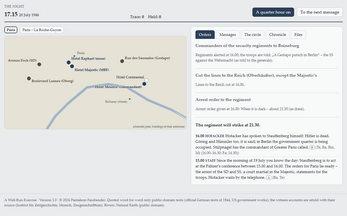
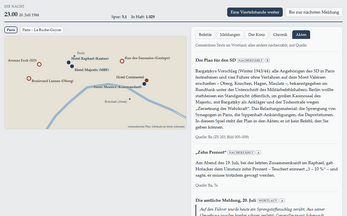
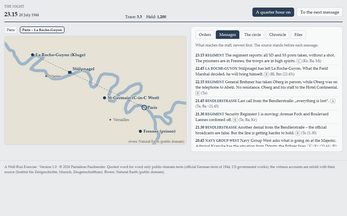
Play proceeds through the afternoon, evening and night, the days after, and the reckoning. In the afternoon, the word from Berlin arrives at 16.00. The player must alert the regiments, choose what the troops are told, cut the lines to the Reich, and select an arrest order: immediately, once darkness falls, or only after Berlin confirms. The evening and night bring messages from Hofacker, the radio, the Bendlerstraße, La Roche-Guyon, the regiment, and the navy. These messages carry their origins and contradict one another.
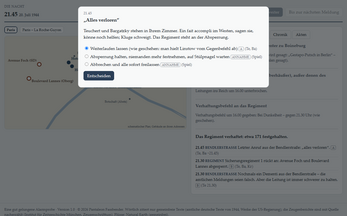
The player decides who drives to Kluge, what happens after 'everything is lost', and how the prisoners go free before the navy's deadline. The demand to shoot the SD leaders is not an order available to give. In the days after, choices concern the battalion, the safe, whom to warn, what to tell the commission, and what to advise Hofacker. The reckoning shows the trace left in the files, how heavily the night weighs on each person, and then replays the orders with thirty other dice. The Berlin night cannot be changed; only the player's orders are measured.
Controls
Command is exercised through a sequence of order choices. The first lever is the regiment: whether to alert it and what the troops are told. The second is communications: whether to cut the lines to the Reich. The third is the arrest order, with the choice of immediate action, waiting for darkness, or waiting for Berlin's confirmation. During the evening and night, further levers include who drives to Kluge, what follows 'everything is lost', and how the prisoners are freed before the navy's deadline. The demand to shoot the SD leaders is explicitly outside the orders available. Later decisions cover the battalion, the safe, whom to warn, what to tell the commission, and what to advise Hofacker. Browser saves allow a run to be resumed, and the final reckoning replays those orders with thirty other dice.
The game page does not list its controls. Check the in-game tutorial or pause menu for the current scheme.
Tips for your first run
First-run advice should stay tied to the choices the game actually presents. Treat the arrival at 16.00 as the start of a chain: alerting the regiments, framing what the troops hear, cutting the Reich lines, and setting the arrest order all shape the night that follows. In the evening, compare the messages from Hofacker, the radio, the Bendlerstraße, La Roche-Guyon, the regiment, and the navy by their stated origins. The contradictions are the material to work with. The demand to shoot SD leaders is not an available order, so planning should focus on the prisoners' route out before the navy's deadline and on who reaches Kluge. In the days after, decisions about the safe, warnings, the commission, and Hofacker carry forward. The ending measures the file trace and individual weight, then reruns the same night with thirty other dice.
- Record which origin produced each evening message, because the reports conflict.
- Decide before midnight how the prisoners can leave before the navy's deadline.
- Keep in mind that immediate arrest, arrest after dark, and arrest only on Berlin's confirmation are distinct paths.
- Prepare for the days after by considering the safe, whom to warn, what to tell the commission, and what to advise Hofacker.
- Use browser saves to revisit the reckoning and see how the same orders fare with thirty other dice.
Content and replayability
A single run takes about forty minutes. The content spans the afternoon, evening and night, the aftermath, and the reckoning. Replay value comes from the order choices and from the final replay with thirty other dice. The Berlin night remains fixed, so variation lies in what the player's orders leave in the files and in how the night weighs on each person. Browser saves make it possible to return to a run. The game is available in English and German.
Contradictions among the reports remain visible rather than being smoothed away. The final comparison places the file trace beside what happened to the people in 1944. The action is compact but dense: the arrest timing, the messages from Hofacker, the radio, the Bendlerstraße, La Roche-Guyon, the regiment, and the navy, the drive to Kluge, the prisoner release before a navy deadline, the days after with the battalion and the safe, and a final file trace. Those are the replay levers. The fixed historical frame means the Berlin outcome is not the player's to alter; the comparison is between the player's orders and the record.
Presentation and performance
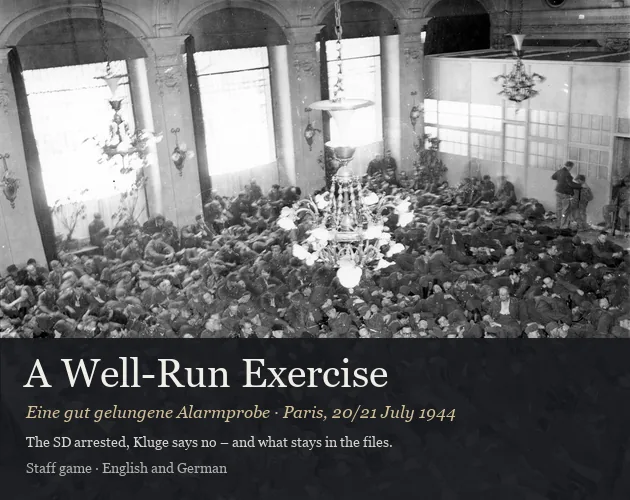
The game runs as a playable HTML5 frame, so play happens in the browser. Browser saves support returning to a run. English and German are both available. The visual layer pairs the text with plates drawn from public-domain US Army Signal Corps photographs and Musée Carnavalet images. Three public-domain texts are reproduced: the official 20 July announcement, a US Army interrogation of Kluge's son-in-law, and an OSS memorandum for President Roosevelt dated 22 July 1944. The design is document-led; the night's tension comes from messages with stated origins and from order choices. A run is about forty minutes, which keeps the scope close to the single night and its aftermath.
The historical setting is Paris on 20 and 21 July 1944, with the German Military Commander's staff at the center. The game presents the afternoon word from Berlin at 16.00, the evening and night messages, and the reckoning after orders are given.
Who should play it
Players who want to occupy Colonel von Linstow's chair will find a compact historical strategy game about staff decisions in Paris on 20 and 21 July 1944. It suits readers who enjoy interactive fiction with contradictory reports, because the messages from Hofacker, the radio, the Bendlerstraße, La Roche-Guyon, the regiment, and the navy arrive with stated origins and disagree. It also suits players drawn to management under pressure: the arrest order, the lines to the Reich, the drive to Kluge, the prisoners' release before the navy's deadline, the safe, and the warnings and statements of the days after.
A single run is about forty minutes, so it fits a short session; browser saves help with returning. English and German are available, and the game costs four dollars. Those looking for a combat simulation should note that the play is about orders, messages, and consequences rather than frontline action. The final reckoning, with its file trace and replay using thirty other dice, is for players who want to compare decisions rather than rewrite the Berlin night.
Screenshots
How we tested it
The build was loaded from games.debutplay.com in a headless Chromium session on ; the canvas started and no request was blocked. The guide was last checked on .
From the developer
A Well-Run Exercise Paris, 20/21 July 1944 On 20 July 1944, for a few hours, the staff of the German Military Commander in France did what the conspirators in Berlin did not manage: it had the SD and the SS in Paris arrested, without a shot. By midnight it was over – Hitler lived, Field Marshal von Kluge refused, and the prisoners walked out again. At three in the morning the staffs agreed over wine with the SS commander they had arrested on a form of words: „a well-run alarm exercise, agreed with the SD“. You sit in the chair of the chief of staff, Colonel von Linstow. - The afternoon: the word from Berlin comes at 16.00. Alert the regiments – and decide what the troops are told. Cut the lines to the Reich. Give the arrest order: at once, when it is dark, or only when Berlin confirms. - The evening and the night: messages from Hofacker, the radio, the Bendlerstraße, La Roche-Guyon, the regiment and the navy, each with its source –…
Frequently asked questions
What is A Well-Run Exercise about?
It is a historical strategy and interactive fiction game set in Paris on 20 and 21 July 1944. The player is Colonel von Linstow, chief of staff, and must handle arrest orders, conflicting messages, prisoner release, and the days after.
How long is a run?
About forty minutes. Browser saves allow a return to a run, and the final reckoning replays orders with thirty other dice.
What does it cost?
It costs four dollars and runs as an HTML5 frame in a browser.
Which platforms and languages are available?
It runs as an HTML5 frame in a browser. English and German are available.
Can the Berlin night be changed?
No. The Berlin night is fixed. The game measures what the player's orders leave in the files and how the night weighs on each person, then reruns those orders with thirty other dice.
Is shooting the SD leaders an available order?
No. The demand to shoot the SD leaders is not an order the player can give. Choices instead concern arrest timing, who drives to Kluge, prisoner release before the navy deadline, and later warnings and statements.
What games are similar to A Well-Run Exercise / Eine gut gelungene Alarmprobe?
The closest matches on DebutPlay are Terminal Tanks, Gig Promotor (free early playtest of first 2 seasons), ARGON DOMINATES. They share the same genre, so the controls and the pace carry over.
Something wrong or missing? Tell us. How we test games.