Simulation · New game
Forecast: Catastrophe
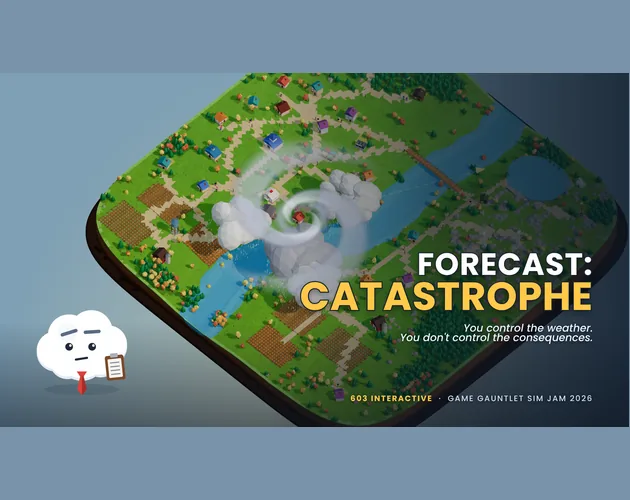
A comic god-game about managing sunshine, rain, wind and lightning over a small low-poly valley where every forecast fixes one problem and starts another.
#38 this weekAI-assisted: Code, Graphics, Sound, Text
The game runs in this tab. No install, no account.
The short answer
Forecast: Catastrophe puts the player in charge of the sky above a growing village. Four weather powers — sunshine, rain, wind and lightning — feed into farming, electricity, flooding, wildfires and villager morale. Eight handcrafted missions and a sandbox mode sit inside a browser build that needs no install, with a floating cloud named Nimbus handling the tutorial.
What is Forecast: Catastrophe?
Forecast: Catastrophe is a low-poly 3D god-game set over a small, thriving valley of hardworking villagers, farms, homes and businesses. The player holds four weather powers and applies them to a settlement that answers back. Crops wither, the lights go out, a house floats off down the river, and the blame always lands in the same place. It is a simulation and strategy game in equal measure, built around cause and effect rather than unit counts.
The systems are knotted together on purpose. Agriculture, electricity, flooding, wildfires and village wellbeing all push on each other, so a single well-aimed decision can rescue a town and a single sloppy one can create three fresh emergencies before the dust settles. Villagers work their farms, visit businesses, occupy homes and go about their routines while the atmosphere is being managed, and they have opinions about how it is going: celebration when life is good, complaints and panic when it is not. Nimbus, a floating cloud companion, guides the player through the basics with helpful instructions, questionable encouragement and thoroughly unnecessary commentary. The game is in development and runs as a free HTML5 build in the browser.
How to play
The loop is short to learn and long to master. Choose a weather power, apply it to the valley, then watch what the environment and the villagers do in response. Between those reactions sits the real work: keeping food, power and wellbeing in balance while finishing the objectives of the current mission and mopping up whatever the last decision broke.
Every power cuts both ways. Sunshine warms the valley, dries out flooded fields and helps conditions recover, but an enthusiastic sun will cook the crops in their rows. Rain grows food, restores moisture and fights wildfires, yet an oversupply turns a peaceful village into a swimming pool. Wind spins up electricity, shifts weather systems around and builds travelling fronts, and it will happily push flames somewhere far worse. Lightning charges electrical infrastructure with dramatic bursts of power, and the expensive things are exactly the ones a stray bolt tends to find.
Eight handcrafted scenarios escalate from the fundamentals of divine weather management to a river threatening to swallow a village, a blackout to reverse, an expanding community to support, a spreading wildfire to stop, a forecast full of frogs, a larger valley to keep thriving, and one final test of everything at once. Sandbox Mode strips out the campaign objectives for players who would rather experiment with the systems directly.
Controls
Play happens in a desktop browser with a mouse and keyboard, and there is nothing to install. Sound is recommended, because so much of the comedy arrives through the villagers and through Nimbus rather than through the weather itself.
The input pattern follows the fiction: select one of the four weather powers, then apply it to the valley and watch the results unfold across farms, homes, businesses and the power grid. Each application is a small experiment, and the feedback shows up in the landscape as well as in the mood of the settlement.
Because the build is still in development, treat the interface as something that can shift between sessions. The core action — pick a power, aim it, live with the outcome — is the part to learn first, since everything else in the simulation is downstream of that choice.
| Input | Action |
|---|---|
| Mouse and keyboard | Play in a desktop browser: select a weather power and apply it to the valley |
Tips for your first run
Start with the Weather Basics scenario and let Nimbus finish the guided tutorial. It introduces the four powers in a low-stakes valley where a mistake costs crops rather than a whole settlement, which makes it the cheapest place to learn how quickly consequences stack up.
Then resist the urge to do something dramatic every few seconds. The most useful habit in Forecast: Catastrophe is checking what the last change actually did before reaching for another power, because the systems are connected and a fix in one place is usually a new problem in another. A few habits worth forming early:
- Hold back on weather. More is rarely better, and sometimes the smartest move a god can make is to stop the rain and wait.
- Read the whole valley, not one field. Flooding, wildfire, power and morale all respond to the same sky.
- Use rain as firefighting first and irrigation second, and watch the water level while doing it.
- Remember that wind moves flames as easily as it moves weather systems and spins up electricity.
- Keep lightning away from anything expensive while still charging the grid.
- Take a break in Sandbox Mode whenever a mission objective starts crowding out the experimenting.
Content and replayability
The campaign is made of eight handcrafted scenarios, each aimed at a different slice of the simulation. Flood defence, blackout recovery, community growth, wildfire containment and the ultimate weather-management challenge all pull on the same systems from different angles, so the skills carry across even though the objectives change.
Sandbox Mode is where the game stretches. With no campaign objectives in the way, the four powers become toys: build a front, dry a flood, set a hillside alight and then decide whether to save it. Dynamic weather systems, environmental hazards and changing seasons keep the valley moving underneath all of it, and unusual events — a forecast of frogs being the obvious one — break up any routine that starts to form.
The villagers do a lot of the replay work themselves. A living settlement of homes, farms and businesses keeps growing and keeps reacting, so the same power used twice rarely produces the same scene. It is a single-player experience built for people who enjoy poking a simulation to see what falls out.
Presentation and performance
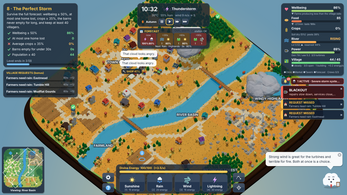
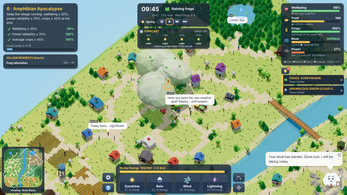
The visual identity is bright, colourful and deliberately low-poly: chunky farmland, small houses, simple villagers and weather that reads at a glance from a distance. That clarity matters, because the player needs to spot a flooded field or a spreading fire without hunting for it among detailed clutter.
The comedy carries the tone. Villagers celebrate when life is good and turn on their deity the moment anything goes wrong, while Nimbus floats above the whole thing offering instructions, encouragement of dubious value and commentary nobody asked for. Disasters are staged as drama rather than punishment, which keeps a failed mission feeling like a story instead of a setback.
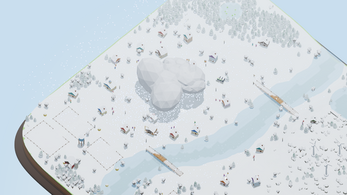
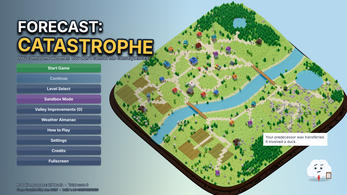
Technically the game runs in the browser with no installation, built for desktop play and recommended with sound on. It is still in development, so the current build represents a work in progress rather than a final state, and the four available screenshots show a portion of what the finished valley is meant to contain.
Who should play it
Anyone who enjoys god-games, management simulations and sandbox tinkering will find the shape of it familiar: indirect control, interlocking systems and a settlement that punishes laziness. Strategy players who like optimising a delicate balance of food, power and morale are the other obvious audience, since every mission is essentially a resource puzzle wearing a weather costume.
It also suits players who prefer comedy to solemnity. The premise — an unqualified deity, a village of complainers and a cloud who will not stop talking — is played for laughs, and the disasters are meant to be entertaining rather than crushing. The short mission structure and browser format make it easy to drop into for a single scenario.
Players who want a long, solemn city-builder or a competitive multiplayer game should look elsewhere; this is a single-player simulation about experimenting with cause and effect in a small valley, and it is happiest when the player is curious rather than careful.
Screenshots
How we tested it
The build was loaded from games.debutplay.com in a headless Chromium session on ; the canvas started and no request was blocked. The guide was last checked on .
From the developer
FORECAST: CATASTROPHE CONGRATULATIONS! YOU'RE THE NEW WEATHER GOD. Unfortunately, nobody checked your qualifications. Welcome to a tiny, thriving valley filled with hardworking villagers, questionable infrastructure, and people who will blame you for absolutely everything. Their crops are dying? Your fault. Their electricity is out? Your fault. Their house just floated down the river? DEFINITELY YOUR FAULT. In Forecast: Catastrophe, you control the weather itself. Summon sunshine, unleash thunderstorms, command powerful winds, and strike the earth with lightning. Your mission is simple: keep a growing village alive. How hard could that possibly be? CONTROL THE SKY. CHANGE THE WORLD. Every weather decision creates consequences. Sunshine: Warm the valley, dry flooded fields, and help restore healthy conditions. Just don't accidentally cook the crops.Rain: Grow food, restore moisture, and fight wildfires. Too much rain, however, can turn…
Frequently asked questions
Is Forecast: Catastrophe free?
Yes. The game costs nothing to play and runs in a browser with no installation step.
What do you need to play it?
A desktop browser plus a mouse and keyboard. Sound is recommended, and no download or install is required.
How many missions are there?
Eight handcrafted scenarios, running from a weather basics tutorial through flood, blackout, growth and wildfire challenges to one final test.
Is there a Sandbox Mode?
Yes. Sandbox Mode removes the campaign objectives so the four weather powers can be combined and tested freely.
Who is Nimbus?
A floating cloud companion who hosts the guided tutorial and provides a running commentary of instructions, questionable encouragement and unnecessary remarks.
When did the game launch?
The build was published on 29 October 2026 and remains in development, so details can still change.
What games are similar to Forecast: Catastrophe?
The closest matches on DebutPlay are Penguin Nursery, A Well-Run Exercise / Eine gut gelungene Alarmprobe, Gig Promotor (free early playtest of first 2 seasons). They share the same genre, so the controls and the pace carry over.
Something wrong or missing? Tell us. How we test games.