RPG · New game
DungeonGame
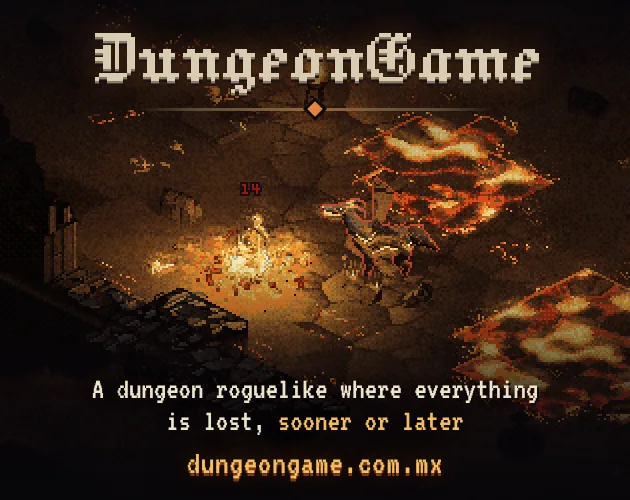
A free, turn-based browser roguelike where every limb has its own health pool, the torch burns down, and the dungeon keeps moving while you are away.
#44 this weekAI-assisted: Code, Graphics, Sound, Text
The game runs in this tab. No install, no account.
The short answer
DungeonGame is a turn-based roguelike you play in the browser for free, with no sign-up. Six body parts carry 100 health each, one exploding d100 decides every attack, and a 20-level dungeon of six biomes sits under a town called Mugswallow. Permadeath passes one identified relic to your heir. Play with keyboard and mouse or touch.
What is DungeonGame?
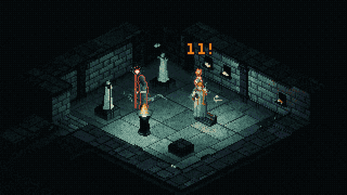
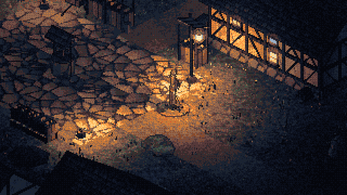
DungeonGame is a turn-based roguelike that runs in a browser, made by elgabo.lora in a dark, mature fantasy register. A low-resolution pixel world is drawn over an isometric 3D space, so light and shadow behave like real light rather than painted tiles.
The structure is two worlds stacked on each other. Below ground is a procedural dungeon of 20 levels; above it is Mugswallow, a town with day and night routines, shops that open and close, reputation, procedural quests and trades. The main quest is a descent: bring the Heart of the Spring back from the very bottom of the dungeon.
What makes the game distinctive is that the dungeon does not wait for you. Creatures hunt each other as readily as they hunt you, ground you have already explored fades into a cold memory once the torch burns low, and blood and noise carry. Death is permanent, and only one relic survives it, passed to your descendant already identified.
How to play
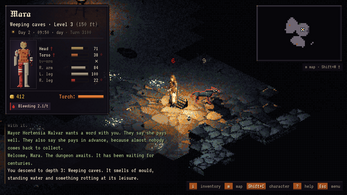
Your character's body is tracked in pieces: a head, a torso, two arms and two legs, each with 100 health. The head and torso are the fatal ones. An arm that takes too much damage drops whatever it is holding, a broken leg makes movement slower, and a limb that has been disabled must be splinted before it will heal.
Attacks resolve on a single exploding d100, compared against the target's dodge, its shield, and the armor sitting on the part you struck. Where you stand matters: there are eight directions of facing, and flanking, backstabs and aimed strikes all change the odds. Weapons are not interchangeable — daggers, maces, spears that reach two tiles and greatswords each behave differently.
Bleeding is a real cause of death, and the noise and blood you leave behind are followed. Bandages and splints are the countermeasures.
There are no experience points and no levels. Skills improve through use, with each improvement arriving more slowly than the last, so a character's strengths are shaped by what you actually do with them.
Controls
Desktop play uses a keyboard and mouse combination. Phones and tablets use touch controls, and that layout is built for landscape orientation, so it expects a wide screen rather than a tall one. The same build serves both.
Language can be changed at any time: F3 switches it, and the Options menu offers the same choice. On first load the game adopts the browser's own language, with English and Spanish as the available pair.
Because combat is turn-based, positioning and aiming are settled before anything resolves — eight directions of facing, aimed strikes at particular body parts and the two-tile reach of a spear all read as deliberate choices rather than reflex tests.
| Input | Action |
|---|---|
| Keyboard and mouse | Play on desktop |
| Touch | Play on phones and tablets in landscape |
| F3 | Switch between English and Spanish |
Tips for your first run
The first hour is mostly about not dying to something small. Keep a bandage on hand before you need one, and treat a disabled limb as an emergency to be splinted rather than a stat to wait out. Light is another resource: the torch burns down and the map behind you turns into memory, so decide early whether to push deeper or turn back, and remember that noise and spilled blood both travel.
- Aim before you swing. Facing, flanking and backstabs change the roll, and a two-tile spear keeps you out of retaliation range.
- Guard the head and torso first; a damaged arm or leg is a setback rather than an ending.
- Carry splints as well as bandages, because a disabled limb will not heal until it has been splinted.
- Try talking first. Some creatures will parley, some will give up, and some can be bought off.
- Use the notebook when identifying: sipping, smelling, dipping, engraving or skimming an unknown item is a guess with risk attached, and scrolls are deciphered sheet by sheet.
- Choose the heirloom your next character will inherit, since the relic arrives identified rather than unknown.
Content and replayability
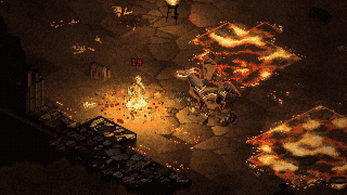
Content is built around the 20-level dungeon and its six biomes, running from damp caves and abandoned mines through a fungal forest to crypts, ruins, and a lava abyss at the bottom. Levels hold secret doors, traps, chests, fountains and braziers, and they persist while your character lives; the creatures inside keep living their lives while you are gone.
The bestiary has 29 original species: 22 common creatures, a boss for each biome and a final boss on top. They are defined by diet and behavior — packs, predators, scavengers, ambushers and thieves — and some will talk, some will surrender, some will accept payment.
Items run to roughly 200. Identification is a game of its own: you can sip, smell, dip, engrave or skim something unknown and record your guess in a notebook, decipher scrolls sheet by sheet at some risk, and combine things — a potion with a weapon, a scroll with a gem, or two potions together.
Mugswallow, the surface town, keeps day and night routines, opens and closes its shops, tracks reputation, hands out procedural quests and supports trades such as skinning, fishing, alchemy and smithing. Its main quest sends you to the bottom of the dungeon for the Heart of the Spring. Permadeath then hands one chosen relic to your descendant, identified.
Presentation and performance
Visually the game is deliberately low-resolution: chunky pixel sprites placed in an isometric 3D space where light and shadow are simulated rather than painted on, so a brazier or a torch actually changes what you can see. The tone is dark and mature. Sound is procedural chiptune music plus positional effects that tell you where something is happening relative to your character.
All art, writing, music and code are original to the project, with sprites, icons and music produced by code rather than drawn or recorded by hand. The typefaces are Jacquard 12, Silkscreen and VT323. It runs as an HTML5 browser game, installs as an app, and works offline once installed.
Who should play it
It suits players who like turn-based roguelikes with real stakes: permanent death, no experience treadmill, and a dungeon that is indifferent to them. The body-part health system and the single exploding d100 make every fight a calculation about risk rather than a damage race, and the ecology of predators, scavengers and thieves makes the dungeon feel populated rather than staged.
The identification minigame and the living town will appeal to anyone who enjoys puzzles and simulation between fights — the notebook, the sheet-by-sheet scroll deciphering and the shop schedules are as much a part of the game as combat.
It is a natural fit for bilingual players, since English and Spanish are both supported and switching takes one key, and for people who play in short browser sessions on a phone or tablet in landscape as well as at a desktop keyboard.
DungeonGame is still in development, so the build available now is a work in progress rather than a finished release.
Screenshots
How we tested it
The build was loaded from games.debutplay.com in a headless Chromium session on ; the canvas started and no request was blocked. The guide was last checked on .
From the developer
DungeonGame is a turn-based roguelike for the browser: low-res pixel art over an isometric 3D world with real lights and shadows, a dungeon full of creatures that hunt each other, and a living town on the surface. Dark, mature fantasy. Free, no sign-up. WHAT'S INSIDE • Body-part health — head, torso, two arms, two legs, 100 HP each. Lose the head or torso and you die. A ruined arm drops what it holds, a broken leg slows you down, and a disabled limb has to be splinted before it heals. • One exploding d100 roll per attack, checked against dodge, shield and the armor on the part you hit. 8-direction facing, flanking, backstabs, aimed attacks and weapons with real identity (daggers, maces, reach-2 spears, greatswords…). • Bleeding that actually kills. Bandages, splints — and monsters that follow the blood trail and the noise. • Skills that improve by use, ever more slowly. No XP, no levels. • 29 original dungeon species (22 common, a…
Frequently asked questions
Is DungeonGame free to play?
Yes. It is free and requires no sign-up, so the browser build opens straight into play.
Does it work on phones and tablets?
Touch controls are provided for phones and tablets in landscape orientation, alongside keyboard and mouse play on desktop. The game also installs as an app and works offline.
What happens when the character dies?
Death is permanent. One relic of your choosing carries over to the next character, a descendant who inherits it already identified.
How is combat resolved?
Each attack is one exploding d100 tested against dodge, shields and the armor covering the body part you struck. Facing, flanking, backstabs and aimed strikes all shape that roll.
Are there experience points or levels?
Neither. Skills rise through use instead, and each gain arrives more slowly than the one before it.
Which languages are supported?
English and Spanish. The game opens in the browser's own language, and the setting can be changed from Options or with the F3 key.
What games are similar to DungeonGame?
The closest matches on DebutPlay are Charterbound: Into the Margins, Road to Sixty, Father's Lamp. They share the same genre, so the controls and the pace carry over.
Something wrong or missing? Tell us. How we test games.