Puzzle · New game
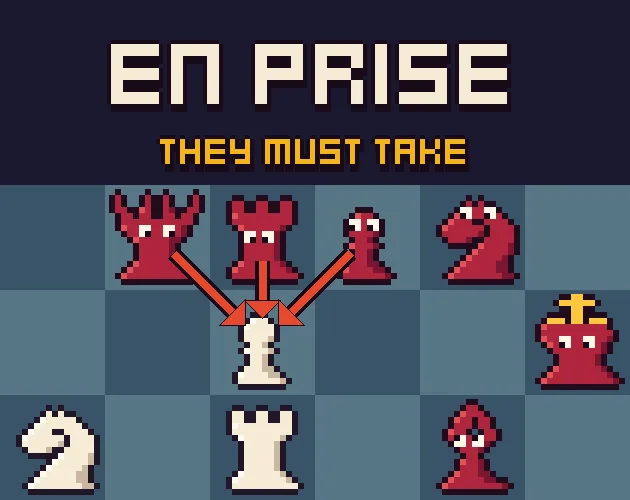
En Prise: Chess, but They Must Take
A browser chess puzzler where the red army never moves unless it can capture, turning every sacrifice into a way to drag defenders off the squares that matter.
#12 this weekAI-assisted: Unspecified
The game runs in this tab. No install, no account.
The short answer
En Prise flips ordinary chess by forcing red to take anything it can, so offering pieces becomes a way to pull defenders away from the squares that matter. Take the red king before the move count runs out across 72 hand-built levels, a shared daily puzzle, and a Bottomless mode with three hearts. It plays free in a browser.
What is En Prise?
En Prise is a turn-based chess puzzle game built around a single rule change: the red side never starts a move of its own, yet it must capture whenever a capture is available. That obligation turns an ordinary board into a trap-laying exercise. Handing over material stops being a blunder and becomes the mechanism that pulls a defender away from the square you need.
The title comes from the chess term for a piece left hanging and ready to be taken. Play is solo and turn-based, presented in 2D with pixel-art pieces, and it runs in a browser on either a computer or a phone. Progress is kept in the browser between sessions. It is out now, published on 3 November 2026, and costs nothing to play.
The hand-built campaign holds 72 levels spread over six chapters, starting with a first simple sacrifice and building to five-move traps on a wider board. A daily puzzle and a Bottomless mode push the same idea past the authored levels.
How to play
The goal is to capture the red king before your move allowance runs out. Red pieces sit still until one of yours steps into a square they attack, and then the capture is compulsory. There is no check and no checkmate in this variant; the king is simply taken like any other piece, so the puzzle ends the moment you reach it.
Priority rules decide which capture happens when several are available. If red can hit more than one of your pieces, it goes for the most valuable target. If several red pieces could make that same capture, the cheapest one does the job, with the order running pawn, then knight or bishop, then rook, then queen, with the king last.
Pawns behave differently from standard chess. They advance a single square and capture on the diagonal only, with no two-square opening step and no promotion when they reach the far end. Undo is free and unlimited in the campaign, and hints are available if a position stalls. Bottomless mode removes both safety nets.
Controls
Selection takes two steps whatever the input. With a mouse, click one of your pieces and then click the square it should move to, or drag it across the board. On a phone, the first tap picks the piece up and the second tap plays the move, and dragging works there too.
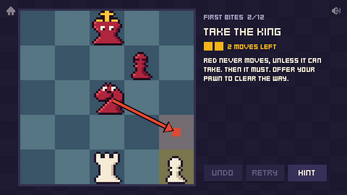
Before committing, hovering over a red piece with the mouse reveals what it is forced to bite and which squares it guards; a red arrow marks the piece that will be dragged into the capture. On a touchscreen, tapping a red piece shows the same information. There is no need to guess at the threat.
The keyboard covers the utility actions rather than movement. U or Z undoes a move, R restarts the puzzle, H calls up a hint, and M switches sound on or off. On-screen buttons provide undo, retry, hint and sound for anyone playing with a pointer or a finger.
| Input | Action |
|---|---|
| Mouse | Click a piece and then click its destination, or drag it; hover a red piece to see what it is forced to capture and which squares it guards. |
| Touch | Tap a piece and then tap its destination, or drag it; tap a red piece to reveal what it bites and guards. |
| Keyboard | U or Z to undo, R to retry the puzzle, H for a hint, M to toggle sound. |
Tips for your first run
The habit that has to go is protecting your pieces. In ordinary chess a hanging piece is a problem; here it is bait, and the whole point is to choose which of your pieces gets eaten so that a defender steps onto the wrong square. Expect to lose material deliberately from the very first level.
Read the arrow before every move. It tells you exactly which red piece will be pulled into the capture, and that is the piece whose departure opens the line you are trying to use. Count the moves you are given as well, because the level ends in failure the instant the allowance is spent.
- Offer the cheapest piece that still drags the right defender out of position.
- Check the arrow preview before committing any move you are unsure about.
- Tap a red piece to see what it bites and guards instead of working it out by eye.
- Remember red grabs the most valuable target when it has a choice, and the cheapest attacker executes it.
- Undo is free in the campaign, so test a sacrifice and rewind if the line collapses.
Content and replayability
The main campaign carries 72 levels across six chapters, curving from a single sacrifice at the start to five-move combinations on a wider board by the end. Each one is a set position with a fixed number of moves, so progress is a matter of reading the forced captures rather than building a position from scratch.
The Daily puzzle gives everyone the same position on a given day, tracked with a streak, and produces a result you can copy and pass on. Bottomless mode trades comfort for endurance: three hearts, no undo and no hints, with the puzzles stretching longer as you go, drawn from a pool of thousands.
Every puzzle in that pool has been checked by a solver, which confirms three things about each one: a solution exists, a sacrifice is required, and a purely greedy player will fail. Paired with browser-saved progress, that makes short repeat sessions easy to justify.
Presentation and performance
The look is clean pixel art, with icons, font, sound effects and jingles from Kenney and additional sounds from rubberduck. The music track, The Old Tower Inn, comes from RandomMind, and the whole audio and art set is released under CC0. The code and the piece sprites were produced with AI, which gives the board a crisp, uniform feel rather than a hand-drawn one.
It is a 2D Godot build that runs in the browser, so there is nothing to install before the first puzzle. The interface is built around a mouse or a finger, and the controls scale down to phone screens. Because progress is stored in the browser itself, returning to the tab picks up where you left off, though that also ties your save to that particular browser.
Who should play it
Anyone who already knows how the pieces move has enough chess knowledge to start. The rules that matter are the movement patterns plus one twist, so a lapsed player or a complete beginner at tactics can pick it up without studying openings or endgames. Mouse-only and touch-friendly controls keep the barrier low on any device with a browser.
It suits puzzle players who like a tight move budget and quick sessions more than anyone looking for a full chess opponent, since red never initiates play and there is no engine to outthink. The short campaign levels, the shared daily and the three-heart Bottomless runs all fit a few spare minutes. Players who dislike giving up material may find the first chapter uncomfortable, which is rather the point.
Screenshots
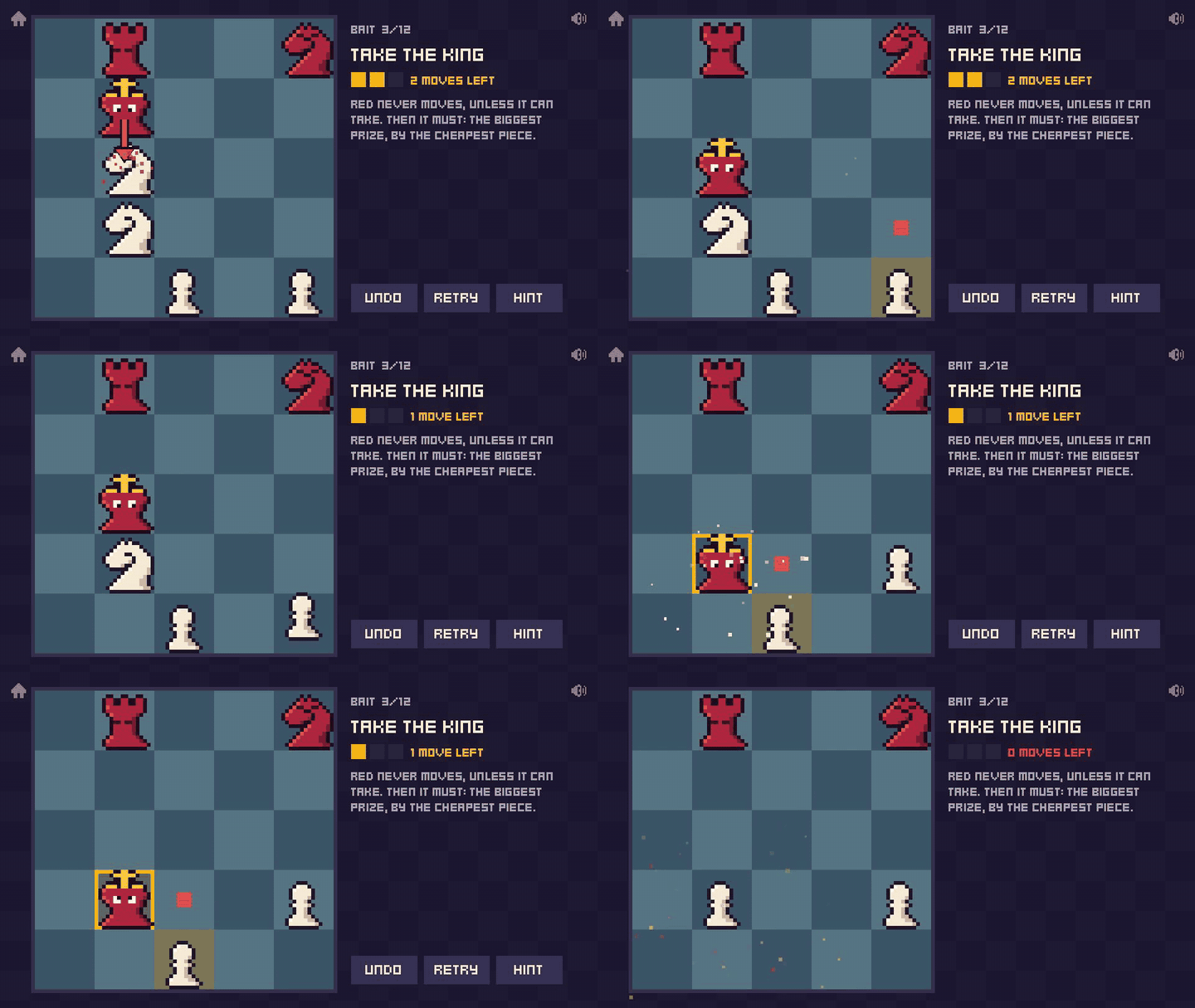
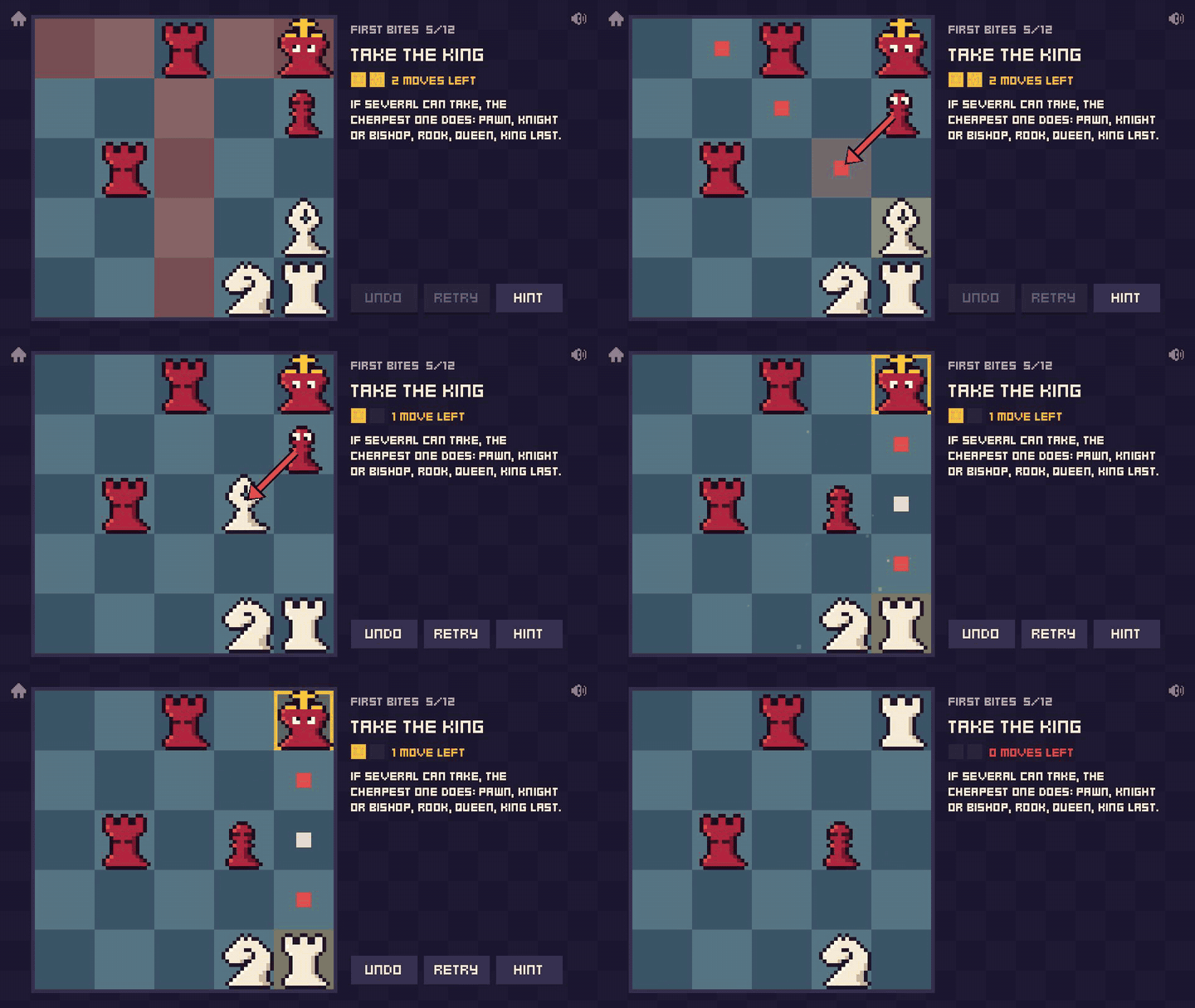
How we tested it
The build was loaded from games.debutplay.com in a headless Chromium session on ; the canvas started and no request was blocked. The guide was last checked on .
From the developer
Chess, but they MUST take. Red never moves on its own. But the moment a red piece can capture something, it has to. Every piece you offer drags one of them out of position. Lose a pawn here, open a file there, then take the king in exactly the moves you are given. How to play Tap one of your pieces, then tap where it goes, or drag it A red arrow shows who will be forced to bite before you commit. With a mouse, just hover the square. On a phone, the first tap shows it and the second plays If red can take several of your pieces, it takes the most valuable one. If several red pieces can take it, the cheapest does: pawn, knight or bishop, rook, queen, king last Pawns step one square forward and bite diagonally, with no double step and no promotion Take the red king before your moves run out. There is no check and no checkmate, the king just gets taken Undo is free, and hints are there if you need them If you know how the pieces move, you…
Frequently asked questions
Is En Prise free to play?
Yes. It costs nothing and runs in the browser, with no purchase needed to start the campaign, the daily puzzle or Bottomless mode.
Can it be played on a phone?
Yes. It loads in a browser on a phone as well as a computer, and the touch controls use a tap-then-tap or drag scheme, with a first tap on a red piece revealing its threat.
Do you need to know chess to play?
Only how the pieces move. The one habit to unlearn is protecting your own material, because in this game a hanging piece is the tool that pulls a red defender out of position.
How many levels are included?
The campaign has 72 levels across six chapters, rising from an opening sacrifice to five-move traps on a wider board, alongside a daily puzzle and a Bottomless mode.
Is there check or checkmate?
No. There is no check and no checkmate; the red king is simply captured, and the puzzle is solved by taking it before the move allowance runs out.
Does Bottomless mode allow undo and hints?
No. Bottomless gives three hearts and removes both undo and hints, and the puzzles get longer the further you push.
What games are similar to En Prise: Chess, but They Must Take?
The closest matches on DebutPlay are Galileo Base: Forces & Motion in 3D, Bubble Tea Sort: Drink Puzzle, After Hours: The Ashgrove Museum. They share the same genre, so the controls and the pace carry over.
Something wrong or missing? Tell us. How we test games.