Interactive fiction · New game
Do Not Turn to 100
A free browser gamebook about cheating a 1986 adventure book, with five finger saves, pencil edits, and an author who notices every move.
#10 this weekAI-assisted: Unspecified
The game runs in this tab. No install, no account.
The short answer
Do Not Turn to 100 is a free interactive fiction game played in a browser. It turns a 1986 gamebook into a cheeky test of rule-breaking: keep fingers in pages, rewrite SKILL in pencil, and face an author who tracks every cheat. Dice, arrow-key page turns, and dozens of endings make a first run easy to start.
What is Do Not Turn to 100?
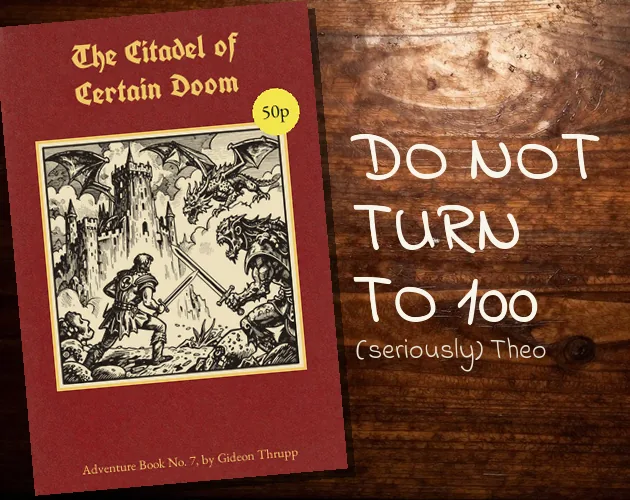
Do Not Turn to 100 is a free interactive fiction game built for the browser. Its framing device is a secondhand copy of The Citadel of Certain Doom, Adventure Book No. 7 by Gideon Thrupp, a 1986 adventure book picked up for 50p at a car-boot sale. The volume contains one hundred numbered sections, a pair of dice, and a pencil.
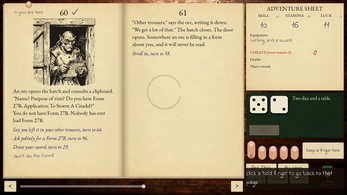
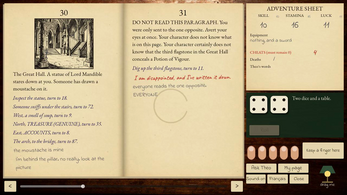
Theo March, age 11, has already filled it with scribbles: a moustache on a statue, a bad instruction to go left, and a record of cheating through the story. Red-ink replies from the author turn the book into a conversation about rule-breaking.
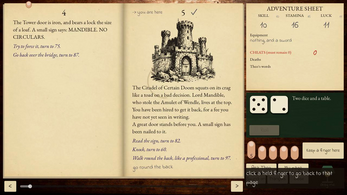
The printed quest includes clipboard-carrying orcs, a troll in the middle of a divorce, a dragon with a paperclip hoard, and a horse. Death can arrive in several comic forms before the Tower summit, and reaching the top is not the final answer. Some content lies beyond the printed pages and must be found by hand. The result is a text-based comedy about temptation, consequences, and the urge to peek at the next paragraph.
How to play
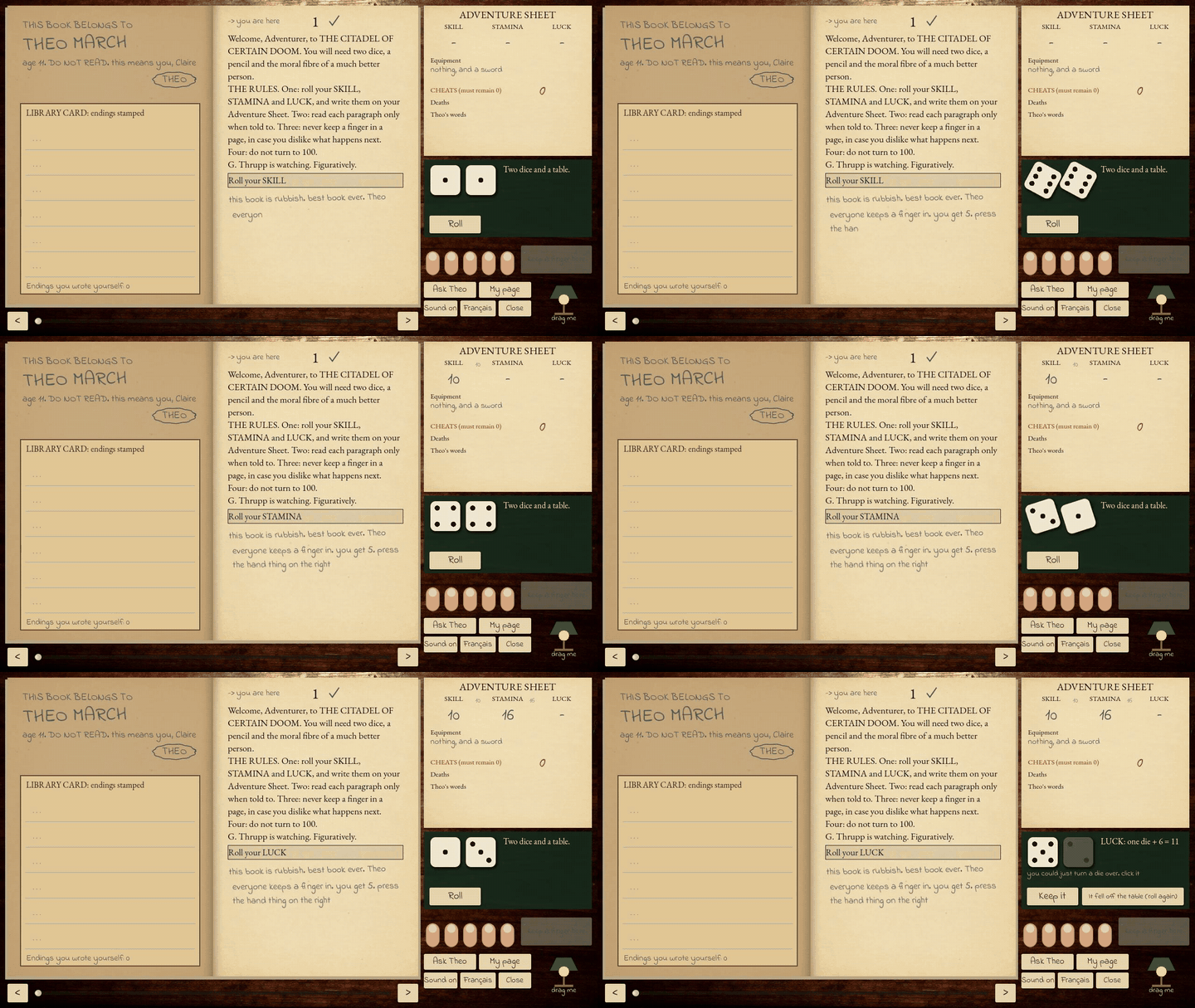
The central joke is that the gamebook can be handled like a real one. Five fingers work as bookmarks: pull one out and the page and character sheet return to the state they had when that finger was placed. From there, a player can read the facing page, jump to another section, claim a die fell off the table, turn the die over, or erase the SKILL score and write a larger number in pencil. These are not side tricks; they are the play.
Gideon Thrupp notices each cheat and keeps a tally on the sheet in red. The book also remembers. It saves itself, and changes made to the pages remain in place. Progress is therefore less about clean play than about managing the author's attention while exploring one hundred numbered paragraphs. Dice rolls, page turns, and pencil edits all feed the same mischievous loop. Players who want a conventional, rule-abiding gamebook should expect to be teased for every shortcut.
Controls
The browser build uses a compact control set. Mouse or touch input handles play in the browser, Space keeps the dice, and the arrow keys turn pages. That split matters because the game is text-heavy: the reader spends most of the time moving through prose, then switches to a separate key when dice are involved.
A tablet or computer is a better fit than a small phone for the long reading stretches. The one-hundred-paragraph structure rewards comfortable page navigation, and the pencil-and-dice theme makes the keyboard shortcuts feel like part of the book's physical gag. Touch play exists, but the screen size advice is worth taking seriously before starting a long session. The controls stay spare, matching the book's pencil-and-paper conceit.
| Input | Action |
|---|---|
| Mouse or touch | Play the browser gamebook |
| Space | Keep the dice |
| Arrow keys | Turn the page |
Tips for your first run
Start by learning the two printed rules, then decide which ones to break. Rule Three warns against keeping a finger in a page; Rule Four warns against turning to 100. The game is built around doing both anyway, so treat the rules as a map of tempting shortcuts rather than a fence. Theo's notes are not reliable: the instruction to go left is flagged as bad advice, which makes his other scribbles worth reading with suspicion.
Watch the red tally on the character sheet. Every cheat Gideon Thrupp notices adds to it, so a run with constant page-hopping and SKILL inflation will feel different from a cautious one. Use the five-finger bookmark system to test a branch, then pull the finger out to restore the earlier sheet. If a page feels like a dead end, the stuck button can ask Theo for help. Save-scumming and pencil fraud are part of the comedy, not a failure state.
- Read the facing page before committing to a jump; the opposite page is part of the trick.
- Keep one finger free for a quick return instead of spending all five on the same branch.
- Try a small SKILL edit early to see how the red-ink tally reacts.
- Do not trust Theo's directions, especially the one that sends you left.
- Use the stuck button when a paragraph puzzle stalls rather than flipping at random.
- Expect several funny deaths before the Tower summit; reaching it is not the whole goal.
Content and replayability
The book offers dozens of endings, and many of them are written by the player in pencil rather than selected from a fixed menu. That makes replayability less about unlocking a canonical route and more about seeing how far the red-ink tally can be pushed while still finding a way out of the one hundred paragraphs. The story is available in English and French through the final pencil note.
The book remembers choices, saves itself, and keeps page changes in place, so experiments leave marks. There is more than one exit from the numbered sections, and the printed adventure includes enough comic hazards to make repeated deaths feel like content rather than punishment. The stuck button that asks Theo gives stalled readers another way forward. Players who enjoy meaningful choices, multiple endings, and text-based comedy get the most from repeated runs. Dozens is the useful scale to hold in mind.
Presentation and performance
The visual identity is pen-and-ink illustration rather than animated spectacle. The art, prose, and code were produced with artificial intelligence assistance, and the result leans on the feel of a marked-up adventure book: handwritten annotations, printed paragraphs, and a character sheet that can be altered in pencil. Typography includes EB Garamond, Caveat, and UnifrakturCook.
Music and sound are CC0 assets from RandomMind, yd, rubberduck, Kenney, and other OpenGameArt contributors. The game is made with Godot and runs in the browser. Because the experience is text-heavy, a tablet or computer gives the pages more room than a small phone. The presentation supports the central joke: the book looks like an object that has been owned, annotated, and argued with. The emphasis stays on reading, annotation, and the pleasure of catching a printed page in the act of changing.
Who should play it
Do Not Turn to 100 suits readers who like interactive fiction with a comic streak and a mischievous attitude toward rules. Gamebook veterans will recognize the numbered paragraphs, dice, pencil, and SKILL score, while newcomers can enjoy the cheat systems without knowing the history of the format. The comedy is broad: clipboard orcs, a divorcing troll, a paperclip dragon, and a horse share space with an author who counts every infraction in red ink.
Players who want meaningful choices, multiple endings, and a story that remembers page edits will find plenty to test. The English and French options widen the audience. A tablet or computer is the better fit for the text-heavy pages; a small phone makes the reading stretches harder. Anyone allergic to reading, or looking for real-time action, should look elsewhere. The ideal player is curious, willing to poke at the book, and happy to see a bad decision turn into a funny death before the Tower.
Screenshots
How we tested it
The build was loaded from games.debutplay.com in a headless Chromium session on ; the canvas started and no request was blocked. The guide was last checked on .
From the developer
You bought it for 50p at a car boot sale. The Citadel of Certain Doom, Adventure Book No. 7, by Gideon Thrupp, 1986. A hundred numbered paragraphs, two dice and a pencil. The Rules are on the first page. Rule Three: never keep a finger in a page. Rule Four: do not turn to 100. Someone has written in it. Theo March, age 11. He drew a moustache on the statue, he told you to go left (don't go left), and he cheated all the way through. The Author wrote back, in red ink. He is very disappointed in you as well. Then you notice that some of the notes weren't there the last time you looked. Cheat. Everyone does. It's a real gamebook, and you can do what you always did with a real gamebook: Keep a finger in the page. You have five. Pull one out and you're back on that page with your sheet as it was, as if nothing had happened Read the page opposite. Flip anywhere you like. Nothing stops you Say the die fell off the table. Or simply turn it…
Frequently asked questions
Is Do Not Turn to 100 free?
Yes. It is free to play in the browser.
What platforms can run it?
It is an HTML5 browser game. Mouse or touch input works, and a tablet or computer is recommended over a small phone for the long reading stretches.
How do the finger bookmarks work?
Five fingers act as saved page states. Pull one out and the page and sheet return to how they were when that finger was placed.
Does cheating have consequences?
Gideon Thrupp notices every cheat and keeps count on the character sheet in red. The book also saves itself, so page changes stay done.
Is there a French version?
Yes. The game is available in English and French through the final pencil note.
What are the controls?
Mouse or touch handles browser play, Space keeps the dice, and arrow keys turn pages.
What games are similar to Do Not Turn to 100?
The closest matches on DebutPlay are The Rune Smith/Der Runenschmied, UNIT4, A Well-Run Exercise / Eine gut gelungene Alarmprobe. They share the same genre, so the controls and the pace carry over.
Something wrong or missing? Tell us. How we test games.