Interactive fiction · New game
HINENI
A coma ward, a ceiling nobody wants you to look at, and a quarter of an hour before the world ends: what to know before pressing Play.
#19 this weekAI-assisted: Code, Sound
The game runs in this tab. No install, no account.
The short answer
HINENI is a short first-person horror game drawn entirely in ASCII, set in a hospital where the world has fifteen minutes left. Walking does not stop the clock, but reading and choosing do. Six endings wait, each with its own look and revisitable from the menu, and every line is voiced in five languages.
What is HINENI?
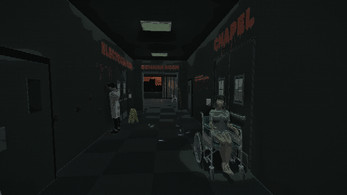
You come out of a coma inside the Threshold Hospital with a quarter of an hour left before the world ends, and the ward keeps its routine anyway. A nurse smooths clean sheets. A doctor counts to forty-one with his forehead pressed to the wall. A woman in a wheelchair waits for a son due at seven, an hour that has already passed and keeps passing. A man in the corner asks you not to look up at the ceiling.
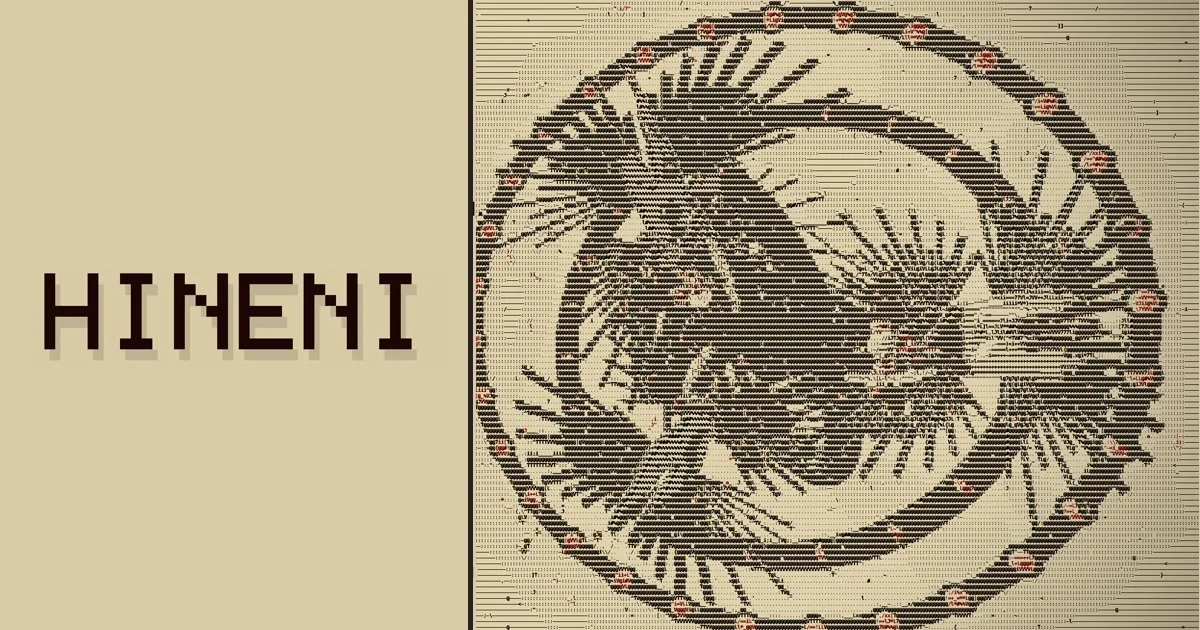
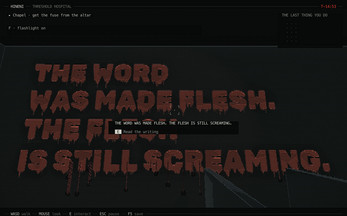
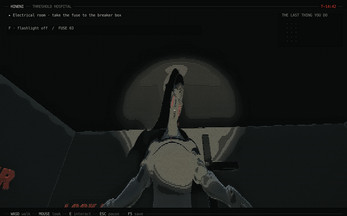
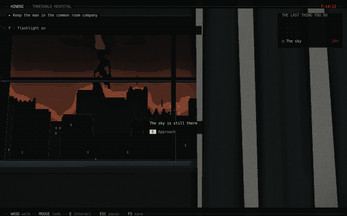
The game is a short first-person horror piece rendered wholly in ASCII: a working three-dimensional hospital converted into text characters by the shape of objects, closer to a living engraving than to pixel art. Nothing here is built around combat, and there is nothing to shoot. The dread sits above you, in wheels packed with eyes and figures carrying the faces of a man, a lion, an ox and an eagle, weeping blood and speaking in tongues, and behind the windows, where a city burns and sirens only reach you when you stand close enough to hear them.
How to play
The clock is the design. Fifteen minutes remain for the world, and only reading and choosing spend them; walking does not stop the timer. Reading is therefore cheap in time and wandering is not, which turns every corridor into a small budgeting decision. Move with purpose, inspect what you pass, and accept that the hospital will keep counting while you travel.
Interaction runs through a single key, and a flashlight is there for the darker stretches. What you finally receive depends on the last thing you do rather than the route that brought you there, so the closing action carries more weight than any earlier detour. Six endings exist, each with its own visual treatment, and any ending already reached can be reopened from the menu afterwards. Because the world clock is fixed and short, a first run works best as one unbroken sitting rather than a game sampled in pieces across an evening.
Controls
On desktop, movement is handled with W, A, S, D and the mouse turns your view. E interacts with whatever is in front of you, F switches the flashlight, Esc pauses, and F5 saves your progress. Nothing else is required to finish a run.
In a browser on a phone, the game is played in landscape with two on-screen sticks, one for movement and one for looking, plus a Controls button that opens the rest of the inputs. Headphones are recommended, and the whole thing is pitched at a dark room and a single sitting rather than a quick break.
The desktop downloads need a small amount of trust from the operating system before they will launch. On macOS the app is not signed with an Apple certificate, so the first launch goes through a right-click on the application followed by Open and Open again. On Windows, SmartScreen may flag an unknown publisher, which is cleared through More info and then Run anyway. On Linux, the executable may need its permissions changed before it runs.
| Input | Action |
|---|---|
| W A S D | Walk |
| Mouse | Look around |
| E | Interact |
| F | Toggle the flashlight |
| Esc | Pause |
| F5 | Save |
| Two touch sticks (phones) | Move and look |
| Controls button (phones) | Reach the remaining inputs |
Tips for your first run
The cheapest resource in the hospital is text, and the most expensive is footsteps. Treat reading as free and movement as a cost, then plan the route around what you actually want to know.
The man in the corner gives you a direct instruction about the ceiling. The game then invites you to look up anyway, so treat that moment as a decision rather than as scenery. Recurring numbers and repeated phrases belong to the ward's rhythm, and the small exchanges with the nurse, the doctor and the woman in the wheelchair are where the world's remaining minutes are explained.
- Play in one sitting, in the dark, with headphones on.
- Remember that walking runs the clock down while reading and choosing pause it.
- Decide what your final action will be before you commit, because it determines the ending.
- Save with F5 ahead of any moment you suspect is irreversible.
- Revisit endings you have already unlocked from the menu instead of replaying blind.
- Keep the volume up near the windows; the city outside only registers at close range.
Content and replayability
The game opens with a warning covering blood, death, religious imagery and flashing images. The religious material is not decorative: the title itself is a word spoken in Isaiah 6:8, and Revelation 6:8 and 9:6 are quoted in the King James Version, Reina-Valera 1909, the Chinese Union Version, the Japanese Colloquial translation and Almeida Revista e Corrigida. The wheels, the eyes and the four faces come from that same apocalyptic register.
Length is deliberately small, and the branching is where the replay value sits. Six endings exist, each with a different look, and the menu keeps track of the ones you have found so they can be watched again without a fresh run. A single playthrough resolves only one outcome, so the ending list is the real measure of how much of the game you have seen. A player who wants a tidy, closed story should expect to make a few deliberate returns.
Presentation and performance
Everything visible is ASCII, drawn from a genuine 3D scene, which gives the hospital its odd double quality: recognisable architecture filtered through characters that flicker and settle. Music comes from Mechanical Hum by antm_ai, layered with bells, sirens and screams sourced from public domain and openly licensed audio. Voices are machine-generated and cover every spoken line.
Language is unusually flexible. Text and voice are chosen separately, each from English, Spanish, Portuguese, Simplified Chinese and Japanese, so a run can be read in one language and heard in another. The browser build runs on desktop and on phones in landscape with touch sticks; installable versions exist for Windows, macOS and Linux. Desktop launches may involve an unsigned-app prompt on macOS, a SmartScreen warning on Windows, or a permissions change on Linux, all handled once before the first session.
Who should play it
This is for players who want a compact, atmospheric horror story with a real decision at the end of it, and who are comfortable with a screen made of characters rather than rendered light. The absence of combat is the point: tension comes from the clock, the ward's calm staff and the thing overhead. Anyone who needs action to stay engaged will find little to do here.
It suits a single evening, a dark room and headphones, and it rewards the sort of player who reads every exchange and then wants to see the other five outcomes. The content warning is worth taking seriously, particularly the flashing images and the religious horror imagery. Players who prefer their horror without scripture, blood or weeping figures should look elsewhere, and so should anyone hoping for a long campaign — this is a short, sharp piece built to be finished and then revisited.
Screenshots
How we tested it
The build was loaded from games.debutplay.com in a headless Chromium session on ; the canvas started and no request was blocked. The guide was last checked on .
From the developer
Content warning: blood, death, religious imagery, flashing images. “Here am I.” — Isaiah 6:8, said on seeing the seraphim. You wake from a coma in the Threshold Hospital. The world has fifteen minutes left. The nurses still change the sheets. A doctor counts to forty-one with his forehead against the wall. A woman in a wheelchair is waiting for a son who comes back at seven; it has been seven since yesterday. A man in the corner begs you not to look at the ceiling. Look at the ceiling. WHAT IT IS HINENI is a short first-person horror game rendered entirely in ASCII: a real 3D hospital turned into characters by their shape, like an engraving that breathes. There is no combat and nothing to shoot. Reading and choosing stop the clock. Walking does not. Fifteen minutes, six endings. The last thing you do decides how the world ends for you. Every ending has its own look, and the ones you find can be revisited from the menu. What is above…
Frequently asked questions
Is HINENI free?
Yes. It is listed at no cost, and the browser version can be played without buying anything.
How long is a run?
It is built as a short game. The world in the story has fifteen minutes left, and the clock runs while you walk but pauses for reading and choosing.
How many endings are there?
Six. Each has its own visual treatment, and endings already found can be reopened from the menu.
Can it be played on a phone?
Yes, in the browser, in landscape, using two touch sticks plus a Controls button for everything else.
Is there combat?
No. There is no fighting and nothing to shoot; progress comes from reading, choosing and the final action you take.
Which languages are supported?
English, Spanish, Portuguese, Simplified Chinese and Japanese, with text and voice language selected separately.
What games are similar to HINENI?
The closest matches on DebutPlay are Kabedon, Last Train to Kaerazu, Skyseed. They share the same genre, so the controls and the pace carry over.
Something wrong or missing? Tell us. How we test games.