
Simulation · New game
Homicidy
A free browser cleanup sim about scrubbing pixel crime scenes clean, one work order at a time, with UV checks, ratings and fifty locations to work through.
#7 this weekAI-assisted: Code, Graphics
The game runs in this tab. No install, no account.
The short answer
Homicidy is a free HTML5 cleanup simulation from TheQuackory in which players drag a tool over pixel floors to lift blood, footprints, glass, dust, wax and rust, then verify the work with UV luminol before signing off for a rating and pay. Fifty scenes, 36 medals, upgrades and special contracts give a first session plenty to chase.
What is Homicidy?
Homicidy is a simulation game about the work that begins once a crime scene has been cleared by everyone else: turning a stained room back into a presentable one. TheQuackory developed it, and it runs as an HTML5 build inside a browser, so nothing has to be installed before the first work order opens. It is free to play.
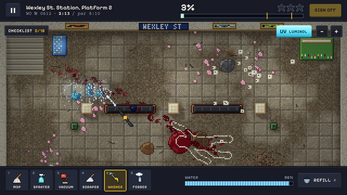
The central interaction is deliberately physical. A tool is dragged across the floor and the mess lifts exactly where it is scrubbed, rather than vanishing from the whole room at once. The grime on offer runs from blood and footprints through glass, dust, wax and rust, with worse promised beyond that list. Every stage arrives with its own layout, its own stains and its own set of cleanup demands.
The mood is cozy-macabre: pixel art, pixel blood and chalk outlines, with no violence shown on screen. Whatever tension the premise carries stays in the setting and the colour palette instead of in anything graphic, which lets the cleaning loop remain calm, methodical and oddly soothing.
How to play
Every job opens with a survey. Work orders are not interchangeable: each one carries a different layout, a different spread of stains and its own list of demands, so the room has to be read before any tool comes out. Matching equipment to the mess matters, because different grime responds to different gear. Supplies are finite, which is what gives that matching its weight; when a tool runs dry, R rinses it, refills it or fits a fresh blade.
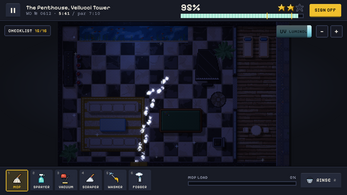
Scrubbing alone does not finish a job. UV luminol can be switched on to expose residue that ordinary light hides, and the checklist is organised by tool rather than by room. Picking a task from that list makes the stains it covers glow, so the last stubborn patch is found by reading the list instead of crawling the floor. When the room is clean, the job is signed off: the finished scene is set against how it looked on arrival, a rating follows and the pay comes in.
Progress is gated by level. Fresh case files appear as the level climbs, and special contracts sit outside the standard run: rush jobs, night shifts lit only by a flashlight, and rooms that arrive with more mess than usual.
Controls
Cleaning is a drag gesture. A tool is moved with the mouse or with a finger, and the mess comes away only along the path traced. Tool switching sits on the number row, with keys 1 through 6 handling the loadout.
R covers maintenance in a single keypress: rinse, refill or swap a blade. L brings up UV luminol, C opens the checklist, and either Esc or P pauses the game. Zoom answers to the mouse wheel, to a pinch or to the plus and minus keys. While zoomed in, the view is moved with space plus a drag, with WASD, with the arrow keys, or with two fingers on a touchscreen.
Both desktop and mobile play are supported, through mouse, keyboard and touch respectively, so the same cleanup can be handled with a cursor or with a fingertip.
The game page does not list its controls. Check the in-game tutorial or pause menu for the current scheme.
Tips for your first run
The opening work order is a poor place to experiment with equipment. Read the room, note which kinds of mess are actually present, and pick tools for those stains rather than scrubbing everything with whatever happens to be in hand. Because supplies run out, a mismatched tool costs twice: once in wasted fluid and once in the trip back to restock it.
There are 36 medals to collect and tool upgrades to buy, so an early rating is not the only measure of progress.
- Run the checklist before the final pass; selecting an entry makes its remaining stains glow and turns a search into a short list of targets.
- Treat UV luminol as a checking tool as much as a finding tool, since residue the eye misses is exactly what the extra light is there to catch.
- Keep R in mind constantly. A tired blade or an empty reservoir will not lift anything, and the fix is a single key away.
- Zoom in when the floor looks clean but the checklist disagrees; small debris such as glass is easy to lose at the default view.
- Leave rush contracts and flashlight-only shifts until the standard rooms feel routine, then use them to break up the pattern.
- Open the comfort settings if flashing or screen shake becomes tiring, since both can be toned down.
Content and replayability
Fifty crime scenes sit on the work list. The settings jump between a casino, a motel, a hockey rink, an all-night diner, a lighthouse, a circus big top, an opera house, a cruise cabin and further sites beyond those. Each one brings a fresh layout and a new cleanup problem, which keeps the scrubbing from settling into a single repeated shape.
Beyond the individual jobs, the long chase is built from 36 medals and a set of tool upgrades available to buy. Case files unlock as the level rises, so there is always a next room waiting behind the current one. Special contracts add variety for anyone who finds the standard work too even: jobs that demand speed, shifts carried out with nothing but a flashlight, and scenes that arrive with extra mess layered on.
Progress is kept by browser saves stored on the player's own device. An optional private recovery code can link supported editions of the game together, though it is not offered on every portal.
Presentation and performance
The whole game is drawn in pixel art, and that style does real work here: blood and chalk outlines read clearly while staying stylised rather than explicit. Nothing violent plays out on screen. The result is a macabre premise handled with a light touch, closer to a diorama than to a horror scene.
Sound is treated as part of the atmosphere. There is a separate theme for the menu, and each level gets its own calmer variation rather than sharing one loop across fifty rooms. Comfort settings can reduce flashing and screen shake for players who find either uncomfortable.
As an HTML5 build, the game runs in the browser, with saves held locally on the device rather than in an account. That makes it quick to pick up for a single work order and equally easy to leave.
Who should play it
Anyone who enjoys cleaning and restoration sims will recognise the appeal immediately: a dirty space, a set of tools, a checklist and the satisfaction of a before-and-after comparison. The pixel art and the macabre framing give that familiar loop a distinctive personality without asking the player to sit through anything gruesome.
It also suits players who want tension in the premise but not on the screen. Pixel blood and chalk outlines carry the theme, and no violence is depicted, so the tone stays comfortable for people who avoid horror games outright. Completionists have 36 medals and a stack of tool upgrades to work toward, and the special contracts offer a harder rhythm once the ordinary rooms stop being a challenge.
Mouse and keyboard players on desktop are covered, and touch controls mean the same work is playable with a finger on mobile hardware. It costs nothing to start.
Screenshots


How we tested it
The build was loaded from games.debutplay.com in a headless Chromium session on ; the canvas started and no request was blocked. The guide was last checked on .
From the developer
Homicidy is a cozy-macabre cleanup game about the work after the crime scene is clear. Drag your tool across the floor and watch the mess come off exactly where you scrub: blood, footprints, glass, dust, wax, rust, and worse. Survey the scene. Each work order has its own layout, stains, and cleanup demands.Choose the right tool. Different messes need different equipment, and supplies run out.Check your work. Switch on UV luminol to reveal residue. The checklist is grouped by tool; select a task to make its remaining stains glow.Sign off. Compare the before and after, earn your rating, and collect your pay. Work through 50 crime scenes: a seedy motel, an all-night diner, a casino, a hockey rink, a circus big top, a lighthouse, a cruise cabin, an opera house, and more. Each site brings a different layout and a new cleanup challenge. Fresh case files unlock as you level up. Keep an eye out for special contracts: rush jobs,…
Frequently asked questions
Is Homicidy free to play?
Yes. It is free, and it runs in the browser as an HTML5 build.
What do you actually do in Homicidy?
Drag a tool over stained floors to lift blood, footprints, glass, dust, wax and rust, check the result with UV luminol, then sign the work order off for a rating and pay.
How many crime scenes are there?
Fifty. Settings range from a casino and a motel to a hockey rink, a lighthouse, an opera house and a cruise cabin, each with its own layout and demands.
Does Homicidy work on mobile?
Yes. Mouse, keyboard and touch controls are all supported, so the game can be played with a finger on mobile hardware.
Is the game gory?
No. The presentation is pixel blood and chalk outlines with no violence shown on screen, so the tone stays stylised rather than graphic.
Will progress be saved?
Browser saves keep progress on the player's device. An optional private recovery code can link supported editions, though it is not available on every portal.
What games are similar to Homicidy?
The closest matches on DebutPlay are Ballotta, Singularity, Ember Vault. They share the same genre, so the controls and the pace carry over.
Something wrong or missing? Tell us. How we test games.