Educational · New game
Modular Masters
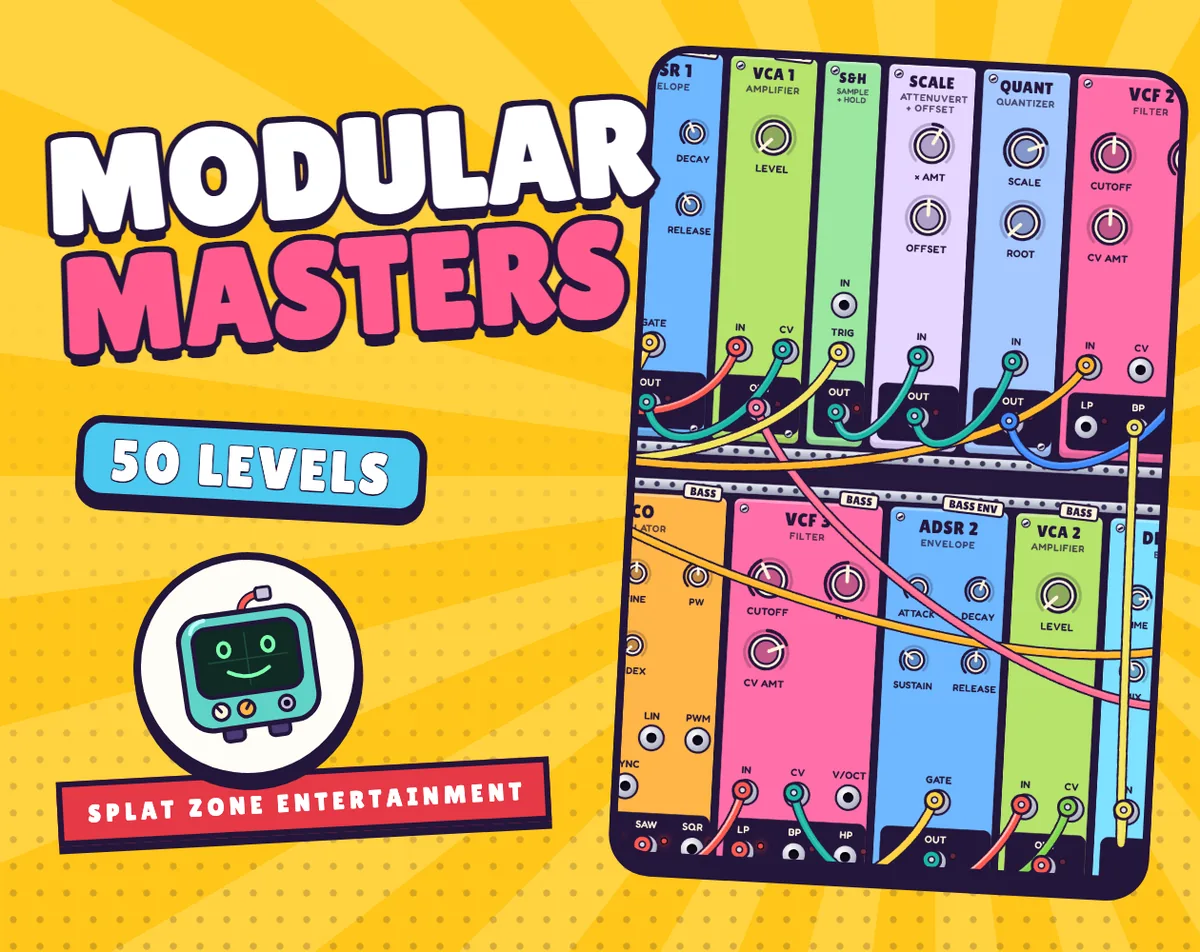
A hands-on modular synth course disguised as a puzzle game, with Ossie the oscilloscope walking you from your first patch cable to a full track.
#44 this weekAI-assisted: Code, Text
The game runs in this tab. No install, no account.
The short answer
Modular Masters is a free patching game that teaches modular synthesis through 40 hands-on lessons. You drag cables between 24 Eurorack-style modules running simulated voltages, and the game grades the pitch, envelopes and filter sweeps you produce rather than quiz answers. Ossie the oscilloscope explains each idea, and Jam mode opens once the Garage is cleared.
What is Modular Masters?
Modular Masters treats the modular synthesizer as something learned by patching rather than by reading. The instrument sits in a virtual case stocked with 24 Eurorack-style modules, and none of them make a sound on their own; every tone begins with a cable. Ossie, a small oscilloscope, serves as guide throughout, explaining each concept and showing the signal present on any jack or cable the player hovers over, with a tuner built into the same readout.
Teaching is split across four main zones holding 40 lessons, with two bonus zones that open along the way. Everything runs on simulated voltages, with audio swinging between plus and minus 5 volts, gates sitting at 0 and 5 volts, and pitch following the 1 volt per octave convention, so patches behave the way the hardware standard says they should. Splat Zone Entertainment released it on 25 October 2026 for HTML5 in the browser plus Windows, macOS and Linux, and it costs nothing.
How to play
Each lesson hands over a goal and a case of modules, then leaves the wiring to the player. Cables run from jack to jack and are color-coded according to the signal they carry, which keeps a dense patch readable at a glance. Goals inspect the patch itself, and many of them also listen to the result: the game renders what has been built and measures pitch, envelope shape, filter movement or how closely the output matches a target sound.
Every level carries three stars — one for solving it, one for solving it without hints, and one for clearing the bonus objective — for 150 in total. A hint button starts with a nudge and can go as far as patching the next step for you. Modules and concepts land in a Codex as they are learned, giving a reference to return to. Clearing the Garage unlocks Jam mode, a free case stocked with every module learned so far that remembers the last patch between visits.
Controls
Two input schemes cover the whole instrument. With a mouse or a touchscreen, a drag from one jack to another makes a connection, and a vertical drag on a knob turns it; holding Shift slows the movement for fine adjustment. The KEYS module can also be performed from the keyboard, using the keys A, W, S, E, D, F, T, G, Y, H, U, J and K, with Z and X changing the octave.
Keyboard navigation reaches everything else. Tab moves focus to any jack or knob, Enter makes a patch, the arrow keys rotate a knob, and Delete unplugs a cable. That arrangement means a patch can be built and edited without touching a pointer, which matters for players who work from the keyboard alone.
| Input | Action |
|---|---|
| Mouse or touch | Drag from one jack to another to patch a cable |
| Mouse or touch | Drag a knob up or down to turn it |
| Shift | Hold while turning a knob for fine adjustment |
| A W S E D F T G Y H U J K | Play the KEYS module |
| Z and X | Change the octave |
| Tab | Move focus to any jack or knob |
| Enter | Make a patch at the focused jack |
| Arrow keys | Turn the focused knob |
| Delete | Unplug a cable |
Tips for your first run
The Garage is the intended starting point for a reason: it establishes oscillators and waveforms, pitch and octaves, mixers, VCAs and gates, the 1 volt per octave relationship, envelopes and filters before anything harder appears. Resist the pull of the later zones until the boss there is solved, because that boss asks for an entire classic synth voice assembled from scratch and exposes any gap in the basics. Ossie's screen is the fastest diagnostic tool available — glance at it before adding another cable rather than after.
Stars come in a fixed order, so a level solved with the hint system still leaves two more to chase. Go back once the idea has settled and repeat it cleanly for the no-hint star, then treat the bonus objective as a separate puzzle. When a patch refuses to behave, the Codex is usually quicker than a hint.
- Hover a jack or cable first so Ossie's screen shows the signal before any connection is made.
- Take the no-hint star on a second pass rather than restarting the moment a hint is needed.
- Use Z and X on the KEYS module when testing whether a pitch patch tracks correctly.
- Hold Shift when turning a knob, since modulation and tuning often depend on small voltage changes.
- Try Jam mode after the Garage to rebuild a lesson patch with no goal checking the result.
- Wear headphones; differences in filter sweep and matched sounds are easier to catch.
Content and replayability
The Garage opens with oscillators and waveforms, then works through pitch and octaves, mixers, VCAs and gates, the 1 volt per octave rule, and envelopes and filters, closing on a boss that demands a complete classic synth voice built from nothing. The Studio moves into LFOs, attenuverters and offsets, clocks, sequencers, sample and hold, quantizers and scales, glide and voltage math, finishing with a sequenced bassline.
The Lab covers pulse-width modulation, hard sync, ring modulation, FM, wavefolding, pinged filters, drum synthesis, polyrhythm and probability, with a drum machine that uses no samples as its boss. The Mainstage adds echoes, plucked strings made from a delay line, sidechain pumping, arpeggios derived from a clock divider, diatonic harmony, three challenges where a sound must be rebuilt by ear, a generative garden that plays itself, and a final patch. West Coast handles Buchla-style ideas such as low pass gates with vactrol decay, a complex oscillator, self-playing function generators and random voltage as an instrument, while East Coast covers a 24 dB transistor ladder filter, three-oscillator stacks, filter contour, glide and a resonant filter that sings in tune. Jam mode keeps a persistent case open afterwards.
Presentation and performance
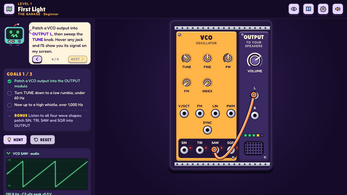
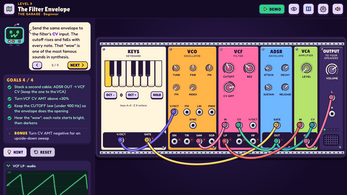
The art and sound are generated by the game's own modular engine while it runs, so the audio heard in a lesson comes from the same patching system being taught rather than from pre-recorded files. Typefaces are Lilita One and Fredoka. Four screenshots and a playable HTML5 frame are available for anyone who wants a look before committing a session.
Nothing requires a connection. The game runs offline, shows no advertisements, asks for no account and includes no tracking, and progress — the star tally together with the current Jam patch — is written to the browser's storage. Reduced motion and screen reader support are both built in. Headphones are recommended, mainly because the gap between one filter sweep, modulation depth or matched sound and the next is easier to hear on them.
Who should play it
Modular Masters suits players who have stared at a modular rack and wanted to know what the cables actually do without buying one to find out. The puzzle framing gives every session a defined target, while the voltage behaviour underneath means the habits carry over: signal flow, attenuation, gating and tuning all respond the way the conventions describe.
It also fits anyone who enjoys graded challenges. Three stars per level create a natural second pass, and the no-hint star rewards real understanding rather than trial and error. The ear-based sound-match challenges and the sample-free drum machine give players with a music background something substantial, while the Garage keeps the entry gentle. It is built as a singleplayer experience, so those after competition should look elsewhere, but as a free, offline, account-free introduction it asks very little of a curious player.
Screenshots


How we tested it
The build was loaded from games.debutplay.com in a headless Chromium session on ; the canvas started and no request was blocked. The guide was last checked on .
From the developer
Ever look at a modular synth and wonder what all those cables actually do? Here you patch them up yourself and find out, from your very first cable all the way to whole tracks made out of raw voltage. A modular synth is a case full of separate modules - oscillators, filters, envelopes, sequencers - and none of them make a sound until you connect them with patch cables. Modular Masters walks you through it one hands-on lesson at a time. Your guide is Ossie, a little oscilloscope who explains each idea, and his screen shows you the signal on any jack or cable you hover over, with a tuner built in. There are 40 lessons across four zones. The Garage is where you start, with oscillators and waveforms, pitch and octaves, mixers, VCAs and gates, 1 volt per octave, envelopes and filters, and its boss has you build the classic synth voice from scratch. The Studio gets into LFOs, attenuverters and offsets, clocks, sequencers, sample & hold,…
Frequently asked questions
Is Modular Masters free?
Yes. There is no charge, and it runs in a browser through HTML5 as well as on Windows, macOS and Linux.
Do you need a real synthesizer or prior patching experience?
No hardware is required. Lessons begin with a single cable, and Ossie explains each idea as it arrives while displaying the relevant signal on his screen.
How many lessons and stars are there?
There are 40 lessons spread across four main zones, plus two bonus zones. Every level holds three stars, 150 in total.
Does it work offline?
Yes. It runs offline with no ads, no accounts and no tracking, and the star tally and Jam patch are saved in the browser.
Can it be played with a keyboard alone?
Tab reaches any jack or knob, Enter patches, the arrow keys turn knobs and Delete unplugs, while the letter keys perform the KEYS module directly.
What are the two bonus zones?
West Coast follows the Buchla approach with low pass gates, vactrol decay and a complex oscillator; East Coast follows the Moog approach with a 24 dB transistor ladder filter and three-oscillator stacks.
What games are similar to Modular Masters?
The closest matches on DebutPlay are SNOWBANK, Tadaima, Packet Adventure: Even a Silly Photo Gets the Full Effort. They share the same genre, so the controls and the pace carry over.
Something wrong or missing? Tell us. How we test games.