Card game · New game
Road Trip Games
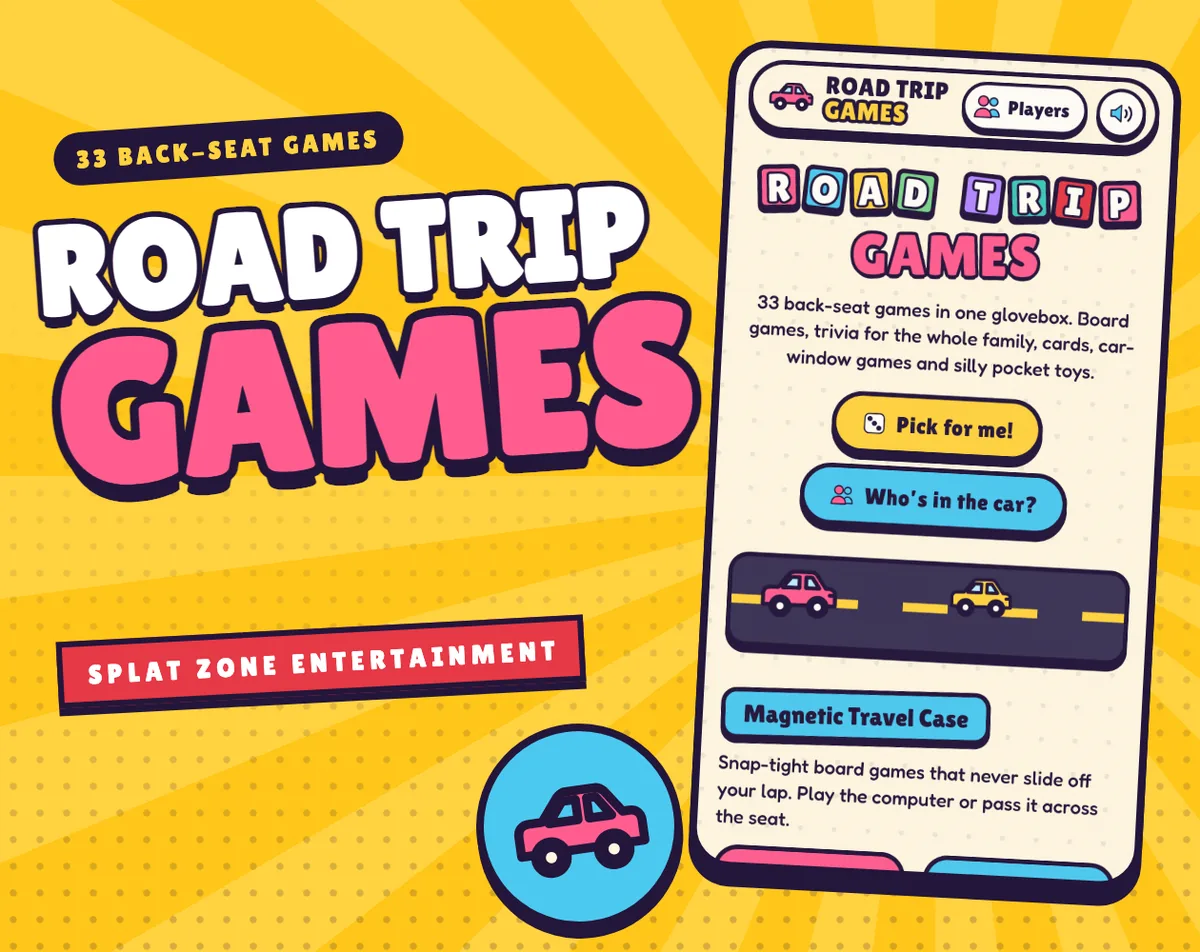
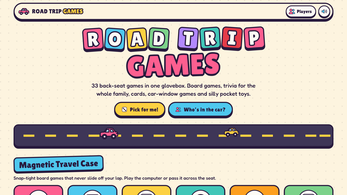
Thirty-three small games for long car rides, from chess and battleship-with-cars to trivia, fill-in stories and a water ring toss, all in one offline package.
#40 this weekAI-assisted: Code, Text
The game runs in this tab. No install, no account.
The short answer
Road Trip Games is a one-dollar collection of 33 back-seat games from Splat Zone Entertainment, running in a browser or on Windows, macOS and Linux. Board classics, 600 trivia questions, 220 fill-in stories, card games and window-watching challenges share one menu, play offline, and let up to eight people pick their own difficulty.
What is Road Trip Games?
Road Trip Games gathers 33 small games onto one page and aims them at long drives, sold for one dollar by Splat Zone Entertainment and released on 25 October 2026. The idea is a glovebox rather than a bag of boxes: the pieces that normally slide off a lap stay put, and the car picks from a single menu instead of hunting for a missing die.
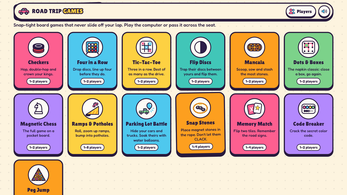
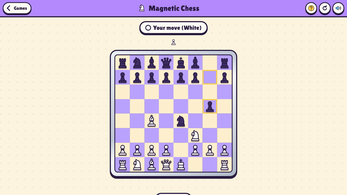
The Magnetic Travel Case holds the board-game side. Chess, checkers, four in a row and tic-tac-toe sit beside flip discs, mancala and dots and boxes. Ramps & Potholes is a snakes-and-ladders climb, and Parking Lot Battle reframes battleship as a hunt for cars and trucks. Snap Stones, Code Breaker, Peg Jump and Memory Match fill out the case, and each of those titles runs against the computer at easy, medium or hard as well as passing across the seat between people.
Around that core sit Trivia Time, Story Time, a small deck of card games, a window-watching set and a drawer of pocket toys. It runs as an HTML5 build in a browser and as a download for Windows, macOS and Linux.
How to play
Set-up starts with one list. Adding everybody once in the Who's in the car? roster gives every game the names and colors of the people playing, so Trivia Time and Story Time can label turns without anyone retyping them. From there the car chooses a mode.
Trivia Time asks 600 questions spread across 20 categories, each with three levels. Up to eight people can join, and each one selects a level, so a six-year-old on Easy competes honestly against an adult on Hard. Story Time draws on 22 books and 220 fill-in-the-blank tales in a road trip edition of Story Shift-Ups; players take turns supplying a word, and the finished page colors each contribution so everyone can see who wrote what. The Little Deck of Cards covers War, Go Fish, Crazy Eights and Higher or Lower.
Look Out the Window holds License Plates, tracking all 50 states plus DC across the journey, Road Trip Bingo with a card per passenger, Alphabet Hunt, Color Cars and 90 conversation cards. The Pocket Toys drawer adds a water ring toss with five levels, a pocket maze, a slide puzzle, Traffic Jam with 20 parking lots to escape, a magnet sketch pad, a fortune ball, a paddle ball, Copy Cat and the word-guessing game Flat Tire.
Controls
Input is deliberately shallow, which matters when a device is being handed between rows of seats. Mouse or touch covers almost everything: tap to play. A question-mark button on every game explains that game's rules on demand, settling arguments about how Peg Jump or Copy Cat works far faster than memory does.
Keyboard support is targeted rather than global. Arrow keys steer the pocket maze and the ring toss, A and L work the pair of pumps on the ring toss, and Enter submits a word during a Story Time turn. On a phone, tilting the handset steers both the ring toss and the maze as an alternative to tapping. Everything else is point-and-tap, so a passenger who has never seen the collection can start a round without a tutorial.
| Input | Action |
|---|---|
| Mouse | Tap to select and play |
| Touch | Tap to select and play |
| Arrow keys | Steer the pocket maze and the water ring toss |
| A and L | Work the two pumps in the water ring toss |
| Enter | Submit a word during a Story Time turn |
| Tilt | On a phone, tip the handset to steer the ring toss and the maze |
Tips for your first run
Start with the roster. Filling in the Who's in the car? list before the first game means every title already knows who is present and which color belongs to whom, which pays off immediately in Trivia Time and Story Time.
Then set difficulty per person rather than per car. The computer opponents in the Magnetic Travel Case run at easy, medium and hard, and Trivia Time goes further by letting each of the eight seats choose a level independently.
- Enter everyone once in the Who's in the car? list so names and colors carry into every game.
- Choose a difficulty per seat, since both Trivia Time and the computer opponents allow it.
- Tap the question-mark button before an unfamiliar game starts rather than guessing at the rules.
- Begin License Plates on day one so the 50 states and DC have the whole journey to fill.
- On the water ring toss, the A and L pumps and phone tilting give finer control than tapping.
- Let the Pick for me spinner break a tie when nobody can settle on a game.
Content and replayability
The count is 33 games, and they are not variations on one another: a chess board, a fill-in-the-blank storybook, a water toy and a trivia bank each ask for something different from the person holding the device. That spread is what keeps a long drive from collapsing into one activity until everyone is bored of it.
State persists. Players, collected license plates, bingo cards, best scores and unlocked levels all save in the browser, so a trip can be paused at a rest stop and picked up with the plates still marked and the levels still open. The computer opponents carry three difficulty tiers, and each trivia category carries three levels of its own, which gives a group room to climb rather than exhaust the content in one sitting.
The puzzle and toy selections, including Traffic Jam's 20 parking lots and the five-level ring toss, are built for short repeat attempts rather than single completions. Nothing described here is a one-and-done set piece.
Presentation and performance
The look is generated at runtime: all the art and sound is made by the game itself while you play, rather than shipped as pre-rendered assets. Typography comes from two open-licensed families, Lilita One and Fredoka, which keeps the interface readable on small screens and consistent across the browser build and the desktop versions.
Practical matters are handled plainly. It works offline, with no ads, no accounts and nothing tracking the people using it, and the download completes with no signal at all, which suits a car in the middle of nowhere. Browsers keep the group's players, plates, bingo cards, best scores and unlocked levels between sessions.
Because the whole collection runs as HTML5 as well as native downloads, there is no install step for anyone who wants to try a round in the browser first.
Who should play it
This is built for a car with mixed ages in it. Up to eight people can share a session, each choosing a difficulty that matches them, so a young player on Easy and an adult on Hard can sit in the same trivia round without either being handed a handicap. Parents who want one purchase instead of a stack of separate apps are the obvious audience.
Solo players are covered too, since the board games in the Magnetic Travel Case can be played against the computer at three strengths. Anyone who likes chess, mancala or dots and boxes but rarely finds a partner gets a quiet opponent.
The trivia and conversation cards suit families who want to talk rather than stare at a screen, and the pocket toys, from the fortune ball to the paddle ball, fill the gaps when a game needs to last five minutes rather than fifty. Groups that need online play, leaderboards or matchmaking should look elsewhere; the design here is local and offline.
Screenshots
How we tested it
The build was loaded from games.debutplay.com in a headless Chromium session on ; the canvas started and no request was blocked. The guide was last checked on .
From the developer
Long drive coming up? This is a whole glovebox of back-seat games in one page - 33 of them - so everybody in the car has something to do besides asking if you're there yet. The Magnetic Travel Case has the board games you'd pack for a trip, minus the pieces sliding all over your lap. There's chess, checkers, four in a row, tic-tac-toe, flip discs, mancala, dots and boxes, Ramps & Potholes (snakes and ladders, basically) and Parking Lot Battle, which is battleship with cars and trucks, plus Snap Stones, Code Breaker, Peg Jump and Memory Match. You can play the computer on easy, medium or hard, or just pass it across the seat. Trivia Time is family trivia with 20 categories and three levels each, 600 questions in all. Up to 8 people can play and everybody picks their own level, so a 6-year-old on Easy can actually beat Dad on Hard. Story Time is a road trip edition of Story Shift-Ups, with 22 books and 220 fill-in-the-blank stories.…
Frequently asked questions
What does Road Trip Games cost?
One dollar. It is a paid release from Splat Zone Entertainment, and there are no ads, no accounts and no tracking in the collection itself.
How many people can play at once?
Up to eight. Trivia Time lets each player choose a level, and the other titles are either passed across the seat or played against the computer.
Does it work without an internet connection?
Yes. It runs offline with no ads, no accounts and no tracking, and the download completes with no signal at all, which helps in the middle of nowhere.
Which platforms are supported?
An HTML5 build plays in a browser, and there are separate downloads for Windows, macOS and Linux.
Where is progress stored?
In the browser. Players, license plates, bingo cards, best scores and unlocked levels persist there between sessions.
What does the question-mark button do?
Every game carries one, and it explains how that game works. It is the quickest way to settle a rules dispute before a turn starts.
What games are similar to Road Trip Games?
The closest matches on DebutPlay are Domon, Kortzale Solitaires, THE VOTE. They share the same genre, so the controls and the pace carry over.
Something wrong or missing? Tell us. How we test games.