Action · New game
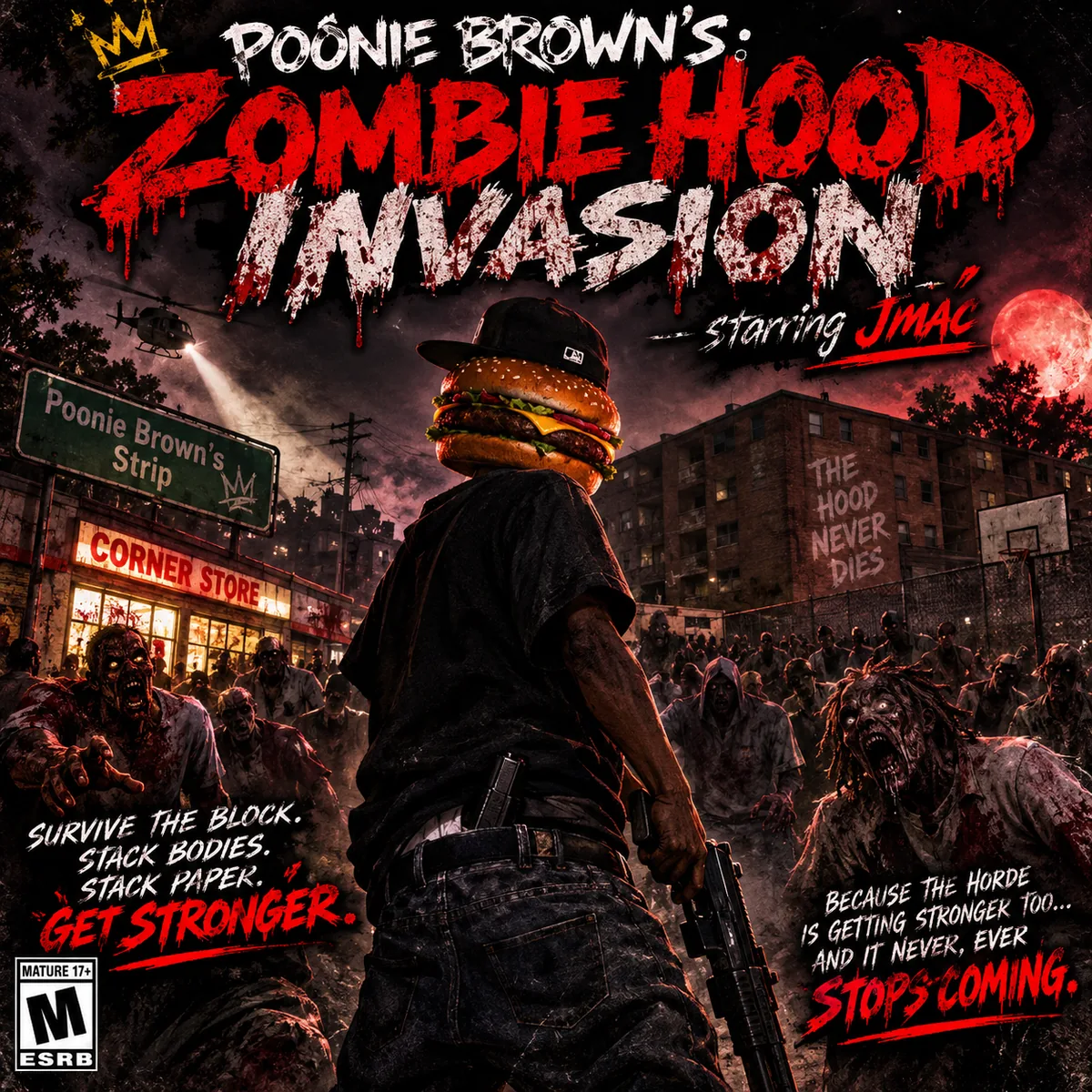
Poonie Brown's: HZG
A free browser roguelite in which a cheeseburger-headed survivor named Jmac auto-fires at a city-sized zombie horde while the player positions, drafts upgrades, and chases the next power spike.
#40 this weekAI-assisted: ai.codeclaude opus 5.5
The game runs in this tab. No install, no account.
The short answer
Poonie Brown's: HZG drops a cheeseburger-headed survivor into an endless procedural block overrun by zombies. Jmac fires on his own, so the work is reading the crowd, kiting through alleys, and choosing between a new gun, a weapon level, or a passive at each level-up. Runs last five to twenty minutes and the game runs in a browser for free.
What is Poonie Brown's: HZG?
Poonie Brown's: HZG is a top-down survival shooter that plays in a browser window. The block has gone bad from the water down to the people, and the last one standing on the strip is Jmac, a survivor with a cheeseburger for a head and a nine in his waistband. There is no backup and nowhere else to be, so the plan comes down to holding the street, dropping bodies, and banking cash while the infection keeps producing replacements.
The structure is a roguelite with an extraction flavour: a session runs five to twenty minutes, every level-up freezes the action for a draft, and dying throws the whole run away. The horde escalates on a thirty-second clock, which means a build that feels comfortable at two minutes has to keep pace with a street that gets meaner while it is being rebuilt.
The city, the enemies, and the effects are all generated at runtime from a single HTML5 file that opens with no install and no download step. One player, one character, and an endless supply of things trying to close the distance.
How to play
Jmac handles the shooting. He auto-fires at whatever target is nearest, never reloads, and never needs a threat picked out for him. Positioning is the real skill: reading where the crowd is densest, pulling the mass away from open ground, and steering pursuers into chokepoints such as a narrow fence gap, the mouth of an alley, or the corner of an apartment block.
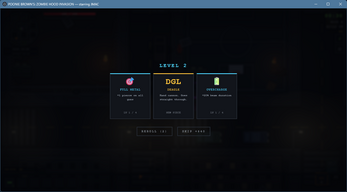
Kills feed experience, and each level-up stops time for a three-card draft. Gold cards add a brand new weapon, green cards raise the level of something already carried, and blue cards add a passive. Every weapon sits eight levels deep and up to six can be carried at once, so each draft is a trade between breadth of arsenal and depth in a favourite.
Two rerolls come with each run by default, with the Blessed passive handing out extra ones and widening hands from three cards to five. Taking none of the offered cards pays out forty dollars instead. The pressure is that difficulty climbs every thirty seconds whether the draft went well or not, and death ends the attempt outright.
Controls
Desktop play is keyboard and mouse. WASD or the arrow keys move Jmac, Shift sprints, and Escape pauses. Firing continues on its own while the player concentrates on footwork, which is why moving well matters more than clicking fast.
Manual aim is optional but available. Moving the mouse overrides the auto-targeting, and holding the left mouse button forces fire at the cursor, which is useful for finishing a specific enemy inside a packed crowd rather than letting Jmac pick his own target.
Touch input is detected automatically on mobile. The left half of the screen becomes a virtual stick for movement, while the right half accepts taps and drags for aiming and forced fire. Weapons keep firing without any input at all, so a touch player can spend attention entirely on where to stand.
| Input | Action |
|---|---|
| WASD or arrow keys | Move Jmac |
| Shift | Sprint |
| Mouse | Manual aim that overrides auto-targeting |
| Left click (hold) | Force fire at the cursor |
| Escape | Pause |
| Left half of touch screen | Virtual stick for movement |
| Right half of touch screen | Tap or drag to aim and force fire |
Tips for your first run
The opening minutes are about learning what the block does before the block does it to you. A handful of habits hold up better than raw firepower.
- Fight with the terrain. Buildings, parked cars, dumpsters, and fence lines are all baked into the pathfinding grid, so turning a corner converts a wide crowd into a queue.
- Hunt the Hollerer early. Its scream sends every zombie nearby into a rage, and a rage wave arriving mid-kite ruins an otherwise clean route.
- Give the Bruiser room. Its 110 HP frame barely registers knockback, so trading shots at close range is a losing exchange.
- Step off the acid. Spitters lob burning pools onto the pavement, and standing still to shoot is exactly what those pools punish.
- Scan the screen edges. Off-screen arrows mark elites, which arrive oversized, gold-crowned, with triple health and four times the loot.
- Back into alleys with the Boombox running. The aura damages and slows everything around Jmac, which buys the seconds needed to reload a bad position.
Content and replayability
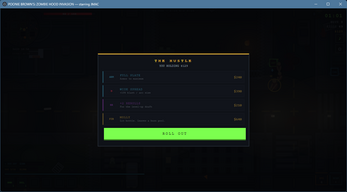
Nine weapons span four roles. Guns include a starting nine that scales into multi-shot, a MAC-11 firing three-round bursts, a pump shotgun that throws six pellets and reaches eleven at max level, a piercing hand cannon, and a full-auto rifle that punches through two targets. Melee, thrown, and aura options round out the list: a wide-swinging nail bat, an arcing molotov that leaves fire on the ground, a staggering brick, and a boombox that pulses damage and slow.
Twenty passives share the same draft screen, each capped and multiplicative with the whole arsenal. Combining Double Tap with Full Metal on a maxed Choppa is the sort of stack the system rewards when the cards cooperate.
Six enemy archetypes keep the pressure varied: the slow baseline Shambler, the sprinting Fiend, the low Crawler, the ranged Spitter, the tanky Bruiser, and the support Hollerer. Elites join at escalating rates. The city itself generates forever from a seed, covering crosswalks, apartment blocks with lit windows, fenced vacant lots, basketball courts, small parks, burning barrels, wrecked cars, hydrants, and shopping carts. The roadmap puts more upgrades and more weapons next.
Presentation and performance
The look is procedural rather than asset-driven. There are no image files and no engine underneath; every pixel is drawn to a canvas at runtime under a dusk wash, with warm pools of streetlight and flickering barrel fire. Hit flashes, knockback scaled to enemy mass, gold crit tracers with gold damage numbers, bouncing shell casings, and per-weapon screen shake carry the impact, while zombies claw their way up out of the asphalt as they spawn.
The simulation runs on a fixed 60Hz timestep with an uncapped render rate. Crowd navigation uses an 80x80 breadth-first cost field rebuilt eight times a second, so hundreds of zombies flow through alleys and around cars rather than marching in a line. The target is a locked 60 frames per second with 300-plus active zombies on desktop, while mobile auto-scales the density cap to 170.
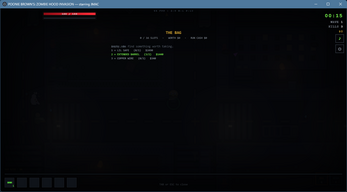
The interface keeps the essentials visible: health and armour in the top left, survival timer, wave, kills and cash in the top right, an XP bar with six weapon slots and level badges along the bottom, and live frame rate with zombie, bullet, and particle counts at the top centre. Display scaling respects device pixel ratio up to twice, and the layout works in portrait or landscape.
Who should play it
This suits players who like top-down survival shooters and bullet-hell crowds but would rather solve a position than a crosshair. The draft is the hook: every level-up asks whether to broaden the arsenal, deepen one gun, or take a passive that multiplies everything already owned, and the answer changes as the horde thickens.
Short sessions make it easy to fit in a run. Five to twenty minutes covers a full attempt, the browser build needs no install, and touch controls mean the same game travels to a phone. Anyone who wants direct control can still aim with the mouse or drag on the right side of the screen, but the default is hands-off shooting.
Players who need a finished product should note that the game is in development, with more upgrades and more weapons planned beyond the current arsenal, passives, and city generation. Release timing is set at 04 November 2026, 04:50 UTC, and play costs nothing.
Screenshots
How we tested it
The build was loaded from games.debutplay.com in a headless Chromium session on ; the canvas started and no request was blocked. The guide was last checked on .
From the developer
# 📄 STORE PAGE / GAME OVERVIEW Copy-paste ready for, Newgrounds, GameJolt, or your own site. --- ## POONIE BROWN'S: ZOMBIE HOOD INVASION ### *starring Jmac* **Genre:** Top-Down Survival Roguelite / Extraction **Platform:** Browser (HTML5 — desktop & mobile) **Players:** 1 **Session Length:** 5–20 minutes per run **Price:** Free **Install:** None. One file. Click and run. --- ### THE SITUATION The block went bad overnight. Something got in the water, got in the food, got in the people — and now every corner store, every basketball court, every vacant lot on Poonie Brown's strip is crawling with the infected. The shamblers came first. Then the fiends. Then things that holler and make the dead run faster. Everybody else got out. **Jmac didn't.** He's still out there with a cheeseburger for a head, a nine in his waistband, and absolutely nowhere to be. Survive the block. Stack bodies. Stack paper. Get stronger every single level —…
Frequently asked questions
Is Poonie Brown's: HZG free?
Yes. It is a free browser game with no install step; one HTML5 file loads and runs, and no payment is attached to play.
Does the game work on phones?
Yes. The browser build covers desktop and mobile, touch input is detected automatically, and the zombie density cap drops to 170 on mobile hardware.
Do players have to aim?
No. Jmac auto-fires at the nearest target and never reloads. Aiming is optional: the mouse overrides auto-targeting on desktop, and the right side of a touch screen can be dragged to aim and force fire.
How long does one run last?
Five to twenty minutes. Death ends the run and takes everything with it, so the loop expects a fresh attempt rather than a recovery.
How much content is in the build?
Nine weapons with eight levels apiece, six carried at once, twenty passives drawn from the same card screen, six enemy archetypes, recurring elites, and an endless procedural city.
What state is the game in?
It is in development, with a publish time of 04 November 2026 at 04:50 UTC. Core engine, horde AI, arsenal, progression, city generation, and run flow are all present, with more upgrades and weapons planned next.
What games are similar to Poonie Brown's: HZG?
The closest matches on DebutPlay are ECHOES OF THE VOID, Onion Dweller Game: MyMy's Rescue Mission, HELLBREACH: TARTARUS. They share the same genre, so the controls and the pace carry over.
Something wrong or missing? Tell us. How we test games.