Adventure · New game
PORTHOLE
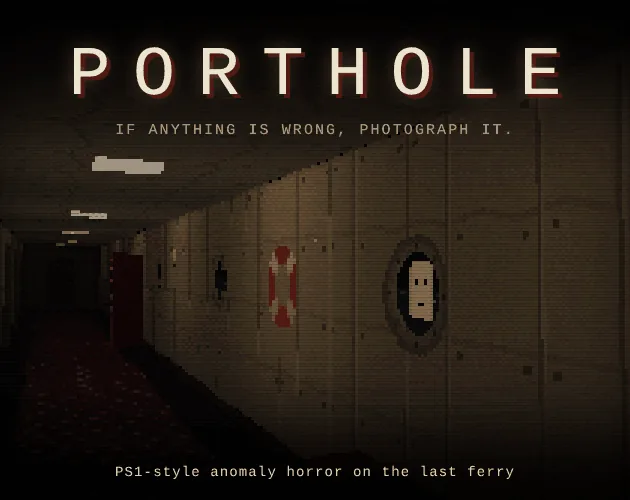
A night purser walks the same ferry corridor, photographs what should not be there, and learns how the crossing ends.
#39 this weekAI-assisted: Code, Graphics, Sound, Text
The game runs in this tab. No install, no account.
The short answer
PORTHOLE is a short first-person horror adventure aboard the 23:40 ferry to Rinsewick. The night purser patrols B deck, checks familiar landmarks, and photographs anomalies before they are missed. The full game costs $2.99 and includes all 33 anomalies, hunters, the album, and both endings.
What is PORTHOLE?
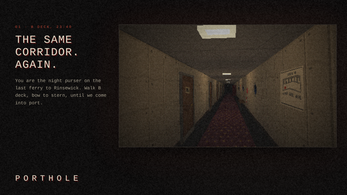
PORTHOLE is a first-person horror adventure set on the 23:40 ferry to Rinsewick. The player is the night purser, assigned to walk B deck from bow to stern repeatedly until the ship reaches port. The corridor is deliberately familiar: seven cabin doors, six portholes, a clock, a vending machine, and a captain's portrait at the far end. That routine is the baseline for the game's central task.
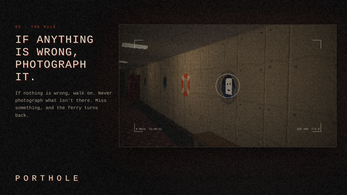
The job is to compare each pass with the last. An anomaly can be a repeated door number, midnight daylight through a porthole, a reversing clock, eyes offered by the vending machine, or a face at the glass. If something is wrong, the purser photographs it and continues. If the corridor is normal, the purser simply walks on. Photographing something that is not present is forbidden, and an overlooked anomaly causes the ferry to turn back.
The release is a short, atmospheric adventure with 33 possible irregularities, a photo album, hunters, and two endings. It was published on 23 October 2026 for HTML5, Windows, macOS, and Linux, and the full game costs $2.99. The singleplayer structure keeps attention on observation and the next pass.
How to play
A run is built from repeated crossings of B deck. The purser starts at the bow, moves toward the stern, and uses the fixed landmarks to judge whether the corridor has changed. The correct response is narrow: capture a genuine anomaly with the camera, or leave the camera down when everything is in order. Missing a change is the failure state that sends the ferry back.
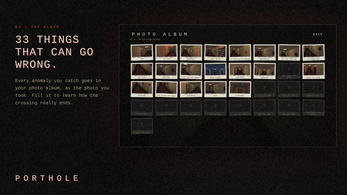
Each valid photograph goes into the album. The album records the player's catches across crossings and leads toward the night's conclusion. The full game has 33 anomalies, along with hunters and two endings. A demo stops four nautical miles from port and includes 12 anomalies, so the complete album and both conclusions are part of the full game.
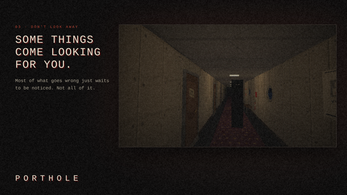
A single crossing is short, roughly 15 to 30 minutes, while completing the album takes considerably longer. The pacing comes from repeating the same route and watching for differences. The purser must be careful on every pass because some anomalies are passive and some actively seek attention.
Controls
Movement uses WASD or the arrow keys, while the mouse turns the view. Holding the right mouse button or Q raises the camera. A left click or F takes a photograph. Esc pauses the game. These bindings cover the basic loop: walk the deck, look carefully, raise the camera only when needed, and capture the irregular detail. Keyboard and mouse form the control setup, and raising the camera is a held action rather than a toggle.
If the browser refuses to lock the pointer, the fallback is to drag with the mouse to look and click to take a photo. The settings menu includes pointer sensitivity, Y-axis inversion, brightness, volume, and a reduced-flash option. The last setting matters because the game carries warnings for flashing lights, sudden loud sounds, and darkness.
| Input | Action |
|---|---|
| WASD / arrow keys | Walk |
| Mouse | Look around |
| Right mouse button or Q (hold) | Raise the camera |
| Left click or F | Take a photo |
| Esc | Pause |
| Mouse drag | Look around when the browser does not lock the pointer |
| Click | Take a photo when the browser does not lock the pointer |
Tips for your first run
Treat the corridor as a checklist, not scenery. Seven doors, six portholes, the clock, the vending machine, and the captain's portrait provide fixed reference points. Compare those landmarks in sequence on every pass, because the anomaly may be a small mismatch rather than a dramatic set piece.
Only take the shot when the change is real. A false capture conflicts with the rule against photographing what is absent, and an ignored anomaly sends the ferry back. Use the album to review catches and see what is already recorded.
- Walk the full bow-to-stern route before deciding that a pass is clean.
- Check the clock against the portholes; daylight at midnight is an anomaly.
- Look at the vending machine and the far portrait as carefully as the cabin doors.
- Play with headphones and the lights off, and adjust brightness only if needed.
- Expect 15 to 30 minutes for one crossing and much longer for a full album.
Content and replayability
The content set is built around 33 anomalies. The album turns each successful photograph into a record, giving the player a reason to keep crossing after the first ending. Two endings provide different conclusions to the night, and hunters add pressure beyond simple observation. The full game includes all of this; the demo covers 12 anomalies and ends four nautical miles from port.
A crossing lasts about 15 to 30 minutes, but album completion stretches well beyond a single run. Replayability comes from spotting missed details, filling gaps in the album, and reaching both endings. The game is singleplayer and contains no gore, though it warns about flashing lights, abrupt loud sounds, and darkness.
Priced at $2.99, PORTHOLE presents a compact horror adventure rather than a long campaign. Its replay hook is the collection itself: every new photograph is proof of a catch, and every missed anomaly is a reason for another pass.
Presentation and performance
PORTHOLE uses a PlayStation-era look: low resolution, wobbling vertices, warped textures, fog, and a 15-bit dither. Audio is built from the ferry's engine drone, metal creaks, and water hitting the hull. Headphones and a dark room are the intended presentation, and the reduced-flash setting is available for players who need it.
The browser build runs in Chrome, Edge, or Firefox from an included index file, requires no installation, and works offline. It is also released for Windows, macOS, and Linux. The project ships without separate image or audio files; its textures, models, and sounds are generated in code. Generative AI contributed to code, graphics, sound, and text.
Available options cover brightness, volume, pointer sensitivity, and Y-axis inversion. The game warns about flashing lights, sudden loud sounds, and darkness, so the presentation is intentionally tense rather than comfortable.
Who should play it
PORTHOLE is for players who enjoy first-person psychological horror, liminal spaces, and the low-resolution texture of PlayStation-era games. The appeal is in careful observation: seven cabin doors, six portholes, a clock, a vending machine, and a captain's portrait become the whole stage for a night of small wrongnesses.
It suits short-session players who want a complete crossing in 15 to 30 minutes, as well as completionists drawn to a 33-anomaly album and two endings. The $2.99 price makes it a compact purchase. It is not aimed at players who avoid flashing lights, sudden loud sounds, or dark scenes; the game carries those warnings and contains no gore.
Anyone expecting a long campaign should adjust expectations. The focus stays on the ferry corridor, the camera, and the next anomaly. The singleplayer design keeps the player alone with the corridor and the album.
Screenshots
How we tested it
The build was loaded from games.debutplay.com in a headless Chromium session on ; the canvas started and no request was blocked. The guide was last checked on .
From the developer
The 23:40 ferry to Rinsewick. You are the night purser. Walk B deck, bow to stern, again and again, until the ship comes into port. You know this corridor: seven cabin doors, six portholes, a clock, a vending machine, the captain's portrait at the far end. If anything is wrong, take a photograph of it - then walk on. If nothing is wrong, just walk on. Never photograph what isn't there. Miss something, and the ferry turns back. 33 THINGS THAT CAN GO WRONGA door number that repeats. Daylight in a porthole at midnight. A clock running backwards. Eyes for sale in the vending machine. A face at the glass. Some anomalies wait to be noticed. Some of them come looking for you. THE PHOTO ALBUMEvery anomaly you catch is kept in your album, as the photograph you took. Fill it across your crossings - and find out how the night really ends. Two endings. PLAYSTATION DREADLow resolution, wobbling vertices, warped textures, fog and a 15-bit dither,…
Frequently asked questions
How much does PORTHOLE cost?
The full game costs $2.99.
What platforms is PORTHOLE on?
It is released for HTML5, Windows, macOS, and Linux. The browser build opens in Chrome, Edge, or Firefox and works offline without installation.
How long is one crossing?
A crossing takes about 15 to 30 minutes. Filling the photo album takes much longer.
How many anomalies are there?
The full game has 33 anomalies. The demo stops four nautical miles from port and includes 12.
Does PORTHOLE have multiple endings?
Yes. The full game includes two endings, along with hunters and the album.
What content warnings apply?
PORTHOLE warns about flashing lights, sudden loud sounds, and darkness. It contains no gore.
What games are similar to PORTHOLE?
The closest matches on DebutPlay are The Little Island Lighthouse, Ashcombe Green, DEPT 99 SUPER JAM. They share the same genre, so the controls and the pace carry over.
Something wrong or missing? Tell us. How we test games.