Strategy · New game
Squadron CO: Battle of Britain
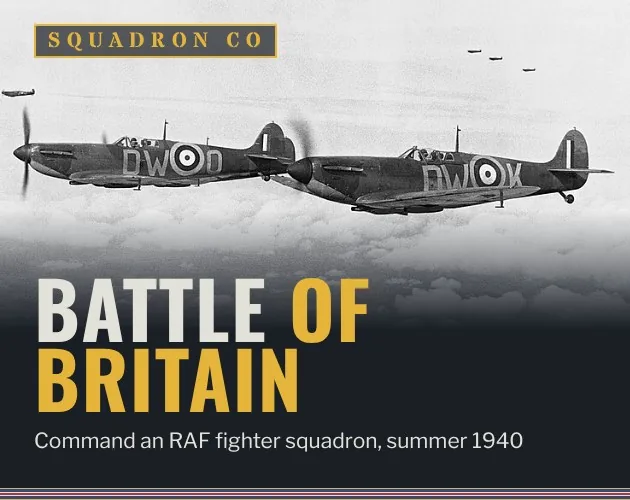
A free, turn-based browser game about running an RAF fighter squadron through eight operations in the summer of 1940, where the pilots you send up may not come back.
#5 this weekAI-assisted: Code, Graphics, Text
The game runs in this tab. No install, no account.
The short answer
Squadron CO: Battle of Britain is a free browser strategy game set in August 1940. You command fifteen pilots, their Hurricanes or Spitfires, and a grass field in Kent, deciding who flies in each section and how every raid is fought across eight operations. A campaign takes about half an hour and saves itself as you go.
What is Squadron CO: Battle of Britain?
Squadron CO: Battle of Britain is a free strategy and simulation game about running an RAF fighter squadron through the weeks that decided the Battle of Britain. The setting is August 1940, with the Luftwaffe pressing the radar stations and airfields of No. 11 Group while your unit sits on a grass field under the North Downs in Kent.
The roster is fifteen pilots flying Hurricanes or Spitfires, and the premise is blunt about your role: the aircraft are not yours to fly, only to hand out. Eight operations cover raids taken from the historical record, from mid-August through to the massed attacks on London on 15 September, and the specific days drawn for each campaign change from run to run.
The pilots, the squadron and its airfield are fictional; the operations follow real raids of 1940. Wartime photographs are drawn from open and public domain sources, while pilot portraits are AI-generated. The game was created by Frederic Janik and runs in a browser.
How to play
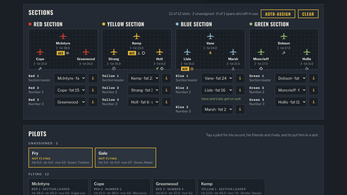
Every operation starts with an order of battle. Pilots are placed in Red, Yellow, Blue and Green sections, and each section needs a leader, so the opening move is a judgment about skill, experience and who can hold a formation together. From there you decide how the squadron meets each raid: a beam attack on the bombers, a head-on pass straight through the formation, or a climb after the escorting 109s.
There is a second tactical fork attached to every raid. You can take time to climb for height before engaging, or go straight in before the bombs fall. Neither is free — height costs time, and time is what the bomber stream is using.
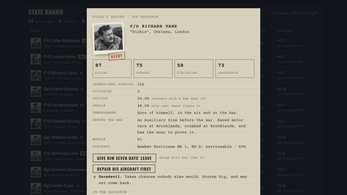
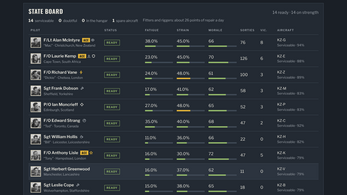
Between operations the pressure shifts to people and equipment. Fatigue, strain and morale all move, and there is never enough slack to rest everyone, so tired pilots keep flying and tired pilots make mistakes. The aircraft have to be kept serviceable with too few fitters on a field that keeps getting bombed, and the adjutant's desk keeps producing decisions: a boy with nine hours on type, a telegram from a bombed-out family, Group on the telephone. Three difficulty levels are available, a campaign runs roughly half an hour, and progress saves automatically.
Controls
Orders are issued at squadron level, not from a cockpit. Play is turn-based and text-led: a plan is committed, the raid resolves, and the result comes back as a report to read rather than a sequence to fly through.
The first set of levers is personnel — which pilots fill the Red, Yellow, Blue and Green sections and who leads each of them. The second is tactical: choosing a beam attack on the bombers, a head-on pass through the formation, or a climb after the escorting 109s, plus the separate call on gaining height first or going in before the bombs fall.
The third set is administrative. Someone has to be stood down, and the small pool of fitters has to be spread across aircraft sitting on a field that is itself a target. Everything else arrives as a decision on the adjutant's desk — the boy with nine hours on type, the telegram from a bombed-out family, Group on the telephone — and each item has to be answered before the next operation begins.
There is no stick-and-throttle flying and no real-time dogfighting to execute in the moment. The outcome comes from the plan, the condition of the pilots and the state of the airfield.
The game page does not list its controls. Check the in-game tutorial or pause menu for the current scheme.
Tips for your first run
The first campaign is really a lesson in scarcity. Fifteen pilots sounds generous until fatigue, strain and morale start moving in the same direction, and the sections you would like to field are rarely the sections you can field. Treat the roster as a rotation rather than a first eleven, and expect to lose people.
The second lesson is that the raid in front of you has a clock attached. Climbing for height buys an advantage but spends time you may not have before the bombs fall; going straight in protects the target but hands the advantage to the escort. Decide which of those two you can afford before committing.
- Rotate sections between raids. With no way to rest everyone, the same tired pilots flying every operation are the ones making the mistakes.
- Use beam attacks when the bombers are the objective and the escort is a secondary problem.
- Take the height when the raid is heading for London and the bombers must be stopped before they reach it.
- Watch the field as closely as the pilots: too few fitters and bomb damage will ground aircraft you were counting on.
- Start on the lowest of the three difficulty levels while learning how fast fatigue accumulates; a half-hour campaign is short enough to replay.
Content and replayability
Five starting situations set the tone of a campaign. A regular Hurricane squadron is the baseline; others begin with a unit back from France or one filled with Polish and Czech pilots. Aircraft can be Hurricanes or Spitfires, and pilots are drawn at random with their own skills, traits, friendships and rivalries, so the same eight operations play differently depending on who is on the roster.
Every raid follows the day-by-day record of 1940, but the days selected vary between campaigns. Combat reports and wartime photographs fill out the picture, and a squadron record keeps track of who was lost. Three difficulty levels and a campaign length of around half an hour keep a run tight enough to repeat immediately.
Separate packs extend the same idea to other theatres: longer Battle of Britain campaigns of sixteen and twenty-four operations spanning the July convoys to the October fighter-bomber raids, a USAAF Mustang squadron escorting bombers to Berlin in spring 1944, a Luftwaffe Staffel facing the bomber streams, Marine Wildcats at Henderson Field from August to November 1942, a French fighter groupe from 10 May 1940 to the armistice, and the American Volunteer Group over Burma and China.
Presentation and performance
The look of the game leans on its documents. Combat reports carry the outcome of each raid, wartime photographs set the period, and the squadron record gives the campaign a memory of its losses. Pilot portraits are AI-generated, while the wartime photographs come from Wikimedia Commons, public domain or open licences, with the full list kept inside the game.
This is a text-based, turn-based design rather than an action game, which suits the browser format: the build is HTML5, so there is nothing to install and no equipment to benchmark. The half-hour campaign length pairs well with automatic saving, since a run can be picked up across short sittings without losing the state of the squadron.
The tone stays dry and administrative. Much of the tension arrives in prose — a pilot's nine hours on type, a telegram from a bombed-out family, Group on the telephone — rather than in spectacle, and losses are recorded rather than dramatised.
Who should play it
This is for players who want the command side of the Battle of Britain rather than the cockpit. The appeal sits in management and strategy: balancing a finite pilot roster against fatigue and morale, deciding who leads a section, and choosing an attack profile knowing the choice cannot be undone once the raid goes in.
It also suits readers. The game is text-based and turn-based, so the rewards come from interpreting reports, weighing a request from the adjutant's desk, and living with a squadron record that remembers who did not come back. Anyone who enjoys aviation history, and specifically the summer of 1940, will recognise the shape of the operations.
It is a poor fit for anyone who wants to fly a Spitfire. You do not handle the aircraft at all — you decide who does. With five starting situations, randomised pilots and raids drawn from different days, a free half-hour campaign is easy to start again with a different squadron.
Screenshots
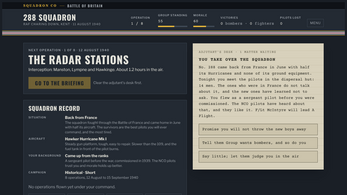
How we tested it
The build was loaded from games.debutplay.com in a headless Chromium session on ; the canvas started and no request was blocked. The guide was last checked on .
From the developer
Command an RAF fighter squadron through the weeks that decided the Battle of Britain. August 1940. The Luftwaffe has turned on the radar stations and the airfields of No. 11 Group, and your squadron is in the front line: fifteen pilots, their Hurricanes or Spitfires, and a grass field under the North Downs in Kent. Eight operations against real raids, from mid-August to the great attacks on London on 15 September, drawn from different days each time. You don't fly the aircraft. You decide who does. WHAT YOU DO • Choose who flies in Red, Yellow, Blue and Green sections, and who leads them • Decide how to go at each raid: beam attacks on the bombers, head-on through the formation, or up after the escorting 109s; climb for height first, or go straight in before the bombs fall • Watch fatigue, strain and morale. There is no time to rest everyone, and tired pilots make mistakes • Keep the aircraft flying with too few fitters and a field…
Frequently asked questions
Is Squadron CO: Battle of Britain free?
Yes. It is free to play in a browser, with no purchase required to start a campaign.
Do you fly the aircraft yourself?
No. You command the squadron from the ground: you choose which pilots fly in the Red, Yellow, Blue and Green sections, who leads them, and how each raid is fought.
How long does a campaign take?
About half an hour. A campaign is built from eight operations, and progress saves automatically, so it can be spread across several sittings.
Is there multiplayer?
No. The game is single-player only.
What platforms does it run on?
It is an HTML5 build that plays in a browser, so no installation is needed.
Is the history accurate?
The operations follow real raids of 1940, from mid-August to the attacks on London on 15 September. The pilots, the squadron and its airfield are fictional.
What games are similar to Squadron CO: Battle of Britain?
The closest matches on DebutPlay are Rooftop, Piastland, THE VOTE. They share the same genre, so the controls and the pace carry over.
Something wrong or missing? Tell us. How we test games.