Simulation · New game
Taco Rush
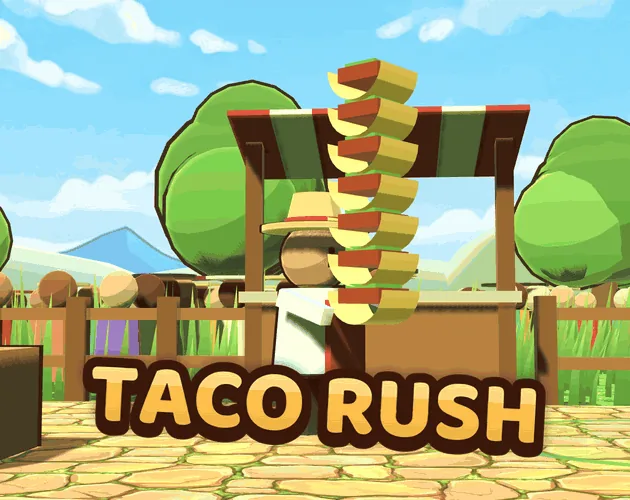
A one-finger carry-and-stack rush through 50 days, five maps and one Festival of the Valley, with Abuela Lupe's taco stand as the prize.
#9 this week
The game runs in this tab. No install, no account.
The short answer
Taco Rush is a free browser cooking game about saving a family taco stand. Slice meat at the trompo, stack hot tacos and run them to the window before the crowd at the fence walks out, chase a streak that climbs to +50% per sale, and put the takings back into a bigger stand. Fifty days, five maps, one Festival of the Valley.
What is Taco Rush?
Taco Rush is a browser-based cooking simulation built around a family taco stand with a deadline hanging over it. Abuela Lupe's stand sits on the plateau and is about to be sold; the way out is the Festival of the Valley, which has to be won inside 50 days for the stand to stay in the family. Stephanie Nguyen of Left-Over Games designed the taquero and Abuela Lupe, along with the 50-day story, the carry-and-stack rules and the tuning.
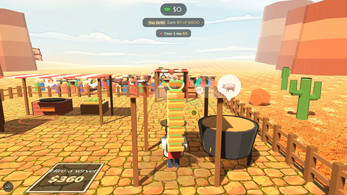
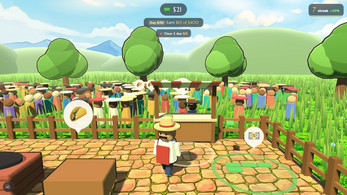
The core is a physical rush rather than a menu-heavy management sim. Meat is sliced at the trompo, dropped onto the comal, and the finished tacos are stacked as high as the taquero can carry before the sprint to the window. Everything is low-poly 3D rendered live in the browser, and it is free to play with no account and no in-app purchases in this version.
Days are short by design, a minute or two apiece, so a session turns into a string of quick attempts at a cleaner day rather than one long sitting at a desk.
How to play
Each day runs on the same routine. Slice meat at the trompo, drop it on the comal, let the tacos build, then stack them as high as the carry rules allow and take the load to the service window. Stacking is where the risk lives: a taller load moves more food per trip, and the tension sits between carrying plenty and getting there quickly.
The crowd at the fence will not wait indefinitely. Miss an order and those customers walk out; keep them fed and the streak climbs until it reaches +50% per sale. A clean run is therefore worth noticeably more than a scrappy one, which matters because the day's takings feed the upgrade list.
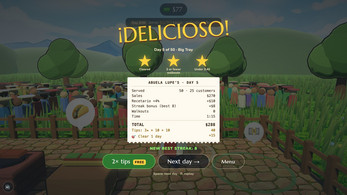
At the close of business an itemised receipt breaks down the day, three stars are up for grabs, and a verdict stamp lands somewhere between ¡BUENO! and ¡DELICIOSO!. Cash goes back into the stand through a second comal, a salsa bar, a bigger tray, and eventually hired help in the shape of a runner and a server.
Controls
Taco Rush is built for one finger. Dragging anywhere on the screen walks the taquero in that direction, and both touch and mouse work. Keyboard players can use the arrow keys or WASD instead. There is no separate button for the work itself: cooking, picking up, serving and collecting all happen simply by walking up to the relevant station or customer.
Between days the inputs change slightly. Space starts the next day and R replays the one just finished, so a weak result can be chased again without hunting through menus. A speaker button in the bottom left corner handles sound.
Because the same drag-or-keyboard scheme covers phone, tablet and computer, changing devices does not mean relearning anything. The control layer stays deliberately thin, which keeps the pressure on the queue at the fence and the height of the stack rather than on a complicated input set.
| Input | Action |
|---|---|
| Drag anywhere (touch or mouse) | Walk |
| Arrow keys or WASD | Walk |
| Walk up to a station or customer | Pick up, cook, serve and collect |
| Space | Start the next day |
| R | Replay the day |
| Speaker button, bottom left | Toggle sound |
Tips for your first run
Treat the opening days as a chance to learn what a full stack feels like to deliver rather than as a pure cash race. The stand's upgrade path runs in a set order, from a second comal to a salsa bar to a bigger tray, with a runner and a server arriving later, so early money is best spent moving along that line instead of saving for a hire that comes further down the track.
The streak carries the money. Customers who are kept fed push the bonus upward until it reaches +50% per sale, so a day that ends with a queue still waiting costs twice over: lost sales and a lost multiplier. Reading the fence and choosing a stack that can actually be delivered is the whole skill.
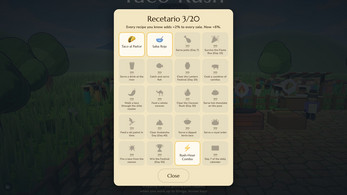
- Discover recipes in the Recetario; all 20 add +2% to every sale permanently, so the collection compounds.
- Read the itemised receipt after each day to see where the money went and how the three stars were judged.
- Use R to replay a day that falls apart rather than carrying a weak result into the next one.
- Three daily missions and a seven-day calendar give short-term targets, and day seven holds a mystery box.
- Copy the save code from the Journal if play needs to move to another browser.
- Branch stands keep earning while away, so time off is not automatically lost progress.
Content and replayability
Fifty days form the spine of the campaign, spread across five locations: Plateau Plaza, River Bridge Market, Canyon Outpost, Snowy Mountain Pass and the Sky Ruins. Each map brings its own twist rather than a reskin. The conditions referenced include wobbly planks, fish, desert shade, caravans, frozen meat, ski patrols, birria and the Festival itself, so the surroundings change how a delivery run feels and not just how it looks.
Longer-term progression sits on three tracks. The Recetario holds 20 recipes, each worth a permanent +2% on sales. The stand grows through the comal, salsa bar, tray, runner and server upgrades. Branch stands continue to earn while the player is elsewhere, which softens the cost of stepping away for a while.
Short-term structure comes from a seven-day calendar with a mystery box on day seven, plus three daily missions. Add three stars per day, a verdict stamp and a replay key, and the loop invites a second attempt at any day that did not go to plan.
Presentation and performance
Everything on screen is rendered live by the game in low-poly 3D inside the browser. Nothing needs installing, and the same build runs on phone, tablet and computer with touch, mouse or keyboard input. The art style keeps geometry simple and readable, which suits a game where the important information is a stack height and a queue at a fence.
Production is credited to Stephanie Nguyen, trading as Left-Over Games, with AI tools assisting. The sky and ground textures were made with AI image tools and the game was built with AI coding tools, while the design, the 50-day story and the carry-and-stack tuning are attributed to Nguyen. That mix is worth knowing if the environment looks different in character from the hand-built figure work.
Sessions are short by construction, with a day lasting a minute or two, so there is little downtime to sit through. Progress is kept on the device, with a save code available for moving it elsewhere.
Who should play it
Anyone who likes the idea of a cooking rush but does not want a spreadsheet should settle in quickly. The one-finger scheme means walking and stacking start within seconds, and the walk-up-to-interact rule removes the usual button hunting. Players who enjoy time-management pressure, with a queue that walks out and a multiplier that rewards a tidy run, are the obvious audience.
It also suits short breaks. A day takes a minute or two, which makes one easy to fit in and easy to follow with another. Since it runs in a browser on phone, tablet or computer with no account and no in-app purchases in this version, trying it asks for nothing but a click.
Completionists get the Recetario's 20 recipes, three stars on every one of the 50 days, daily missions and a seven-day calendar. Players who want a reason to keep going get Abuela Lupe, the plateau stand and the Festival of the Valley. What it does not offer is a second player, as this is a singleplayer stand.
Screenshots
How we tested it
The build was loaded from games.debutplay.com in a headless Chromium session on ; the canvas started and no request was blocked. The guide was last checked on .
From the developer
Designed by Stephanie Nguyen (Left-Over Games): the taquero and Abuela Lupe, the 50-day story, the carry-and-stack rules and the tuning are hers. AI tools assisted production. Taco Rush is a carry-and-stack restaurant rush with 50 days to save a family taco stand. Abuela Lupe's stand on the plateau is about to be sold. Win the Festival of the Valley in 50 days and it stays in the family. Every day you slice meat at the trompo, drop it on the comal, stack the hot tacos as high as you can carry and race them to the window. The crowd at the fence won't wait forever: miss them and they walk out, keep them fed and your streak climbs to +50% per sale. Features One-finger controls: drag anywhere to walk; everything else happens when you walk up to it.50 days across 5 maps: Plateau Plaza, River Bridge Market, Canyon Outpost, Snowy Mountain Pass and the Sky Ruins, each with its own twist (wobbly planks and fish, desert shade and caravans,…
Frequently asked questions
Is Taco Rush free to play?
Yes. It is free to play in the browser, with no account and no in-app purchases in this version.
What do you actually do in Taco Rush?
Slice meat at the trompo, drop it on the comal, stack the finished tacos as high as the carry rules allow, and race the load to the service window before the waiting crowd leaves.
How long does the campaign run?
Fifty days across five maps, ending with the Festival of the Valley. Individual days are short, taking a minute or two each.
Can it be played on a phone or tablet?
Yes. The low-poly 3D build runs in the browser on phone, tablet or computer, with touch, mouse or keyboard input.
Does progress carry over between sessions?
Progress including days cleared, stars, cash and tips, upgrades, recipes, calendar, missions and the sound setting is saved on the device. The Journal can produce a save code to move it to another browser.
Is there multiplayer?
No. Taco Rush is a singleplayer game about one taquero working one family stand.
What games are similar to Taco Rush?
The closest matches on DebutPlay are Maré de Azar (Demo), I’m the Ticket Gate, Warm Water. They share the same genre, so the controls and the pace carry over.
Something wrong or missing? Tell us. How we test games.