Simulation · New game
Soju O'Clock
A rainy Korean street tent, three company evenings, and a legendary broth that keeps simmering: this launch guide covers what to expect before pressing Play.
#25 this weekAI-assisted: ai.textthe english translation of the in-game text was produced with generative ai (claude).
The game runs in this tab. No install, no account.
The short answer
Soju O'Clock is a free, short 3D simulation set in a Korean street tent on rainy evenings. It mixes ramen, soju, coworker scenes, drinking games, and a broth that keeps simmering in real time. Play in a browser or download the Windows version, then work toward one of five endings.
What is Soju O'Clock?
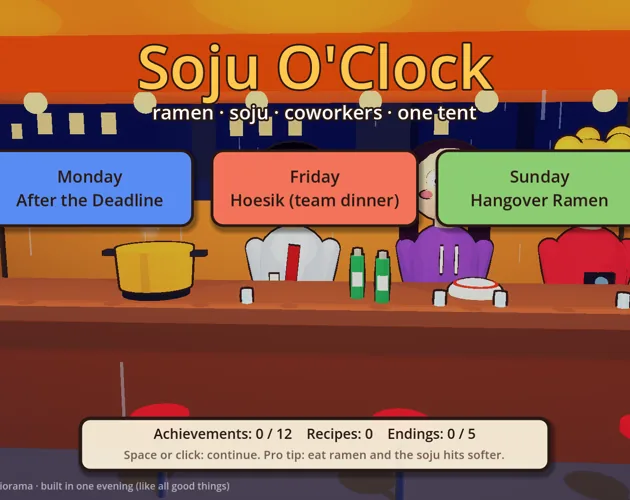
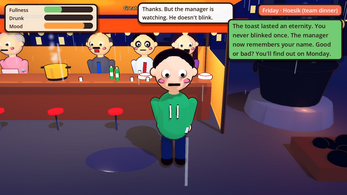
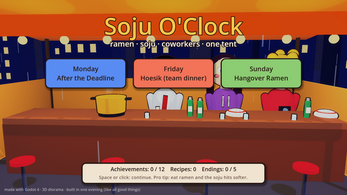
Soju O'Clock is a small 3D simulation from developer konstans02-sys, released on 4 November 2026. The setup is a Korean street tent, or pojangmacha, where rain falls outside and the evening centers on ramen and soju. The game is built around three evenings with three different companies. Monday is After the Deadline, with Min-su, who claims just one glass, and Su-jin, who counts every calorie. Friday is Hoesik, the team dinner led by Manager Park and his endless toast. Sunday is Hangover Ramen, with Tom and his camera plus a Korean grandpa who insists on drinking together.
The tent and yard are both walkable, and the game invites poking at objects, playing drinking games, and feeding the Great Broth. That broth is a legendary soup that has simmered for years and keeps developing in real time, including when the game is closed. Five endings wait at the other end, ranging from a taxi home to falling asleep on the subway and waking up in Incheon. The game is singleplayer, available in English and Russian, and intended for players 18 and older because it depicts alcohol consumption.
How to play
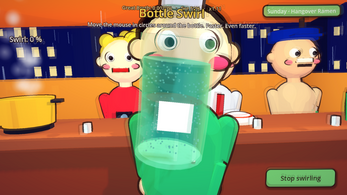
Soju O'Clock is not a passive dinner scene. You walk around the tent and yard, interact with objects, and let the evening unfold through hands-on activities. Chopsticks can dig through a bowl of ramen; the noodles bounce and part, toppings sit at the bottom, and a golden dumpling can turn up. The soju bottle has a cap tail that can be twisted with the mouse and flicked off, with the person who snaps it taking a drink. A bottle can also be swirled until a small tornado of bubbles forms, and cheese can be pulled up with chopsticks until the string thins, wraps the noodles, and snaps.
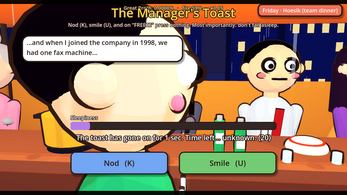
The named minigames push those actions into short challenges. Ramen recipes are cooked in a pot that boils over if the green zone is missed. A rhythm toast sends glasses sliding down the counter. A boss fight against the manager's toast asks for nodding and smiling while staying awake. Drinking changes the view: the camera sways, the screen doubles, and buttons swap places. Ramen sobers the character up a little, which makes it a useful counterweight during a long evening. Five endings give the three evenings a reason to be replayed.
Controls
Movement uses WASD or the arrow keys. E is the interact key for objects and people in the tent and yard. Q drinks from the bottle currently in hand, while F swirls that bottle. Mouse input controls hand activities, including chopstick work and the soju cap. Esc closes panels.
The control scheme is built for short, physical gags rather than a large command list. Walking up to a bowl or bottle and pressing the relevant key keeps the focus on the food and the drinking games. The mouse handles the fiddly parts: digging through ramen, pulling cheese, twisting the cap tail, and other hand-based actions. Because drinking can make buttons swap places, the controls are also part of the comedy. The browser build runs in a playable frame, and a Windows version is available for download.
| Input | Action |
|---|---|
| WASD or arrow keys | Walk |
| E | Interact |
| Q | Drink the bottle in hand |
| F | Swirl the bottle |
| Mouse | Hand activities, including chopstick work and the soju cap |
| Esc | Close panels |
Tips for your first run
Keep ramen close during heavy drinking. The camera sway, doubled screen, and swapped buttons are part of the drinking system, and ramen reduces those effects a little. In the cooking minigame, watch the pot rather than the conversation; missing the green zone causes a boil-over. During the rhythm toast, track the glasses as they slide down the counter, because the timing is the challenge. In the manager's toast boss fight, nodding and smiling are the actions that matter, while falling asleep is the failure state.
- Swirl a bottle until the bubble tornado forms before moving on; it is one of the small hand interactions the game is built around.
- Test the chopsticks in a ramen bowl. Toppings collect at the bottom, and a golden dumpling is one possible find.
- Feed the Great Broth. It keeps simmering in real time, even after the game is closed.
- Treat the cap flick as a drinking trigger. The person who snaps the cap tail drinks.
- Expect five endings and use the three evenings to see how different scenes land.
Content and replayability
The structure is compact: three evenings, each tied to a different company gathering. Monday's After the Deadline pairs Min-su and Su-jin. Friday's Hoesik brings Manager Park and his toast. Sunday's Hangover Ramen adds Tom and his camera plus a Korean grandpa who wants a drinking partner. Those scenes supply the character comedy, while the minigames supply the hands-on pressure.
Replay value comes from the five endings and from the different activities packed into a short game. The endings range from a taxi home to a subway nap that ends in Incheon, so the final state of an evening matters. The Great Broth adds a persistent thread: it is a legendary soup that has simmered for years and keeps simmering in real time, including when the game is closed. That gives players a reason to return and feed it again. The game is singleplayer, with English and Russian versions, and its short scope means a run is not built around a long campaign.
Presentation and performance
Soju O'Clock uses a 3D presentation with characters built from primitives and toon shading. The result is a toy-like look that suits the comedy: the tent, yard, ramen bowls, bottles, and toast scenes are readable rather than realistic. Rain outside the pojangmacha sets the mood, and procedural sound effects support the small interactions. The game was made in Godot 4.
The drinking system also drives the presentation. As more alcohol goes in, the camera sways, the image doubles, and the buttons swap places. Ramen pulls the effect back a little. Those changes are part of the comedy and part of the challenge, especially during minigames. The game runs as a playable HTML5 frame in the browser and as a Windows download.
Who should play it
This is for players who want a short, comedic 3D simulation rather than a long management game. The draw is the combination of Korean street-tent atmosphere, ramen cooking, soju drinking games, and coworker comedy. Players who enjoy poking at objects, pulling cheese with chopsticks, flicking bottle caps, and chasing small interactive gags will find plenty to do in the tent and yard. The three evenings and five endings give completionists a clear target.
The 18+ guidance matters. Soju O'Clock depicts alcohol consumption, and drinking is central to the minigames and the camera effects. Anyone looking for a competitive multiplayer game should note that this is a singleplayer title. Anyone who prefers realistic visuals should also expect a stylized look: characters are built from primitives with toon shading. The game is free, available in English and Russian, and playable in a browser or through a Windows download. It is a good fit for a short evening session.
Screenshots
How we tested it
The build was loaded from games.debutplay.com in a headless Chromium session on ; the canvas started and no request was blocked. The guide was last checked on .
From the developer
Soju O'Clock is a small, silly 3D game about eating ramen and drinking soju with your coworkers in a Korean street tent (pojangmacha) while it rains outside. Walk around the tent and the yard, poke at everything, play drinking games, and keep feeding the Great Broth, a legendary soup that has been simmering for years. In real time. Even while the game is closed. THREE EVENINGS, THREE COMPANIES - Monday, "After the Deadline": Min-su ("just one glass") and Su-jin, who counts every calorie. - Friday, "Hoesik": the team dinner with Manager Park and his endless toast. - Sunday, "Hangover Ramen": Tom with his camera and a Korean grandpa who insists you drink with him. THINGS TO DO WITH YOUR HANDS - Dig through a bowl of ramen with chopsticks: the noodles bounce and part, toppings hide at the bottom, sometimes a golden dumpling. - Twist the soju cap tail with your mouse and flick it off. Whoever snaps it drinks. - Swirl a bottle until a tiny…
Frequently asked questions
Is Soju O'Clock free?
Yes. The game is free to play.
Where can Soju O'Clock be played?
It runs in a playable HTML5 browser frame and is also available as a Windows download.
What languages are available?
English and Russian versions are available.
How many endings are there?
There are five endings, ranging from a taxi home to falling asleep on the subway and waking up in Incheon.
Does the Great Broth keep going while the game is closed?
Yes. The legendary broth simmers in real time, including while the game is closed.
Who is the game for?
It is a singleplayer, 18+ game that depicts alcohol consumption.
What games are similar to Soju O'Clock?
The closest matches on DebutPlay are Primordio, Maré de Azar (Demo), I’m the Ticket Gate. They share the same genre, so the controls and the pace carry over.
Something wrong or missing? Tell us. How we test games.