Simulation · New game
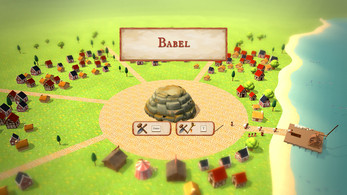
Babel
A free browser simulation where crews speaking different tongues must be fed, calmed and supplied while a Bruegel-inspired spiral climbs into a gathering storm.
#15 this weekAI-assisted: Code, Graphics, Sound, Text
The game runs in this tab. No install, no account.
The short answer
Babel is a god-game tower builder modelled on Pieter Bruegel the Elder's 1563 painting, played entirely without words or numbers. Coins stack, stone forms pyramids and lean reads on a plumb-line dial. Play it now for a tight half-hour session of hauling, crane repair and crowd control under a growing storm.
What is Babel?
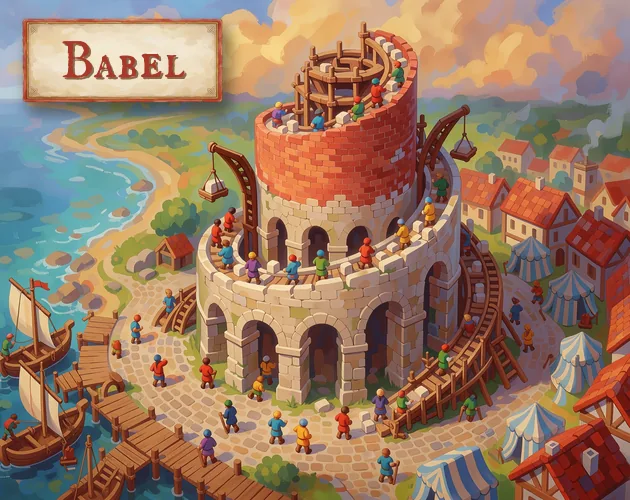
Babel casts the player as Nimrod's master builder, raising a spiral tower after the fashion of Pieter Bruegel the Elder's 1563 painting. The opening position is a purse of coins and bare ground. Ships have to be chartered, workers hired, lodges and mess tents raised, cranes set onto the ramp and leaning walls propped before the next coil of the spiral can rise.
The pressure comes from language. Every few loops a new tongue is born among the workforce, and crews that cannot understand each other stop cooperating: quarrels become brawls, dropped stones shatter on the ramp, and hungry builders turn sour. Scribes who speak every tongue, a separate tent for each language, and steady arrivals of food and beds are the tools for holding the site together.
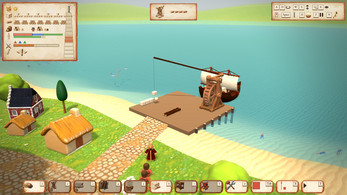
Nothing on screen is written. Coins are counted as stacks, stone as little pyramids, timber as woodpiles, and the lean of the structure as a plumb-line dial. An old storyteller's voice reads every tooltip aloud, and can be silenced.
How to play
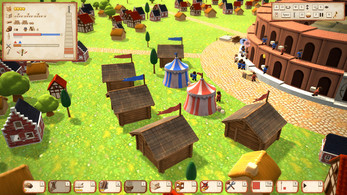
A session opens with coins and an empty site. Chartering ships brings workers and cargo; hiring puts builders on the ramp; cranes lift stone into position; buttresses brace the foot of the structure; a stone yard, lodges and mess tents shape the camp around it. Placement is the player's call, so cranes belong on the ramp and buttresses around the base.
Nothing moves by itself. Every stone and log is hauled by a worker from ship to quay, then to a crane, then to the build front, which makes the length of that chain a real cost. Provisions and beds arrive by ship and compete for cargo space with stone, so every hungry crew is also a decision about what did not get loaded.
Higher loops bring new languages. Every few coils a fresh tongue appears, crews that cannot talk begin to quarrel, quarrels become brawls, and dropped stones shatter. Parting a fight, stationing a scribe along a stretch of ramp, and giving each language its own mess tent are the countermeasures, alongside keeping cranes and carts in repair as they wear out.
Controls
Everything is driven from keyboard and mouse. Number keys 1 through 9 cover the build and service options: hire, crane, scribe, buttress, ship, yard, lodge, mess tent and service. Tab and X handle picking a tongue and dismissing a selection. A click places what has been chosen, breaks up a quarrel or assigns a crew to a crane, while Escape or a right-click cancels a placement.
The camera orbits on A and D, raises and lowers on W and S, tilts on Q and E, and zooms with the mouse wheel; right-dragging also orbits the view. Space follows the tower and H looks towards the harbour. F and P set speed at ×1, ×2 or ×4 and handle pause, and N switches the narrator on or off.
On the title screen, T begins the guided first game, which walks through the opening moves with the narrator talking through each tool. The narrator can be turned off at any point, and the guided run is optional rather than forced.
| Input | Action |
|---|---|
| 1–9 | Select hire, crane, scribe, buttress, ship, yard, lodge, mess tent or service |
| Tab / X | Pick a tongue or dismiss a selection |
| Click | Place an object, part a quarrel or give a crane a crew |
| Escape / right-click | Cancel a placement |
| A / D | Orbit the camera |
| W / S | Raise or lower the camera |
| Q / E | Tilt the camera |
| Mouse wheel / right-drag | Zoom, or orbit with the right button held |
| Space / H | Follow the tower or look at the harbour |
| F / P | Set speed to ×1, ×2 or ×4, and pause |
| N | Turn the narrator on or off |
| T | Start the guided first game from the title screen |
Tips for your first run
The first hour is really a supply problem wearing a tower's clothes. Stone only moves as fast as hands can carry it, so a crane stranded without a crew is wasted coin, and a cargo hold filled with food is a loop that will not rise. Watch the plumb-line dial before walls lean too far, and place buttresses early enough to matter.
Language is the quiet killer. Scribes patrol a stretch of ramp and settle it, so a couple of them posted along the busy sections save more stone than any single extra crane. Service checks are cheap compared with a snapped crane or a broken cart halfway up the spiral.
- Press T on the title screen to run the guided first game before touching anything.
- Give every new tongue its own mess tent so crews eat without mixing.
- Station scribes along long stretches of ramp rather than in one spot.
- Load ships with beds and provisions before the crews start complaining.
- Look over cranes and carts before they fail, not after.
- Use H to check the harbour and F or P to speed up the quiet stretches.
Content and replayability
A single game takes roughly half an hour, which makes Babel a lunch-break build rather than a long campaign. The escalation curve does the work of keeping that half hour busy: each new loop adds another tongue to manage, another crew to feed and a stronger storm overhead, so the site gets noisier and more expensive the higher it climbs.
Because placement is left to the player, the camp layout changes from run to run. Cranes can sit close to the build front or further back, buttresses can ring the foot densely or sparsely, and the yard, lodges and tents can be pulled tight around the ramp or spread out. Each choice trades hauling distance against safety.
The narrator can be switched off once the symbols are familiar, which suits a second or third attempt, and the speed settings stretch or compress a session. The guided opening can be skipped by players who already know the palette.
Presentation and performance
The look is drawn from Bruegel's 1563 painting: a spiral tower under a darkening sky, with a harbour and camp at its foot. Art, models, sound effects and the narrator's voice were generated with Ludo, and design and code are credited to Allan Rowntree, written in C on the ARC engine.
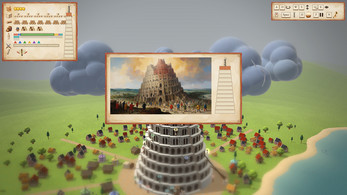
The interface is entirely pictorial. Coins pile in stacks, stone sits in small pyramids, timber in woodpiles, and the lean of the walls reads off a plumb-line dial, so the screen stays free of counters and labels. Weather does the dramatic work, with lightning and thunder arriving near the top of the climb as the storm swells loop by loop.
Typography in the credits is set in IM Fell English by Igino Marini under the SIL Open Font License. The game runs in an HTML5 frame in the browser, and it is built for single players.
Who should play it
Babel suits management players who enjoy logistics more than combat: the interesting decisions here are about cargo space, walking distance and where a scribe stands. Anyone who has enjoyed city builders but bounced off sprawling tech trees will find the scope pleasantly narrow, since a run is over in about half an hour.
It also fits players who like unusual interfaces. Reading a site through stacks of coins and a plumb-line dial is a genuine adjustment, and the narrated tooltips do the teaching for anyone who would rather listen than read a manual.
Art-minded visitors are a third audience. The Bruegel reference is not decoration; the spiral, the ramp, the cranes and the darkening sky are the whole stage. Those wanting competitive scoring, long campaigns or multiplayer are looking at the wrong tower.
Screenshots
How we tested it
The build was loaded from games.debutplay.com in a headless Chromium session on ; the canvas started and no request was blocked. The guide was last checked on .
From the developer
Babel — a tower-builder after Pieter Bruegel the Elder's The Tower of Babel (1563). You are Nimrod's master builder. Starting with nothing but a purse of coins, you charter ships, hire workers, raise their lodges and mess tents, set cranes on the ramp and prop the leaning walls, and wind the great spiral up loop by loop towards the clouds. But the higher it climbs, the less the builders understand each other. Every few loops a new tongue is born. Crews that can't talk quarrel, quarrels become brawls, dropped stones shatter on the ramp, and hungry workers turn sour. Part the fights, send scribes who speak every tongue, feed each tongue in its own tent, and keep the cranes and carts in repair. The sky darkens as you go, and the storm grows with every loop. No words, no numbers. In keeping with the jam's rule, nothing in the game is written: coins are counted as stacks, stone as little pyramids, timber as woodpiles and the lean as a…
Frequently asked questions
Is Babel free to play?
Yes. It carries no price and runs as an HTML5 browser game, so nothing needs buying before the first stone is laid.
How long does one game take?
About half an hour. Speed can be set to ×1, ×2 or ×4, and the game can be paused, so a session can run longer or shorter.
Does the game use words or numbers?
No. Coins appear as stacks, stone as small pyramids, timber as woodpiles and lean as a plumb-line dial, and the narrator speaks the tooltips aloud instead of printing them.
Can the narrator be turned off?
Yes, N toggles the narrator. A guided first game starts by pressing T on the title screen for anyone who wants the walkthrough first.
What happens as the tower climbs?
Every few loops a new tongue is born among the crews, quarrels and brawls follow, and a storm builds with each loop, bringing lightning and thunder near the top.
How are cranes and carts kept working?
They wear out and break, so they need looking over before failure. A crane also takes a crew, which is assigned with a click.
What games are similar to Babel?
The closest matches on DebutPlay are Galileo Base: Forces & Motion in 3D, Filthy Rich-ish, Against History: WW2. They share the same genre, so the controls and the pace carry over.
Something wrong or missing? Tell us. How we test games.