Simulation · New game
Sealed Goods
A five-day bottle-shop simulation about catching Saltwick's weather-bound moments, sealing them in jars, and haggling with six townsfolk before the Guild's charter deadline.
#12 this weekAI-assisted: Code, Graphics, Text
The game runs in this tab. No install, no account.
The short answer
Sealed Goods is a free HTML5 simulation set in Saltwick, where you catch fleeting things such as sea fog, a gull's cry, thunder, or moonlight, seal them in jars, and sell them at your counter. Hone your haggle, upgrade your wax seal, and fill five Guild charter seals by day five.
What is Sealed Goods?
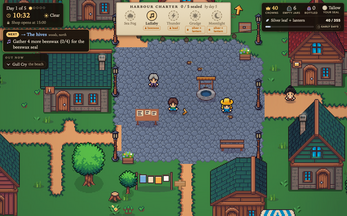
Sealed Goods is a free browser simulation from sam_hi about running a bottle shop in Saltwick, a small seaside town. The work has two halves. By day you walk the town and catch fleeting things that appear only at particular places, hours, and weathers; by evening you open the shop and haggle with townsfolk over the jars.
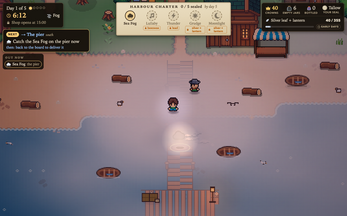
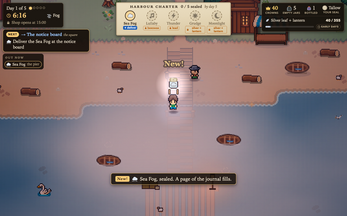
The catchable moments include sea fog on the pier at dawn, a gull's cry on the beach, laughter at the tavern door, a nursery lullaby at dusk, thunder at the lighthouse in a storm, a grudge in the graveyard after dark, and moonlight at the pier's end when the sky is clear. Once caught, each is sealed in a jar. The notice board carries the Guild's Harbour Charter, which asks for five wax seals: Sea Fog, Lullaby, Thunder, Grudge, and Moonlight. Fill all five by the end of day 5 or the Guild seals your door.
How to play
A run lasts five in-game days, roughly half an hour. The loop starts outside: walk to the pier, beach, tavern, nursery, lighthouse, graveyard, or other spots and use the catch command when a moment is present. You also gather driftwood, sea glass, beeswax, and lead ore, then craft better seals at the workbench. Better seals hold stronger things, so counter money should feed the seal rather than sit idle.
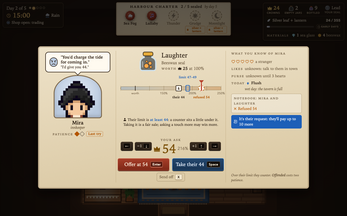
At the counter, name a price and watch the customer lean in, frown, or take offence. They counter. You can accept their counter, push your luck with a new ask, or send them off. A cellar ages bottles overnight until the seal gives out, so stock can change while you sleep. The clock stops whenever a panel is open, and the notice board plus the NEXT box point to useful work. The journal tracks bottled things, townsfolk, and the charter; number keys switch its tabs.
Controls
Keyboard play uses WASD or the arrow keys to walk. E catches, gathers, talks, and operates the board, counter, workbench, and bed. Tab opens and closes the journal, where 1, 2, and 3 switch tabs. Esc closes a panel or pauses. The pause menu lists every key, and N starts a new run after a confirmation. Every button names its key: number keys pick actions on the board, workbench, chandler's shelf, and in chats; Shift+1 at the chandler buys three jars; W waits for an hour when a place is not open yet.
During a haggle, left and right arrows or A and D set the ask in 5 percent steps, while up and down or W and S move it by one crown. Enter offers, Space accepts the counter, and X sends the customer away. The mouse works on every panel. A standard gamepad uses the left stick or d-pad to walk, A to use and confirm, B to close, Y for the journal, LB and RB for tabs, Start to pause, and View for the guide arrow. In a haggle, the d-pad sets the ask and A, X, and Y offer, accept, or dismiss. Enter or Space starts from the title, G toggles the guide arrow, and M toggles sound.
| Input | Action |
|---|---|
| Keyboard walk | Use WASD or the arrow keys to move. |
| E | Catch, gather, talk, or use the board, counter, workbench, and bed. |
| Tab | Open or close the journal; 1, 2, and 3 switch tabs. |
| Esc | Close a panel or pause. |
| N | Start a new run from the pause menu after confirmation. |
| W | Wait for the next hour when a place is not open yet. |
| Haggle keyboard | Left and right arrows or A and D set the ask in 5 percent steps; up and down or W and S adjust by one crown; Enter offers; Space accepts a counter; X sends the customer off. |
| Mouse | Use every panel. |
| Gamepad | Left stick or d-pad walks; A uses or confirms; B closes; Y opens the journal; LB and RB switch tabs; Start pauses; View toggles the guide arrow. |
| Title screen | Enter or Space starts; G toggles the guide arrow; M toggles sound. |
Tips for your first run
The charter is the spine of a run: the notice board tracks five named seals, and the deadline is the end of day 5. Treat every other task as support for those seals. Because panels pause the clock, the journal and notice board are safe to check often. The NEXT box is a quick read on what matters now.
- Check the notice board first and note which of the five charter seals is still empty; the run is lost if they are not all filled by day 5.
- Use the journal's tabs to track bottled things, townsfolk, and charter progress without burning daylight.
- Put counter earnings into better seals; stronger seals hold stronger things, and the crafting chain moves from tallow to beeswax, lead, and silver, with a lantern for dark work.
- Learn each of the six townsfolk's likes and watch mood shift with the weather; a better read makes haggling less of a guess.
- Use the cellar when a bottle needs to age, but remember that aging stops when the seal gives out.
Content and replayability
The structure is compact: one run covers five in-game days and takes about half an hour. Six townsfolk each have likes, a purse, and a mood tied to the weather, and they share more as you get to know them. That makes the journal and repeated conversations part of the long game, not decoration. The charter names five seals, Sea Fog, Lullaby, Thunder, Grudge, and Moonlight, so each run has a clear checklist and a hard stop.
Crafting runs from tallow through beeswax, lead, and silver, plus a lantern for the dark. A cellar can age bottles overnight until the seal fails. Haggling gives each sale a small decision: set the ask, read the reaction, then accept a counter, raise the price, or walk away. Because the shop, the seal, and the charter all pull at the same time, a short run can be replayed around different priorities. The game is singleplayer and built for a browser session.
Presentation and performance
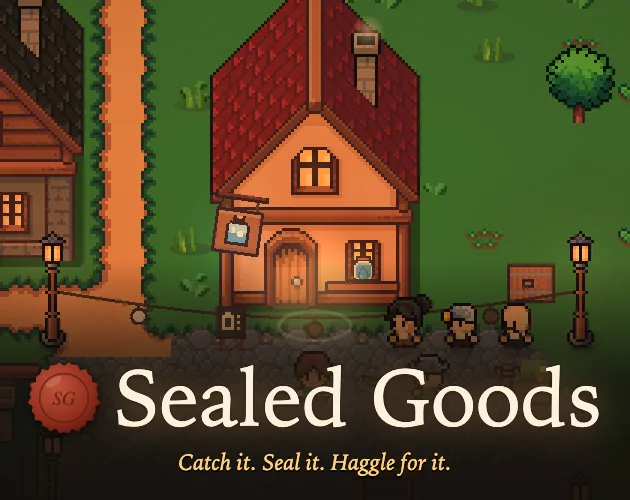
Sealed Goods wears a top-down 2D pixel-art look, with a cozy and cute tone suited to a shopkeeping simulation. The town, buildings, people, animals, and weather use Kenmi's Cute Fantasy RPG art. Additional art comes from Kenney's Roguelike RPG Pack and Roguelike Characters. The title screen's map of Saltwick was generated with OpenAI's image model.
Sound draws on Kenney's interface, UI, RPG, impact, and music-jingle sets, while sea, rain, wind, crickets, gulls, and thunder are synthesized in the browser. The game runs on Phaser 3 and is built with TypeScript and Vite; Claude Code was used in development. No font files ship with the build. It uses a system serif and a system sans for key chips, so typography follows the machine rather than a bundled typeface. The audio can be toggled with M, and the guide arrow with G.
Who should play it
Sealed Goods fits players who want a compact, cozy simulation with a visible deadline. The appeal is in the two-part loop: a quiet walk to catch a specific moment, then a tense counter conversation where a price can be accepted, pushed, or refused. Players who like pixel art, shopkeeping, crafting upgrades, and short browser runs have a clear match. The five-day structure also suits someone who wants a complete arc in one sitting rather than an open-ended management game.
It is a small-town trading game with six townsfolk and a charter checklist. The haggling is the social mechanic at the counter, and the seal is the upgrade path. Anyone who enjoys learning a customer's likes and mood, then setting a price in 5 percent steps and one-crown nudges, will find the intended friction. The game is singleplayer and plays in HTML5.
Screenshots
How we tested it
The build was loaded from games.debutplay.com in a headless Chromium session on ; the canvas started and no request was blocked. The guide was last checked on .
From the developer
You run the bottle shop in Saltwick, a small town on the sea. Some things only exist at certain places, hours and weathers: sea fog on the pier at dawn, a gull's cry on the beach, laughter at the tavern door, a lullaby from a nursery window at dusk, thunder at the lighthouse in a storm, a grudge in the graveyard after dark, moonlight at the end of the pier on a clear night. You walk out, catch them, and seal them in jars. In the evening you open the shop and haggle with the townsfolk over them at your counter. Name a price; they lean in, frown or take offence, and counter. Take their counter, push your luck, or send them off. The Guild's Harbour Charter on the notice board has five empty wax seals: Sea Fog, Lullaby, Thunder, Grudge and Moonlight. Fill all five by the end of day 5 and Saltwick keeps its charter. Fall short and the Guild seals your door. Better seals hold stronger things, so the money from the counter goes into your…
Frequently asked questions
What is the goal in Sealed Goods?
Fill the five seals on the Guild's Harbour Charter, Sea Fog, Lullaby, Thunder, Grudge, and Moonlight, by the end of day 5. If they are not all filled, the Guild seals the shop door.
How long does a run take?
A run covers five in-game days and lasts about half an hour.
How does haggling work?
Name an ask, read the customer's reaction, and choose whether to accept their counter, push for a better price, or send them off. The ask moves in 5 percent steps or by one crown.
What can be caught and sealed?
Fleeting moments tied to place, hour, and weather, such as sea fog on the pier at dawn, a gull's cry on the beach, thunder at the lighthouse in a storm, or moonlight at the pier's end when the sky is clear.
What is used for crafting?
Driftwood, sea glass, beeswax, and lead ore feed the crafting chain, which moves from tallow to beeswax, lead, and silver, plus a lantern for the dark.
Is Sealed Goods free?
Yes. It is free and runs as an HTML5 browser game.
What games are similar to Sealed Goods?
The closest matches on DebutPlay are DEAD AIR, Toxicode, FOSSICK. They share the same genre, so the controls and the pace carry over.
Something wrong or missing? Tell us. How we test games.