Action · New game
Thrones of Eldmere : WAR MMO GAME
A free browser-based first-person war game where a ruler fights in the front rank, commands up to 200 soldiers, and builds a kingdom between battles.
#19 this weekAI-assisted: Graphics, Sound
The game runs in this tab. No install, no account.
The short answer
Thrones of Eldmere is a first-person fantasy war game that runs in the browser at no cost. You fight with a mouse-driven blade in the front rank of an army of up to 200, manage morale and prisoners, then switch to founding a base, forging gear and raising walls. It is in development, and its open world is shared with other players' houses.
What is Thrones of Eldmere?
This is a first-person fantasy war game set in a contested medieval world, and its angle is unusually direct: the player is not a general watching markers drift across a map but a ruler standing in the line with a sword in hand. Around that ruler marches a human kingdom's army of up to 200 soldiers, and fights are settled by execution rather than by comparing numbers on a character sheet.
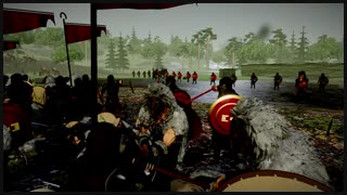
Combat is entirely manual. Nothing plays out as a canned attack animation, so the swing goes where the player sends it. Steel throws sparks on impact, shields splinter under repeated blows, spent arrows stay stuck where they land, and troops bleed, burn and drop as the fighting reaches them.
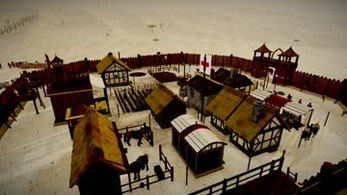
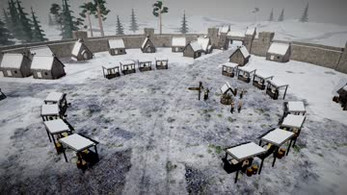
The same save carries a second layer once the battlefield goes quiet. Land is cleared, a base is founded, palisades and gatehouses and towers go up, weapons and armour are forged, and a camp is grown into a walled town with people to recruit, train and feed. Four realms — Calder, Zahir, Bram and Norr — bring their own warriors, voices, buildings and terrain, and past the walls sits an open world shared with other houses, both player-run and AI-controlled.
How to play
Everything begins with the mouse. Cutting, thrusting, blocking and deflecting are all performed by dragging the pointer, so the first minutes are about learning reach and timing rather than memorising a hotbar. Once the swing feels natural, the army becomes the second weapon: troops can be grouped and given orders while on the move, arranged into shield lines, or committed as cavalry. Telling them to follow and riding at the head of the charge yourself is a perfectly valid plan.
Morale is modelled, which changes what a victory looks like. A line that breaks will run, and a beaten opponent may kneel and beg instead of fighting to the last. That creates a decision at close range: execute, take the survivor prisoner, or let them go. Captives can be folded into your own ranks, so mercy is a recruitment method as much as a choice of conscience.
Between battles the game turns into a settlement builder. Clearing ground and founding a base comes first, followed by palisades, gatehouses and towers. Weapons and armour are forged and then handed to the specific soldier who will carry them, which ties production directly to the roster. People need recruiting, training and feeding as a camp swells into a walled town, and raiders will eventually arrive to test the walls.
Beyond your own land the world is shared. Rival houses can be met on the road and fought, or besieged where they live, with ladders carried up to their walls. Doves carry letters that forge alliances or issue challenges, and AI lords run houses of their own that raid, scheme and write back.
Controls
The supported input is keyboard and mouse, with the mouse carrying the fighting. Clicking locks the pointer to the game, which matters because every offensive and defensive action is a drag or a motion rather than a keypress. From that locked state a drag cuts, a forward motion drives the point in, and the same hand raises a shield or turns an incoming blade aside.
The keyboard works alongside the mouse as part of the standard setup. Playing in fullscreen is recommended, and it also keeps the pointer inside the battlefield instead of sliding out into browser furniture.
Because attacks are not canned animations, there is no single button that resolves an exchange. Two players pressing the same input can get different results depending on where the mouse travelled, how early the shield came up, and how the swing was aimed. Expect the first few fights to be clumsy while reach and timing settle in.
| Input | Action |
|---|---|
| Mouse | Drag to cut, push forward to thrust, raise the shield and turn a blade aside |
| Mouse click | Locks the pointer to the game |
| Keyboard and mouse | The supported control scheme for the whole game |
Tips for your first run
The opening hours reward patience more than aggression. A ruler who charges alone into a formed line dies quickly, while one who learns the drag-cut behind a shield wall accumulates both kills and recruits. A few habits make the early game smoother:
- Practise the cut, the thrust and the shield raise on the bandits that walk the roads before picking a fight with another house.
- Keep a shield line forward and cavalry in reserve; a formation that holds together is what prevents the morale collapse that turns an army into a rout.
- Take prisoners rather than killing everything, then recruit them — a beaten foe is a free soldier.
- Found the base early and get palisades, gatehouses and towers standing before raiders come looking for an easy target.
- Hand forged weapons and armour to the soldiers you intend to keep, not to whoever happens to be nearest.
- Save the Grimwood and the Red March for later; orcs, goblins and undead twice the height of a man hold those deeper stretches.
- Sign in with Google early so the kingdom lives on the server and can be picked up from another machine.
Content and replayability
Four realms give the world its texture. Calder sends bronze spearmen of the line, Zahir fields masked blade-killers in silk with curved steel, Bram supplies hunters in furs and skull headgear, and Norr brings snow warriors down from the frozen north. Each realm carries its own warriors, voices, buildings and land, so choosing where to fight changes what you are looking at as much as who you are fighting.
The open world outside the walls is shared by every house. Bandits walk the roads and towns are guarded, and the further out you push the harsher the opposition becomes: the Grimwood is held by orcs and goblins, and past that lies the Red March, where the undead stand twice the height of a man.
Other houses are real. Riding out means meeting other players' houses on the road and fighting them, besieging a rival's base with ladders against their walls, or sending doves with letters to arrange an alliance or deliver a challenge. AI lords hold houses too, and they raid, scheme and answer correspondence.
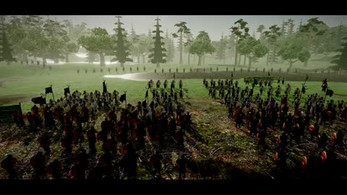
Replay value comes from the overlap of those systems rather than from a scripted campaign. A player can spend an evening growing a town, another running prisoners into new ranks, and a third drawing an army up over a neighbour's land, with up to 200 soldiers on the field at a time.
Presentation and performance
The camera sits in first person, which puts the player's own blade at the centre of the screen and keeps the army visible as a mass around them. Physical detail does a lot of the work: sparks fly off struck steel, shields break apart, arrows remain where they hit, and casualties bleed and burn. Those touches exist because there are no pre-made attack animations to hide behind.
Technically this is an HTML5 game that runs in a playable frame in the browser, with keyboard and mouse as the input and fullscreen recommended for the best experience. Clicking locks the pointer so the mouse stays inside the game.
Progress is stored server-side once a player signs in with Google, which means a kingdom is not tied to one machine and can be continued elsewhere. The game is in development, so players should expect the balance of combat, morale and settlement building to keep shifting as work continues.
Who should play it
Anyone who has wanted to fight a strategy game from inside the front rank rather than from above it is the obvious audience here. The mouse-driven combat rewards mechanical skill instead of stat advantage, which suits players who like their action role-playing games personal and physical.
It also fits people who enjoy the management half of a medieval war: laying out palisades and gatehouses, forging kit for specific soldiers, feeding a growing population and keeping walls standing when raiders arrive. The two halves are not separate modes, so a preference for one does not lock anyone out of the other.
Players who want company will find a shared open world where other houses can be met on the road, challenged by letter, or besieged at home. Those who prefer a quieter start can build and defend against AI lords first. Because it runs in a browser and costs nothing, trying it carries little commitment — but it is still in development, so treat it as a work in progress rather than a finished product.
Screenshots
How we tested it
The build was loaded from games.debutplay.com in a headless Chromium session on ; the canvas started and no request was blocked. The guide was last checked on .
From the developer
Thrones is a first-person fantasy war game. You command a human kingdom from the front line, sword in hand, with your army around you. Every blow is yours There are no canned attack animations. Your mouse is the weapon: drag to cut, thrust, raise your shield and turn a blade aside. Steel sparks on steel, shields splinter, and arrows stay where they land. Men bleed, burn and fall as they really would. Skill wins fights, not stats. Command an army you fight beside Lead up to 200 soldiers into battle. Group them, give orders on the run, form shield lines, send in the cavalry, or shout follow me and ride at the head of the charge. Morale counts: a broken line runs, and a beaten foe kneels and begs for mercy. Execute them, take them prisoner, or let them go. Prisoners can be recruited into your own ranks. Build your kingdom from nothing Clear the land and found your base. Raise palisades, gatehouses and towers. Forge weapons and armour,…
Frequently asked questions
Is Thrones of Eldmere free to play?
Yes. It costs nothing and runs as an HTML5 game in the browser. It is still in development, so systems and balance may change over time.
How many soldiers can be commanded at once?
Up to 200. They can be grouped, given orders on the run, arranged into shield lines, or committed as cavalry during a charge.
Can it be played with other people?
Yes. The open world is shared by every house, so other players' houses can be met on the road, fought, besieged at their bases, or contacted by dove with letters.
Will progress be saved?
Signing in with Google keeps the kingdom on the server, so it can be picked up from any machine rather than being tied to one browser.
What happens to defeated enemies?
A broken foe may kneel and beg for mercy. The choice is to execute, imprison or release them, and prisoners can be recruited into your own ranks.
What are the four realms?
Calder fields bronze spearmen of the line, Zahir masked blade-killers in silk and curved steel, Bram hunters in furs and skull headgear, and Norr snow warriors from the frozen north. Each has its own warriors, voices, buildings and land.
What games are similar to Thrones of Eldmere : WAR MMO GAME?
The closest matches on DebutPlay are Speedhook, HUNGERETH, Hordebreaker. They share the same genre, so the controls and the pace carry over.
Something wrong or missing? Tell us. How we test games.