Card game · New game
Tower Dice Poker
A dice poker roguelite where five dice wear card faces, three rolls decide each duel, and ten floors of a tower stand between you and Mordrek.
#43 this weekAI-assisted: Code, Graphics, Sound, Text
The game runs in this tab. No install, no account.
The short answer
Tower Dice Poker is a free browser card game that turns five dice into a deck of 9, 10, Jack, Queen, King and Ace. Keep the dice worth keeping, reroll the rest, and build the strongest hand across ten floors of duels. Each hero brings one power per floor, three hearts cover your mistakes, and Mordrek waits at the top.
What is Tower Dice Poker?
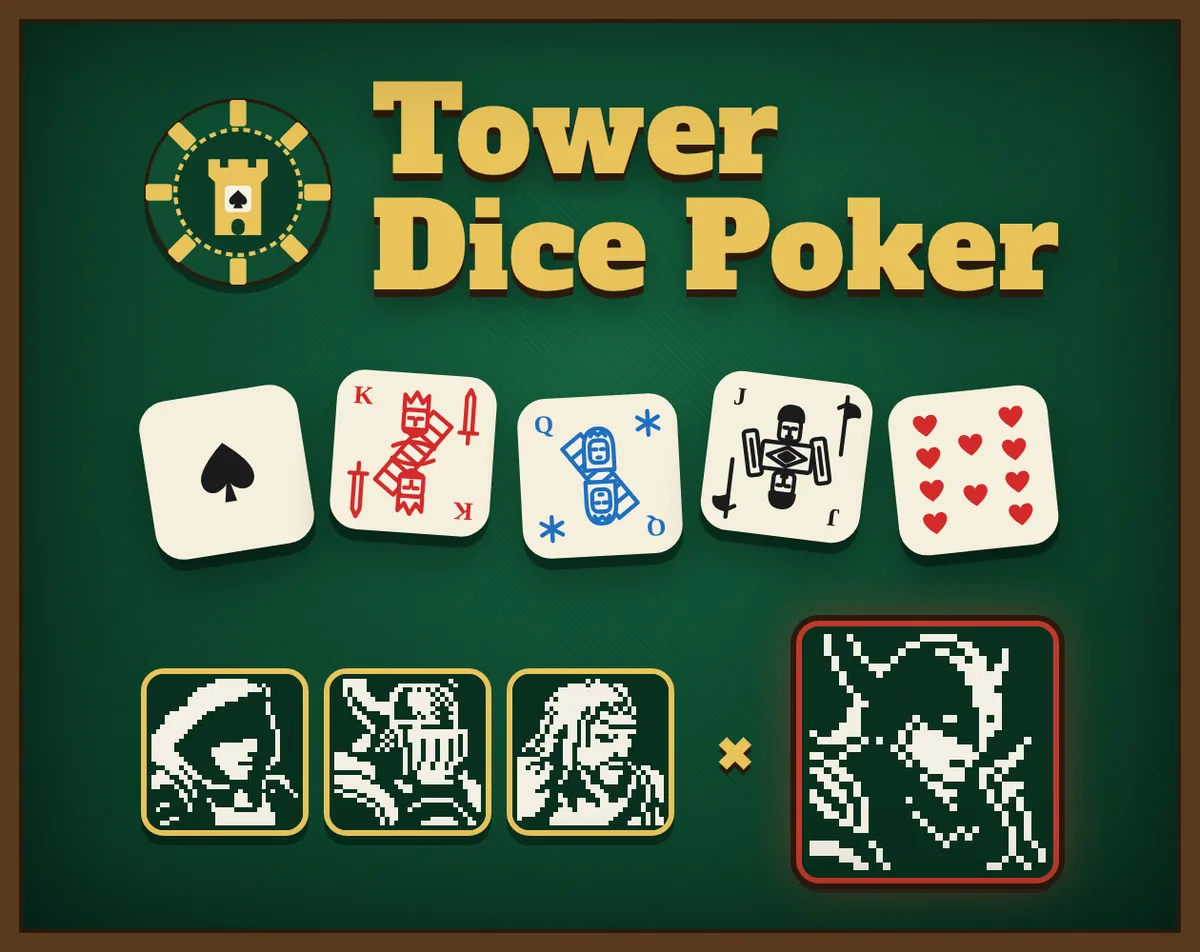
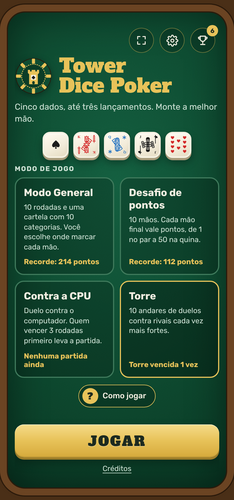
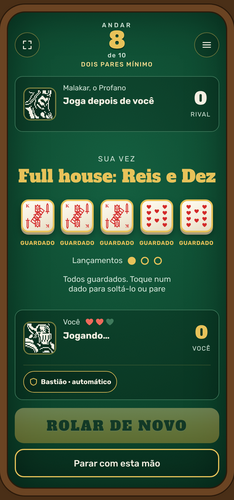
Tower Dice Poker is a single-player card game built on five dice whose faces stand in for six playing cards: 9, 10, Jack, Queen, King and Ace. A turn allows three rolls, and dice can be held back between them while the others go again, which is how a player works toward three of a kind, a full house or the rare five of a kind. The strongest combination takes the hand, and hands of the same type are separated by the card faces involved.
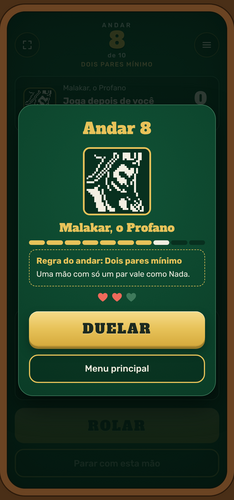
Around that sits a climb. Ten floors mean ten duels against rivals drawn fresh for each run, with Mordrek, Lord of the Tower, holding the summit. Heroes bring a power that recharges each floor, three hearts absorb defeats, and campfires after the third, sixth and ninth floors let a player recover. The game runs free in the browser, is in development at beta 0.9, and is playable from start to finish.
How to play
A climb is measured in duels rather than distance. Ten floors, ten opponents, and one heart lost every time an opponent takes a duel. Three hearts are the whole cushion, and a defeat sends the player back to the same floor to try again, which turns each loss into a spent resource instead of a clean restart. Reaching the summit means surviving that arithmetic.
After floors three, six and nine a campfire appears, and resting there restores what the climb has taken so far. Floors eight and nine tighten the rules, so the final stretch plays differently from the opening floors. Mordrek opens the last duel a point ahead and wins every tie, which means a level hand is never a safe result against him.
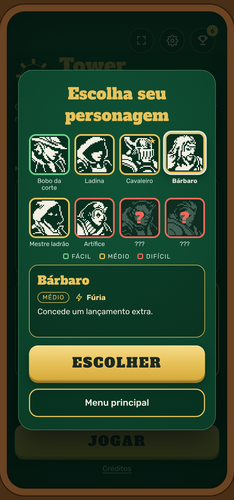
Heroes are the other lever. Each character plays differently and carries a power usable once per floor: the Jester turns a die into any face, the Rogue swaps one die with the rival, and the Barbarian gains an extra roll. Spending that charge on a hand that is already winning wastes it; saving it for a hand that is falling apart is what keeps a heart in reserve.
Controls
The game is built for portrait screens and one-handed play inside a browser, which narrows the interaction to a few repeated moves: dice are chosen to be held, the rest are thrown again, and the sequence runs until the three rolls are used up. Choosing which dice to keep is the real decision on any ordinary turn, because a held die cannot improve.
The same restraint applies beyond the dice. A hero carries a power that fires once per floor, so spending it is a timing decision as much as a tactical one. Nothing in the loop demands speed: play is turn-based, hands resolve one after another, and the tower waits while a hand is considered. The result is a control scheme closer to a small set of choices than to a sequence of reflexes.
The game page does not list its controls. Check the in-game tutorial or pause menu for the current scheme.
Tips for your first run
The opening climb is mostly about not wasting what little the tower gives. Three hearts cover the entire ascent, and every lost duel takes one, so a floor that keeps slipping away is a floor that can end a run. Treat early opponents as practice for reading hands, because the later rivals are described as far less forgiving.
The hero power is the tightest resource in the game, recharging only once per floor. Holding it until a hand genuinely needs rescuing beats firing it on the opening roll out of impatience.
- Save the once-per-floor hero power for a hand that is failing, not one that is merely mediocre.
- Against Mordrek a tie is a loss and he begins a point ahead, so aim to beat him outright rather than match him.
- Plan around the campfires after floors three, six and nine, the only points where the climb gives something back.
- Expect less slack on floors eight and nine, where the rules tighten just before the summit.
- Use Versus CPU to learn how faces break ties between hands of the same type before hearts are on the line.
- In General, keep flexible categories in reserve instead of filling them with the first hand that fits.
Content and replayability
Five modes share the same dice. Tower is the campaign, carrying heroes, powers, hearts and the boss at the top. Versus CPU is a straight duel in which the first player to take three rounds wins. Points Challenge hands out ten hands to score as high as possible against a personal best. General uses a classic ten-category scorecard where the player decides which category each hand fills. Infernal Tower is a hidden mode reserved for clearing the tower with no power at all.
Each climb draws its opponents from a pool of 20 rivals, each with a name and portrait of their own; the early ones still make mistakes, while the later ones show no mercy. Because the draw changes, two climbs rarely run in the same order. Clearing the tower unlocks three secret heroes for players who want a harder test, and 28 achievements plus statistics for every climb give the runs something to measure.
Presentation and performance
Visually the game leans on pixel art. Rival portraits and the campfire come from Oryx Design Lab and are used under a commercial license, while the type is set in Alfa Slab One and Rubik under the SIL Open Font License. The layout is built for portrait screens and one-handed browser sessions, matching the turn-based pace of play.
Tone comes partly from the tower conceit and partly from a borrowed line: a quotation from Dante's Inferno about abandoning hope, in Longfellow's public-domain translation, frames the descent into the harder modes. All text is offered in English and Portuguese, and progress is stored on the player's own device without an account or sign-up. The build is labelled beta 0.9, reported as complete and playable from beginning to end, with bug reports and ideas still welcome.
Who should play it
Players who like the hand-ranking logic of poker but want something shorter and stranger will find an easy fit here: five dice, three rolls, and a decision on every keep. Roguelite players get a climb with real friction, since a defeat costs one of three hearts and sends them back to the same floor rather than to the start. Anyone squeezing a game into a few minutes gets a portrait, one-handed browser layout with progress saved between sessions.
Completionists have 28 achievements, per-climb stats, three secret heroes and the hidden Infernal Tower to chase. Portuguese and English speakers are both served. Newcomers can learn the hands in Versus CPU before committing hearts to a campaign, while veterans can attempt a power-free climb and see what the Infernal Tower has in store.
Screenshots
How we tested it
The build was loaded from games.debutplay.com in a headless Chromium session on ; the canvas started and no request was blocked. The guide was last checked on .
From the developer
🇧🇷 Português · English below Cinco dados. Três lançamentos. Uma torre inteira para conquistar. Tower Dice Poker é um pôquer de dados em que cada face é uma carta do baralho: 9, 10, Valete, Dama, Rei e Ás. Lance, guarde os dados que interessam e arrisque de novo atrás de uma trinca, um full house ou a sonhada quina. Partidas rápidas, decisões tensas e aquele último lançamento que muda tudo. ⚔️ Suba a Torre Dez andares, dez duelos, rivais cada vez mais espertos. Você começa com 3 corações: perder um duelo custa um deles, e você tenta o andar de novo. Depois dos andares 3, 6 e 9, uma fogueira deixa você descansar e recuperar o fôlego. Nos andares 8 e 9 as regras apertam, e no topo espera Mordrek, o Senhor da Torre, que começa na frente e vence todos os empates. 🛡️ Escolha seu herói Cada personagem joga de um jeito, com um poder que vale uma vez por andar: o Bobo da corte transforma um dado na figura que quiser, a Ladina troca um dado…
Frequently asked questions
Is Tower Dice Poker free to play?
Yes. It carries no price, runs in the browser as an HTML5 game, and saves progress on the device without a sign-up.
Is the game finished?
It is in development at beta 0.9. The build is playable from start to finish, and bug reports and ideas are still being collected.
How many floors and rivals are there?
A climb runs through ten floors and ten duels, drawn from a pool of 20 named rivals with their own portraits. Mordrek holds the top floor.
Does progress carry over between sessions?
Progress is stored on the player's own device, and no account or registration is required to keep it.
Can two people play against each other?
It is a single-player game. The duel mode sets the player against the CPU, and whoever takes three rounds first wins the match.
What makes the final duel harder?
Mordrek, Lord of the Tower, starts the last duel one point ahead and wins every tie, so matching his hand is not enough.
What games are similar to Tower Dice Poker?
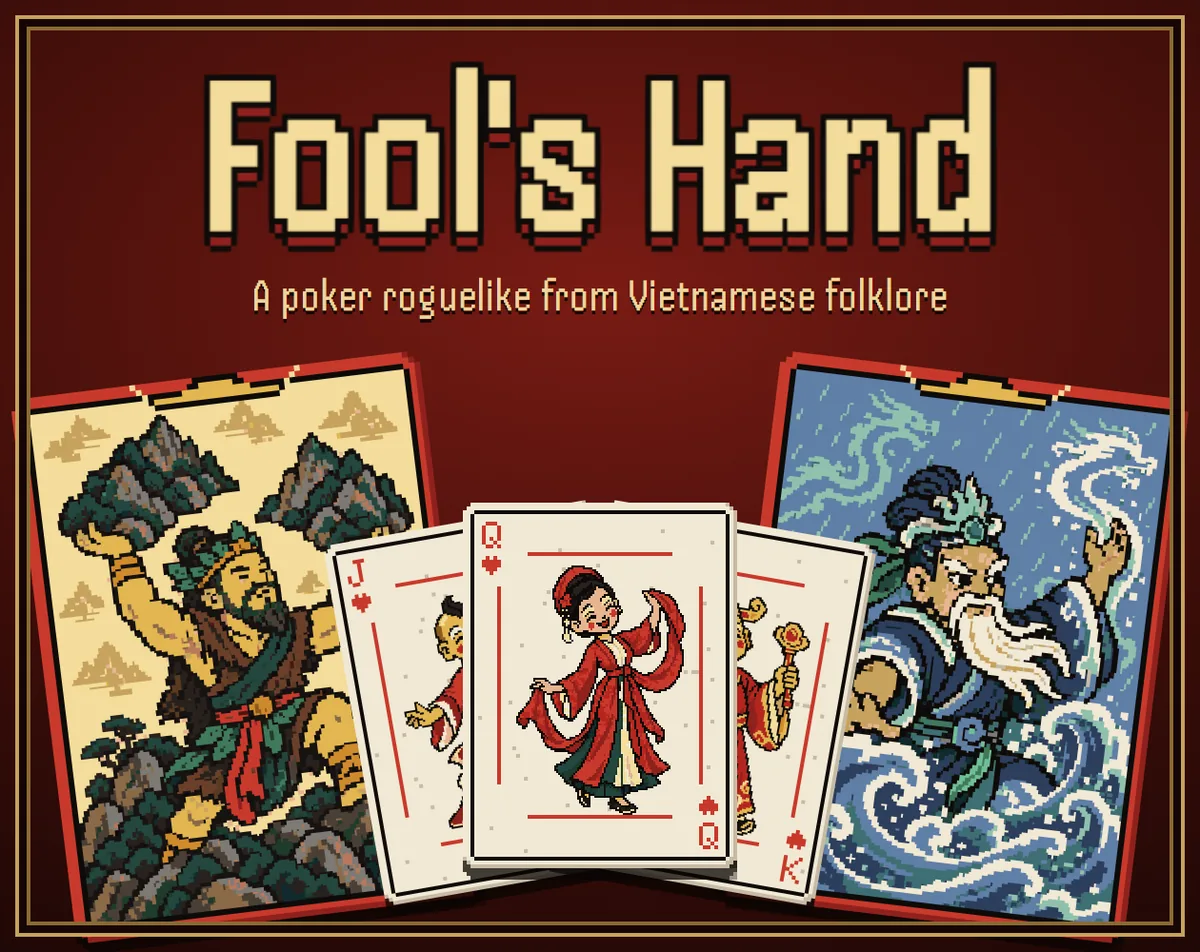
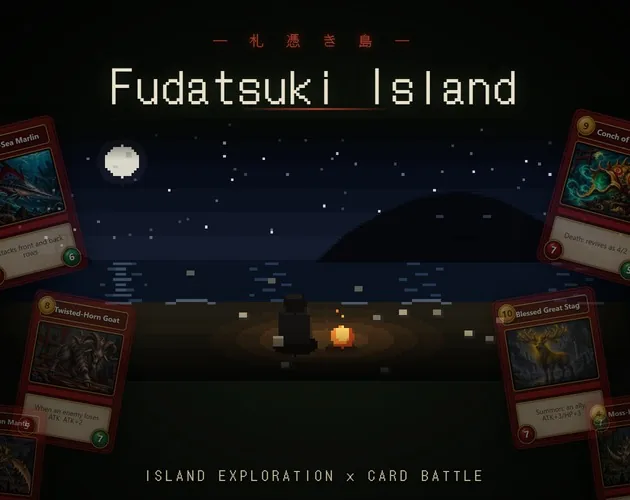
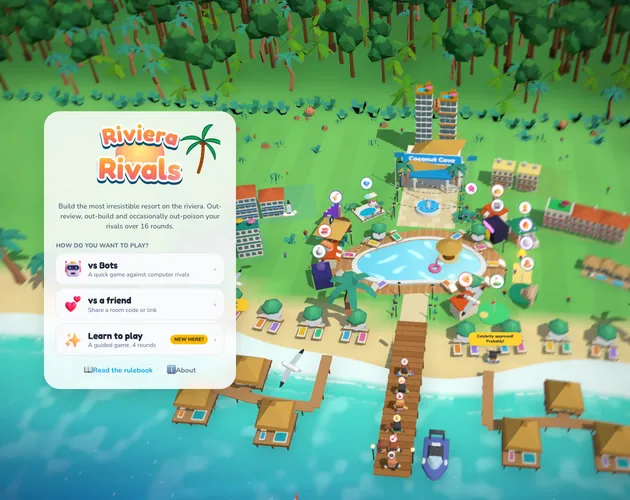
The closest matches on DebutPlay are Fool's Hand, Fudatsuki Island, Riviera Rivals. They share the same genre, so the controls and the pace carry over.
Something wrong or missing? Tell us. How we test games.