Puzzle · New game
Lighthouse & Tides (Phare et marées)
A free hex-grid puzzler about relighting your grandmother's lighthouse, scoring with cottages and docks, and outrunning a tide that never stops.
#1 this weekAI-assisted: Code, Graphics, Sound, Text
The game runs in this tab. No install, no account.
The short answer
Lighthouse & Tides is a cozy hex-grid puzzle game with city-builder bones. You relight a lighthouse that has been dark for ten years, place buildings on the sand for points, and choose new pieces as the village grows. Every placement moves the tide, so the safest square now may be underwater soon. It runs in the browser, plays on phones, and is free with no ads or account.
What is Lighthouse & Tides?
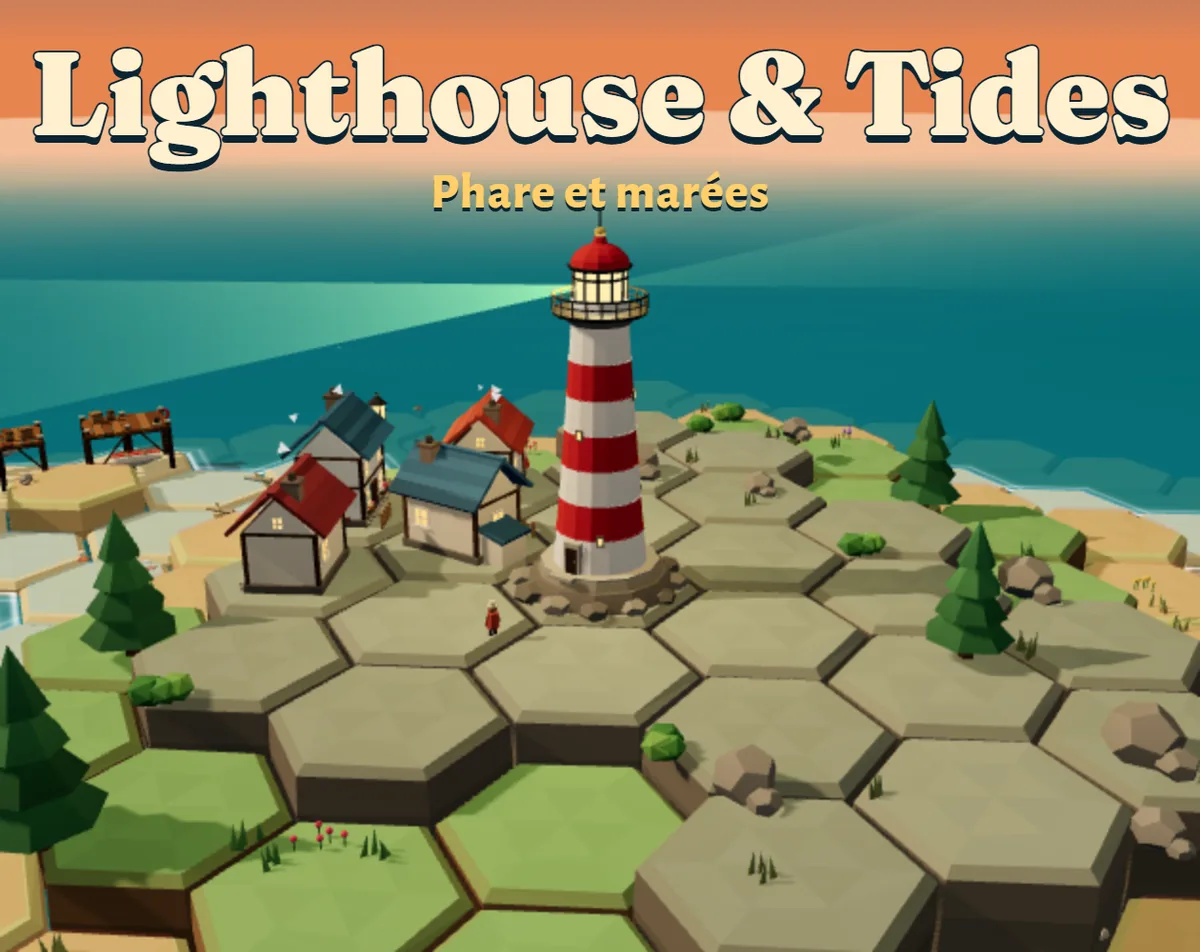
Lighthouse & Tides is a hex-grid puzzle game about bringing a shuttered coastal village back to life. The tower has been dark for ten years, ever since your grandmother Ondine sailed away, and the shore around it has emptied out. Relighting the lighthouse is the opening task; the real work happens tile by tile on the beach, where each building earns points and nudges the water line.
Scoring and growth are linked. Hit a level's target and the village expands, but you decide which of the offered buildings you take next, so each choice shapes the board you are about to play on. Out at sea, bottles keep drifting toward shore and some of them carry Ondine's letters, which is how the story reaches you between moves rather than in a separate cutscene.
The presentation is low-poly 3D and the pacing is unhurried, but the systems underneath are not soft. Tides, darkness, fog and ruins all change what a safe placement looks like. It is built for one player.
Everything sits on a hex grid, which matters more than it sounds: each tile has several neighbours, so cottages can be packed together for their bonuses while docks and sea walls are pushed out toward the water to soak up the tide.
How to play
The loop is simple to start and awkward to master. You place a building on a hex tile, it scores, and the tide advances. Reach the level's point goal and the village grows, which is also when you pick the next buildings you will be handed. Good moves in a row build a streak that pays bonus points, and bottles should be collected before they drift back out.
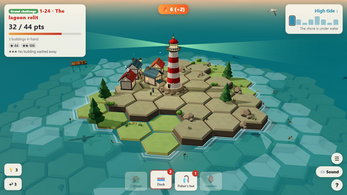
The tide is the real opponent. It moves with every building you place, and the bar in the top right shows where it stands, so the perfect patch of sand can be submerged two moves later. Anything the water reaches is washed away and its points are lost with it. Docks and sea walls are the exceptions; those hold against the tide.
Each building type follows its own rule. Cottages want company and light, fishers' huts want docks nearby, markets reward variety, and chapels pay out for buildings that survived a high tide. Later levels add weather and obstacles: at night, cottages left in darkness score nothing unless lanterns are placed, fog limits the tide forecast to two moves ahead, ruins block the best tiles, and the final chapter closes in a great storm.
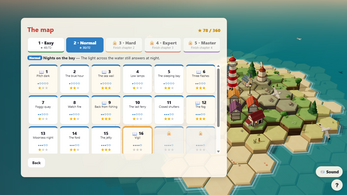
Difficulty is shown on the map, so the step up from one chapter to the next is visible before you commit to it.
Controls
On a mouse, a click places the current building, dragging rotates it, a right-click pans the view and the wheel zooms. Touch is handled differently: tap a tile once to preview the points it would score, tap it again to confirm the placement, and pinch to zoom.
The keyboard covers the rest. Number keys 1 to 8 pick a building, Z undoes, H gives a hint, Esc pauses, and M and S toggle music and sound respectively. The number keys line up with the eight buildings in the set, so switching between a cottage, a fishers' hut, a market or a chapel is a single keypress rather than a trip through a menu.
Nothing about the control scheme demands precision, which suits a puzzle where the thinking happens before the click. Being able to preview a tile's value on touch before committing is the equivalent of hovering with a mouse, and it makes phone play practical rather than cramped. An offline Windows build with the same content is available, and progress is saved on your device.
| Input | Action |
|---|---|
| Mouse click | Place the selected building on a tile |
| Mouse drag | Rotate the building |
| Right-click | Pan the view |
| Mouse wheel | Zoom in and out |
| Touch tap | Preview a tile's points, then tap again to place |
| Pinch | Zoom on a touchscreen |
| 1 to 8 | Select a building |
| Z | Undo the last move |
| H | Show a hint |
| Esc | Pause the game |
| M | Toggle music |
| S | Toggle sound effects |
Tips for your first run
The first few levels are forgiving enough to learn on, so use them to watch how the tide bar in the top right responds to each placement. Once that rhythm clicks, the rest of the systems layer on cleanly.
Treat the shoreline as expendable and the interior as valuable. Anything you expect to lose should be a dock or a sea wall, because those are the only structures that hold when the water arrives. Buildings that score well but sit on wet sand are loans, not income.
- Check the tide bar before every placement, not after the water has already moved
- Keep cottages clustered near a light source so the company and light rules both pay
- Place fishers' huts next to docks rather than on open ground
- Spread building types around a market to feed its variety rule
- Save chapels for boards where several buildings have already survived a high tide
- In night levels, budget a lantern before you chase cottage points
- In fog, assume the third move forward is unknown and leave yourself room
- Grab drifting bottles early; they carry letters and they do not wait
- Use undo and hints freely, and remember a level can be skipped after two failed attempts
Content and replayability
The campaign runs 120 levels across 5 chapters, graded from Easy up to Master with the difficulty printed on the map. Every level carries 3 stars and a separate challenge to chase, so a clear is rarely the end of a board.
There are 8 buildings, 18 achievements and 7 lighthouses to unlock, which gives the collection-minded something to work through alongside the level list. Beyond the campaign, a new island appears every day with scores to compare against friends, and a free play mode runs across three kinds of islands when you would rather build without a target.
The game is also careful about frustration. Hints, undo and a skip option after two failed attempts mean a stubborn board cannot end a session. Autosave runs in the background, so a browser tab can be closed without losing the current run.
It is free and complete, with no ads, no account and nothing gated behind money. English and French are both supported.
Presentation and performance
The game is rendered in low-poly 3D on a hex grid, with a calm palette that suits the coastal setting. The 3D models and the sounds are generated by the game's own code, with no external art or audio files shipped alongside them, which is why the whole thing loads in a browser tab without a hefty asset download.
It was made by a solo developer working with AI assistance, with the code and text written alongside an AI assistant and the background of the store page produced with an image model. Worth knowing if you care how a small game gets built; it does not change how it plays.
Because it is an HTML5 game, it runs directly in the browser and works on phones, with touch controls that mirror the mouse ones. An offline Windows download is offered with the same content if you would rather not depend on a connection. Progress is saved on your device, so sessions resume where they stopped.
Who should play it
This is for players who like a puzzle with a spatial argument: cottages that want neighbours and light, markets that want variety, chapels that reward buildings that outlast a high tide. If you enjoy fitting rules together on a grid more than reacting quickly, the tide gives you a slow, readable pressure to plan around.
City-builder fans who want the placement decisions without the supply chains will find the growth loop familiar, since reaching the goal expands the village and hands you the next buildings to choose from. The bottles and Ondine's letters add a thread of story for anyone who wants a reason to keep sailing past the tutorial chapters.
It also suits short sessions and shared screens: a daily island with comparable scores, autosave, phone support and a free price with no ads or account make it easy to open for one level. Players who need a fixed difficulty curve may prefer the campaign order, since the map shows the Easy to Master grading before you start.
Anyone allergic to being stuck will appreciate hints, undo and the skip after two failed attempts, though the Master chapters and the closing storm still expect careful reading of the tide.
Screenshots
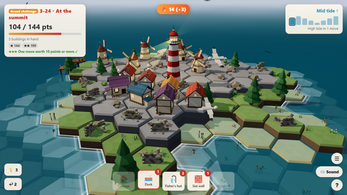
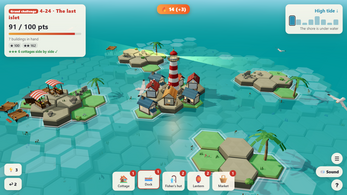
How we tested it
The build was loaded from games.debutplay.com in a headless Chromium session on ; the canvas started and no request was blocked. The guide was last checked on .
From the developer
A lighthouse dark for ten years. A tide that never stops. A village to bring back to life. You inherit the lighthouse of your grandmother Ondine, who sailed away ten years ago. Relight it and rebuild the village around it, one tile at a time. Out at sea, bottles keep drifting in, and some of them carry her letters. Place buildings to score points. Reach the goal and the village grows: you choose the next buildings you receive. The tide moves with every building you place. Watch the bar at the top right and plan ahead: the perfect spot on the sand may be under water two moves later. The shore is a gamble. When the tide reaches a building, it is washed away and you lose its points. Only docks and sea walls hold. Every building has its own rules. Cottages love company and light, fishers' huts want docks, markets want variety, chapels reward the buildings that survived a high tide. Keep a streak going with good moves for bonus points, and…
Frequently asked questions
Is Lighthouse & Tides free to play?
Yes. The game is free and complete, with no ads, no account requirement and nothing to unlock with money.
What platforms does it run on?
It runs in the browser as an HTML5 game and works on phones with touch controls. An offline Windows download with the same content is also offered.
How many levels are there?
The campaign has 120 levels split across 5 chapters, graded from Easy to Master, with 3 stars and a separate challenge on each level.
Can you skip a level you cannot beat?
Yes. A level can be skipped after two failed attempts, and hints and undo are available at all times.
Does the game save progress?
Autosave runs automatically and progress is stored on your device, so a session can be resumed later.
What is the daily island?
A new island appears every day with scores you can compare against friends. A free play mode also covers three kinds of islands.
What games are similar to Lighthouse & Tides (Phare et marées)?
The closest matches on DebutPlay are En Prise: Chess, but They Must Take, Doodle Bait, Pippin. They share the same genre, so the controls and the pace carry over.
Something wrong or missing? Tell us. How we test games.